




MSI is the latest motherboard maker to pop up with advice for those who are experiencing PC games crashing with their Core i9 14th-gen or 13th-gen processors - and it includes "some workarounds recommended by Intel."
This advice is delivered in a blog post from MSI on the topic of 'Improving Gaming Stability for Intel Core i9-13900K and Core i9-14900K' processors.
So, let's dive in: Suggested workaround number 1 is simply notching back the processor's power limit to Intel's default of 253W.
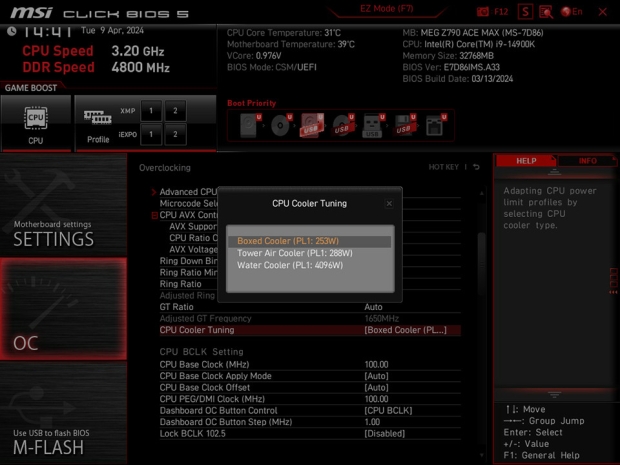
With an MSI motherboard, this is achieved in the BIOS via the CPU Cooler Tuning menu, where you should select 'Boxed Cooler' (default) which uses the mentioned 253W. Of course, if you're using air cooling with a Core i9, you really should make sure you've got a high-quality air cooler (and ideally a good airflow situation in your PC case, for that matter).
The caveat is that taming the power settings will also knock you back a bit with performance in games - but better that than crashing (and possibly prematurely aging your CPU to boot).
The kind of performance loss we're talking about is clearly illustrated with the recent testing of an ASUS firmware update for its Intel 700 series motherboards that brought in a new 'Intel Baseline Profile' rather than ASUS' own defaults. (This is pretty much the same thing MSI is advising here).
The other step you can take is to put the CPU voltage back to its default, as MSI explains: "You can restore the CPU voltage behavior to default settings by selecting the 'Intel Default' option in MSI BIOS's 'CPU Lite Load Control'. Keep in mind that default settings may result in an increase in the processor's voltage."
MSI provides some further details on how to lower the voltage if the Intel default option proves to be too high, and these are imparted in the blog post here.
It's good to see motherboard vendors being proactive, but we're still waiting to hear about Intel's investigation into exactly why these crashes are happening to its top-end CPUs in some games.
Read more: AMD Zen 5 CPUs may not debut until late in 2024 - could Intel's Arrow Lake even arrive first?