













The first spacecraft to make a close approach to Earth's enigmatic quasi-moon, Kamo'oalewa, has been confirmed, and as it approached, it captured clear photos of the object in orbit.

The mission, launched in May 2025, is now within 12.5 miles of the space rock, setting the stage for an unprecedented attempt to collect surface samples. The Chinese spacecraft Tianwen-2 spent 400 days traveling to the asteroid, covering 620 million miles to arrive at an asteroid that is only 50 - 60 feet wide. Its mission will last over a year, during which it will fly alongside the quasi-moon to study its composition and attempt to retrieve material from its surface using methods such as "anchor-and-attach" and "touch-and-go." If successful, China will join only two other nations in the elite club of asteroid samplers.
Kamo'oalewa, one of seven known quasi-moons, presents a unique challenge for the engineers behind the project, as the moon spins rapidly, completing one rotation every half hour. Its speed, along with its small size, demands extreme precision from the nearly two-ton space probe, especially if China doesn't want to disturb the rock's trajectory. According to planetary scientist Cristina Thomas, this is the smallest object ever visited by a spacecraft, and to successfully execute sample retrieval, it will take some skill.

Frequently Asked Questions
TweakBot answers common questions about this news using TweakTown's own coverage from this page and related content from our archive. Tap a question to reveal the answer, or type your own below.
How will Tianwen-2 compensate for Kamo'oalewa's 30-minute spin during sample collection maneuvers?
How long will Tianwen-2 remain within close proximity to Kamo'oalewa to conduct mapping and sampling activities?
Have a question not listed here? Ask below and TweakBot will answer it.

Tianwen-2's success could redefine how we understand these mysterious orbiters and further solidify China's growing influence in deep-space exploration. What happens next will be a test of engineering, patience, and dexterity. If successful, we may learn much more about these mysterious Earth-bound satellites.


 NASA discovers asteroid that's now the most significant threat to Earth
 A SpaceX Falcon 9 rocket is on a collision course with the Moon
 NASA selects SpaceX to send a $3.35 billion nuclear-powered helicopter to Saturn
 Starfield comes to PS5 on April 7 for $50, new story DLC Terran Armada launches same day
 Opinion: Game Pass tier with first-party games won't fix the subscription's biggest problem
 Assassin's Creed Hexe to be revealed 'relatively soon' according to insider
 LG claims that you can improve your aim by up to 38% by playing on a 480Hz OLED monitor
 Pixel 11 Pro Fold leak may reveal Google's next big foldable upgrade
 Sony's $500 million lawsuit heats up after choice to end PlayStation disc production
 AI models could soon get cheaper as OpenAI, Meta, and xAI enter a new price war
 SAP escapes EU penalty by easing customer lock-in concerns
 Cursor builds AI agent 'Sand' to rival Anthropic's Claude Cowork
 PocketMage is a distraction-free pocket computer with a wizard-themed operating system
 Samsung is holding your health data hostage to train its AI
 ASUS unveils the new ROG Gjallar Gaming Soundbar with wireless subwoofer
 MOZA FMP18 Panel Bundle Review: authentic F/A-18 Hornet cockpit controls for flight sims
 Micron 6600 ION 245.76TB Enterprise SSD Review - Best in Class Programming Speeds
 MOZA MA3F EFCM Flight Control Module Review: authentic Airbus A320 autopilot panel for simulators
 Turtle Beach Stealth Pro II Wireless Gaming Headset Review - Premium Sound, Fantastic Features
 MOZA MGX1000 Instrument Panel Review: a realistic Garmin G1000 replica for immersive flight sims
 Simagic Zeus Formula Steering Wheel Review: premium build and advanced inputs for F1 racing
 GIGABYTE X870E Aero X3D Dark Wood Review - A woody goody
 The Super Mario Galaxy Movie (2026) 4K Ultra HD Blu-ray Review
 KTC H49S66 5K2K (5120x1440) 49-inch 180Hz Gaming Monitor Review
 HighPoint Rocket 1604L Gen5 x16 NVMe Software RAID AIC Review: half the price with full 59 GB/s speed
 I stopped digging through Windows menus after I set up this one folder
 Don't sell your Windows laptop until you do these things
 6 PC cleaning mistakes to avoid for safer hardware maintenance
 Phison and Intel Take Aim at Local AI's Memory Wall with aiDAPTIV
 How to Remap Keyboard Keys in Windows using Microsoft PowerToys
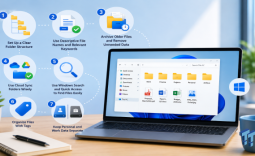 7 tips to organize your Windows files for faster, easier access
 Intel Arc G3 Extreme first impressions with MSI's Claw 8 EX AI+ - Incredible power for an extreme price
 How to fix Wi-Fi Adapter Not Working on Windows laptops: troubleshooting tips
 Hisense U7SG 4K TV: Modern Entertainment for the New Age
 6 underrated Microsoft Word features worth using to boost your productivity