












Intel's Robert Hallock, vice president and general manager, has announced plans to expand overclocking support to a much wider range of processors. The company wants to take overclocking out of the hands of the enthusiast and mainstream segments and give the budget market a piece of the pie, too.
In an interview cited by PC Games Hardware, Hallock said Intel wants to deliver "more and more unlocked SKUs over time," adding that the capability shouldn't be reserved for people paying the most. Just because a PC enthusiast buys at a lower price point doesn't mean their enthusiasm is any less.

It is a significant shift for Intel, which has historically locked overclocking behind its K and KF SKUs, most of which cost more than $500. The groundwork has already been laid with this year's Core Ultra 200S Plus lineup, which includes the 250K Plus at a competitive $199 and the 270K Plus, offering 285K-level performance with overclocking support, for just $299.
The same report also confirms that Intel is restructuring its approach to the desktop self-builder market. Hallock noted that Intel's DIY segment is now managed separately from the OEM desktop CPU business. The idea is that this separation will allow Intel to deliver more enthusiast-friendly options going forward, with the results expected to show up in its next-generation CPU lineup.

What Intel has not yet explained is how far this opening will go at the platform level. Overclocking requires both an unlocked CPU and a compatible motherboard chipset. Historically, Intel has enabled overclocking only on its Z-series chipsets, such as Z690 and Z790, which are typically high-priced. Buyers who wanted to overclock needed these premium motherboards to use unlocked K or KF chips. Additionally, Intel has restricted features such as external bCLK generators that enable overclocking on some mATX and ATX boards to specific products and chipsets.
If Intel is serious about lowering the barrier to entry, any meaningful rollout would need compatible chipsets and CPUs in equal measure. No specific products or launch windows were named, so it remains unclear whether this applies to upcoming generations or is a longer-term play. Either way, this is a welcome direction from Intel, and one that aligns with the company's recent push toward AMD-like socket longevity for its platform.


 Intel's Z970 chipset could replace most B860 motherboards for Nova Lake, leaker claims
 Intel VP says PC games would run up to 30% faster if they were properly optimized for its CPUs
 Intel will continue supplying Raptor Lake CPUs for 'years to come' thanks to the memory crisis
 Intel says Raptor Lake CPUs aren't going anywhere and hints at more DDR4/DDR5 hybrid motherboards
 Intel confirms Arc G3 gaming handhelds, expect a big reveal soon
 Iconic N64 shooter GoldenEye 007 is getting a native PC port
 Diablo 4 is coming to the Switch 2 with both expansions in a special Age of Hatred Collection
 CXMT DDR5 memory hits 9,000 MT/s speed milestone on AMD AM5 motherboard
 Sony says PlayStation 6 release date and pricing are still up in the air
 Lexar's DRAM-less Thor Ultra series PCIe Gen 5 SSDs are built for desktop and laptop PC gaming
 Gaming monitors are next in line for a price hike as manufacturers can no longer absorb costs
 Linux 7.2 makes TSC support mandatory for x86 CPUs, but it's not like Windows 11's TPM 2.0 check
 ChatGPT can now build a timeline of everything you do on your Mac
 Redditor finds a working RTX 2080 Super in the dump, gets a huge free upgrade
 Redditor sends a gaming laptop with 64GB RAM for repair, comes back with 32GB RAM
 ASUS ROG Strix XG129C Review: A $199 Gaming Monitor You Don't Play Games On
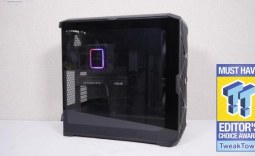 Cooler Master HAF II 500 Mid-Tower Chassis Review
 Corsair HS35 v3 Wireless Gaming Headset Review - An Affordable Winner
 D-Link F518 5G Wi‑Fi 6 AX1800 Mobile Hotspot Review: All-Day Mobile Hotspot
 Bose Lifestyle Ultra Speaker Review - Impressively Detailed Room-Filling Sound
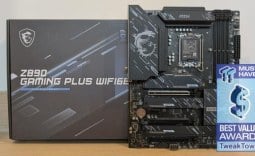 MSI Z890 Gaming Plus WIFI6E Review - Z890 for under $200
 Mortal Kombat (1995) 4K Ultra HD Blu-ray Review
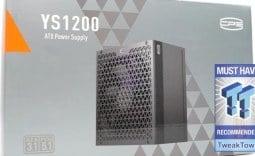 CPS PCCOOLER YS1200 ATX 3.1 80 PLUS Gold PSU Review
 ASRock X870E Taichi White Review: a premium AM5 motherboard with 10G LAN and WiFi 7
 Asetek Initium Pedal Modular Upgrades Review
 Using Multiple Monitors? Change these Windows settings for a Better Experience
 Windows Sandbox is The Windows Security Feature Most People Never Use
 I ditched the Windows 11 context menu for this open-source tool, and here's why
 Windows 11 may be encrypting your drive already, and I checked where my recovery key went
 GIGABYTE's 40 Days of INFINITY celebrates 40 Years of Innovation with stunning GeForce RTX graphics cards and rewards
 I swapped File Explorer for this free file manager and finally got the layout I wanted
 How to tell if someone has been using your Windows PC without your permission
 6 Task Manager tips for troubleshooting Windows performance problems
 ASUS ROG's 20th Anniversary Line-up of Premium PC Gaming Gear has Arrived - Here's Everything You Need to Know
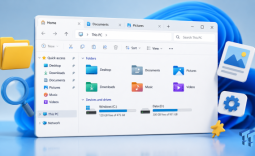 Six File Explorer tips every Windows user should know