









Full ray tracing or path tracing is still a relatively new frontier in gaming, with the realistic cinematic lighting mode opening the door to a new level of immersion in games like Cyberpunk 2077, Alan Wake 2, DOOM: The Dark Ages, and Resident Evil Requiem. It's incredibly demanding on hardware, significantly more so than single-use ray-tracing effects like reflections or shadows, and it's widely considered the future of AAA in-game visuals.

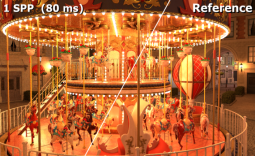
One of the most challenging elements of path tracing, as it covers all ray-traced lighting effects, is global illumination, with NVIDIA's latest technology to accelerate and improve fidelity and performance called ReSTIR (Spatiotemporal Importance Resampling PT). Without getting into the technical weeds, NVIDIA's Research team just released a paper on ReSTIR PT Enhanced, which "significantly" improves performance, produces fewer artifacts, and enhances visual fidelity.
Path tracing is so demanding that it requires additional help from DLSS Super Resolution, Ray Reconstruction, and Frame Generation to deliver smooth gameplay. Based on this new paper (which you can check out as a PDF here), ReSTIR PT Enhanced improves path-tracing performance by over 2X.
It achieves this through several optimizations and clever techniques that reduce data duplication by performing complex calculations for every pixel. It also unifies ReSTIR for both direct and indirect lighting while implementing new technology that adapts to the scene and the materials present. The paper ran its tests on a GeForce RTX 5080-equivalent workstation card, which isn't the top-of-the-line RTX Blackwell GPU for gaming, so it's a good sign that NVIDIA isn't targeting its top-end hardware for path tracing.
As ReSTIR PT is part of the RTX SDK and available to developers, the good news is that, even though this is a research paper, NVIDIA notes that this update is "closer to production-ready."




 NVIDIA's new path tracing tech could change game graphics forever
 DOOM: The Dark Ages path tracing upgrade vs standard ray-tracing
 War Thunder adds new Path Traced lighting with support for DLSS, FSR, and XeSS
 Indiana Jones and the Great Circle will have Full Ray Tracing on PC with DLSS 3.5 support
 DOOM: The Dark Ages on the RTX 5090 - 4K 210 FPS with Path Tracing and Ultra Settings
 Rumor: Ubisoft's Splinter Cell remake slips to 2027, and Far Cry 7 development is 'going through hell'
 Multi-frame generation could be coming to AMD GPUs, latest FSR update hints
 Xbox announces limited edition Forza Horizon 6 controller and wireless gaming headset
 SK hynix begins mass production of 192GB SOCAMM2 memory for NVIDIA Vera Rubin
 NZXT AIO allegedly leaks and damages flagship ROG ASTRAL GeForce RTX 5090
 Ubisoft officially announces Assassin's Creed Black Flag Resynced reveal showcase
 League of Legends officially gets controller support after nearly 20 years of mouse and keyboard
 Assassin's Creed Black Flag Remake leaks unveiling updated graphics
 Xbox Project Helix leak signals end to what made consoles unique
 AOC U27G4 Gaming Monitor Review - Affordable Dual-Mode 4K and 320Hz Gaming in One Display
 ASUS ROG Kithara Gaming Headset Review - Audiophile Sound for PC Gamers
 MSI MPG 272QRF X36 Review - NVIDIA Pulsar Powers the Peak of 1440p Esports Gaming Monitors
 Sapphire Pure X870A WiFi 7 Motherboard Review - Premium looks at a bargain price
 MOZA CM2 HD Racing Dashboard Display Review
 ASUS ROG Swift PG32UCDM3 Gaming Monitor Review - Unbeatable OLED Just Got Even Better
 ASUS ROG Strix Pulsar XG27AQNGV Review - The Bleeding Edge of 1440p Gaming Monitors is Here
 ASUS ROG Rapture GT-BE19000AI Gaming Router Review: Shiny and fast (except when it isn't)
 GIGABYTE X870E Aero X3D Wood Motherboard Review - A touch of wood adds a touch of class
 Corsair MAKR PRO 75 Hall Effect DIY Keyboard Review - Pre-Built and Ready for Action
 Common Laptop Battery Mistakes That Reduce Battery Lifespan in 2026
 6 PowerToys Features I Wish Were Built Into Windows
 Task Manager only tells half the story - this built-in tool shows the rest
 Your PC is overheating, and Windows won't tell you - here's how to check
 Best Windows right-click menu tweaks that will actually save you time
 Windows not using your dedicated GPU? Here's what to do
 Five Windows 11 registry tweaks I apply on every new PC
 7 Windows registry tweaks that actually make a difference
 The Super Mario Galaxy Movie Cinema Review
 Camera or webcam not working in Windows 11? Try these fixes