All the major players in the PC gaming hardware space, alongside Microsoft with DirectX, are actively investing in neural rendering technologies designed to benefit developers and gamers alike. Intel's Texture Set Neural Compression was demonstrated last year; however, an updated version was shown at the recent GDC event, and Intel noted it plans to make it available later this year.

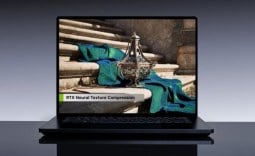
Like NVIDIA's Neural Texture Compression (NTC), one of the benefits of Intel's Texture Set Neural Compression is its ability to leverage AI and new technologies to significantly reduce the VRAM or memory footprint of traditional textures that use "block compression." AI-powered texture compression offers a fundamentally different approach, which is why Texture Set Neural Compression can compress textures by up to 18X compared to the original format.
Texture Set Neural Compression (TSNC) is planned to be made available as a standalone SDK that takes standard BC1-compressed textures, the industry standard for texture compression in games, and compiles them for modern GPU and even CPU decompression.

One potential use case for it has very little to do with in-game use, as TSNC could be leveraged to reduce game install and patch sizes. The neural network that powers TSNC stores latent data to reconstruct the original textures and can run during installation, when a game is loading, while streaming texture data, or during per-pixel sampling at runtime. The latter is all about saving big on VRAM; however, Intel notes that Texture Set Neural Compression supports multiple goals - whether that's to save on storage space, memory bandwidth, or VRAM usage.
In the full presentation below, Intel's solution currently supports two modes: Variant A and Variant B, with the latter being a more aggressive form of compression. Still, with only a 7% loss in visual fidelity, achieving up to an 18X reduction in overall texture data size is an impressive achievement. Naturally, this new tech supports Intel GPUs with XMX support, including the company's new Panther Lake mobile chips with integrated Intel Arc B-Series graphics. However, there's a fallback path for non-Intel GPUs and even CPUs, so this technology isn't dependent on one specific type of hardware.