Just weeks before the rumored Computex unveiling, NVIDIA's N1 SoC (System-on-Chip) for WoA (Windows on Arm) devices has surfaced, suggesting the silicon is in its final validation phase. Hardware enthusiast RubyRapids on X found an engineering board on Goofish that appears to be a mobile reference design showcasing the N1 in all its glory.
After a year of delays and pivots, most notably the decision to prioritize the GB10-based DGX Spark at Computex last year, it seems NVIDIA's N1 family is finally nearing launch. With Jensen Huang himself teasing an upcoming SoC collaboration with MediaTek just months ago, all signs now point to a massive N1 and N1X finally being on track for a debut at Computex 2026.
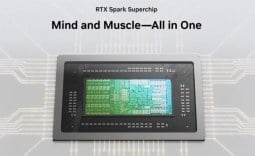
Targeting the high-end WoA market, the N1 series utilizes a "superchip" design that combines a MediaTek-designed CPU with NVIDIA's Blackwell GPU architecture. The chip leverages the same GB10 silicon as the DGX Spark. It features 20 Arm cores-both Cortex-X925 (Performance) and Cortex-A725 (Efficiency)-split into two clusters, each with 16MB of L3 cache. On the graphics side, there is a Blackwell-based integrated GPU with up to 6,144 CUDA cores, comparable to the RTX 5070. The wide 256-bit memory interface supports 128GB of LPDDR5X-8533 memory, delivering about 273 GB/s of bandwidth, similar to Apple's M5 Pro and AMD's Strix Halo.

The pictured motherboard shows the GB10's CPU and GPU fused using TSMC's advanced CoWoS (a high-bandwidth chip packaging technology). The board is populated with eight SK hynix modules, totaling 128GB of shared memory. On the I/O side, the engineering board has two NVMe slots, a 3.5mm audio jack, an HDMI port, and both USB Type-A and Type-C ports.
The price tag is steep, sitting at 9,999 RMB (about $1,400), mainly due to the integrated 128GB of LPDDR5X memory. For comparison, Strix Halo-powered workstations with 128GB of RAM often retail for over $3,000 amid the ongoing DRAM crisis. While we hope NVIDIA's offerings launch at competitive prices, high-memory configurations will certainly command a premium.

The N1 family is clearly an "AI-first" design, and gaming performance will largely hinge on Microsoft's Prism translation layer. The latest Windows 11 26H1 release adds AVX/AVX2 emulation support to Prism, which should help run x86 software previously locked behind these instruction sets. However, since NVIDIA has optimized this silicon for local LLM workloads, users may still encounter issues with kernel-level anti-cheat measures and general performance optimization.
We are less than eight weeks away from Computex, where Jensen Huang is expected to finally take the wraps off these long-awaited chips.