Introduction
Introduction
While most of us on TweakTown are after the most performance and overclocking capable boards out there, it's important to note that there is still a very large side of the market that we don't always give a great deal of thought to, that being the integrated market.
It may come as a surprise, but most office desktop PC's and many generic workstations are all based around integrated design where the motherboard uses an integrated GPU. In the past IGP based systems have been shunned like the plague; their use of system memory for the video cache has caused system slow downs. Not only this, but the limited bandwidth that the system memory offers isn't enough for any decent game play or video rendering. That is until AMD/ATi finally listened to the end users.
Yes, IGP's are meant to be low cost, but the fact was that the performance of an IGP based system was that bad, the IGP was disabled and a cheaper AGP or now PCIe based graphics card would be used in their place as they had their own frame buffer memory. AMD's 790GX was the first IGP to integrate a 128MB GDDR3 memory chip onto the board to act as the primary frame buffer. Yes, you can still allocate system memory to it as well to help bolster performance, but if you simply want to use the 128MB without having it suck system memory, you can now do that as well. The 785G also continues this tradition to include cache which AMD has called SidePort memory.
Today as a follow up to the 785G chipset review, we are taking a look at the 785G's graphics performance compared the 790GX's. Since the 785G is DX10.1 compatible, will it have any performance increase over the 790GX? - Let's have a bit of a look see.
The Contenders
790GX

First off on the list we have a re-cap of the AMD 790GX chipset, which by far is a much better option than the high-end and aging 790FX chipset that AMD still calls its flagship chipset.
790GX supports AM2+ and AM3 processors using the Hyper Transport 3.0 link from the CPU to the External Northbridge. This gives the CPU as much bandwidth as it needs to communicate with offboard devices like the GPU and others. The 790GX is a two-chip solution with the Northbridge containing the IGP and PCI Express 2.0 hubs. The Southbridge can be paired with any of the ATI/AMD offerings that use either A-Link or A-Link II for communication, the best of which is the new SB750.
The Northbridge is quite impressive for a mid-range chipset. The 790GX PCI Express controller hub on the Northbridge has a total of 20 lanes. 16 of them are used for the graphics system, while the other four are for the A-Link II. That's right, ATI uses a PCIe x4 link to connect to the SB and the NB, a very smart idea as it allows for modular designs. You can add any SB to any chipset that uses this connection. For the 16 PCIe lanes for discrete GPU use, you can have them as either a single x16 lane or two x8 lanes.
The IGP that the 790GX incorporates is a Radeon HD 3300. This GPU itself is equipped with 40 stream processors and there's also an increase in the 16-bit memory interface from 500MHz on the 780G chipset to 700MHz on the 790GX.
To add a bit of spice to the onboard graphics situation, AMD finally went with adding an optional cache memory chip. It is at the motherboard manufacturer's discretion to add this, but 128MB of GDDR3 memory can be added which is clocked at 700MHz to help reduce the overall use of system memory.
In the 790GX there are three options for the video memory processing; you have SidePort, UMA and Sideport+UMA. In SidePort only mode no system memory is set in reserve for additional frame buffer space, only the 128MB of GDDR3 is used.
In UMA only mode the board functions like any other IGP based system, using the system memory only for its frame buffer. This option is only there for boards without the cache memory integrated.
In Sideport+UMA the IGP is able to access a set amount of system memory for additional frame buffer space to try and help increase the overall performance.
Not only does the IGP get a boost with the cache memory, it still supports ATI's Hybrid Crossfire design, allowing the IGP and a discrete ATI graphics card to be paired up to not only help save power, but also increase the system performance by running Crossfire.
Paired with any number of AMD's Southbridges that support either A-Link or A-Link II, the most common pairing is using the AMD SB750, the most advanced Southbridge AMD currently has on offer.
AMD 785G

Now it's to the newest member of the group from AMD, the 785G. With the naming you may think it's an older and slower chipset compared to the 790GX, which is far from the truth. In fact, it is the 785G chipset that supports something the 790GX cannot.
785G supports the same ability to run two ATI video cards in Crossfire by splitting the 16 lanes on the 785G Northbridge into 2x8 slots on the board, this as well as PCIe 2.0 and all the latest AM2+ and AM3 processors. The only difference lies in the IGP itself.
The IGP is based on an ATI 4xxx series core designed to bring DX10.1 to the IGP market, which ATI has been a little slack about actually. The 785G supports a Radeon HD 4200 GPU which contains the same shader count and memory clock bus and width as well as support for SideWort memory. Only the DirectX driver has been changed to be compliant with DX10.1 games and applications.
Test System Setup and Memory Performance
Test System
Memory: 2x 2GB DDR2-1200 G.Skill (Supplied by G.Skill)
Hard Disk: Intel X25-M 80GB SSD (Supplied by Intel)
Cooling: GIGABYTE 3D Galaxy II Water Cooling
Operating System: Microsoft Windows Vista X64 SP1
Drivers: ATI Catalyst 9.6
Now we get onto testing the setups. Today we will be doing tests using the IGP's only. We will be testing in SidePort Only, UMA Only and Sideport+UMA modes on each board to determine the performance gains or hits, if any.
EVEREST Ultimate Edition
Version and / or Patch Used: 2006
Developer Homepage: http://www.lavalys.com
Product Homepage: http://www.lavalys.com
Buy It Here
EVEREST Ultimate Edition is an industry leading system diagnostics and benchmarking solution for enthusiasts PC users, based on the award-winning EVEREST Technology. During system optimizations and tweaking it provides essential system and overclock information, advanced hardware monitoring and diagnostics capabilities to check the effects of the applied settings. CPU, FPU and memory benchmarks are available to measure the actual system performance and compare it to previous states or other systems.

First off, we have memory performance. When UMA and Sideport+UMA are used the system takes a performance hit because some of the system memory is allocated to the IGP. In SidePort Only mode we see that the system takes no performance hit. It's as if it's a discrete GPU.
Benchmarks - SiSoft Sandra
SiSoft Sandra
Version and / or Patch Used: 2009
Developer Homepage: http://www.sisoftware.co.uk
Product Homepage: http://sisoftware.jaggedonline.com/index.php?location=home&a=TTA&lang=en
Buy It Here
SiSoft Sandra (System ANalyser, Diagnostic and Reporting Assistant) is a synthetic Windows benchmark that features different tests used to evaluate different PC subsystems.

Doing a similar test with Sandra, we see the same result trend as EVEREST. SidePort+UMA and UMA Only mode cause performance hits in the memory subsystem.
Benchmarks - PCMark Vantage
PCMark Vantage
Version and / or Patch Used: Unpatched
Developer Homepage: http://www.futuremark.com
Product Homepage: http://www.futuremark.com/benchmarks/pcmark-vantage//
Buy It Here
PCMark Vantage is the first objective hardware performance benchmark for PCs running 32 and 64 bit versions of Microsoft Windows Vista. PCMark Vantage is perfectly suited for benchmarking any type of Microsoft Windows Vista PC from multimedia home entertainment systems and laptops to dedicated workstations and high-end gaming rigs. Regardless of whether the benchmarker is an artist or an IT Professional, PCMark Vantage shows the user where their system soars or falls flat, and how to get the most performance possible out of their hardware. PCMark Vantage is easy enough for even the most casual enthusiast to use yet supports in-depth, professional industry grade testing.

Synthetic PC tests now. We see that the 785G is slightly faster in all three modes than the older 790GX with its DX10.1 graphics options.
Benchmarks - SYSmark 2007 Preview
SYSmark 2007
Version and / or Patch Used: 1.04
Developer Homepage: http://www.bapco.com/
Product Homepage: http://www.bapco.com/products/sysmark2007preview/>

SYSmark 2007 Preview is the latest version of the premier performance metric that measures and compares PC performance based on real world applications.
SYSmark 2007 Preview extends the SYSmark family, which has been widely accepted by IT Managers, PC OEMs, press and analysts worldwide to support Windows Vista™.
SYSmark 2007 Preview allows users to directly compare platforms based on Windows Vista™ to those based on Windows XP Professional and Home.
The new release also incorporates numerous new features and enhancements such as an improved GUI allowing streamlined start-up and run along with a heads-up-display (HUD) and automated error reporting.
SYSmark 2007 Preview is an application-based benchmark that reflects usage patterns of business users in the areas of Video creation, E-learning, 3D Modeling and Office Productivity. This new release includes a robust and refreshed set of applications.

Moving into a more real world application setup, we see that the two platforms are identical as there is no 3D acceleration here. In real world applications there is little hit taken with the system memory as the video memory.
Benchmarks - 3DMark Vantage
3DMark Vantage
Version and / or Patch Used: 1.01
Developer Homepage: http://www.futuremark.com
Product Homepage: http://www.futuremark.com/products/3dmarkvantage/
Buy It Here

3DMark Vantage is the new industry standard PC gaming performance benchmark from Futuremark, newly designed for Windows Vista and DirectX10. It includes two new graphics tests, two new CPU tests, several new feature tests, and support for the latest hardware.
3DMark Vantage is based on a completely new rendering engine, developed specifically to take full advantage of DirectX10, the new graphics API from Microsoft.

This is where things get interesting. In UMA mode the performance is the worst of all as the system memory is running the IGPs frame buffer. In SidePort mode and SidePort+UMA the systems perform almost identically. There is a slight increase in performace with SidePort+UMA, but not by a lot. This could be offset by the performance hit the system takes for using the system memory as VGA memory over the advantages of having beyond 128MB of graphics memory.
However, the constant here is that the 785G's DX10.1 graphics system is slightly better than the older 790GX.
Benchmarks - Crysis
Crysis
Version and / or Patch Used: 1.1
Timedemo or Level Used: Custom Timedemo
Developer Homepage: http://www.crytek.com/
Product Homepage: http://www.ea.com/crysis/
Buy It Here
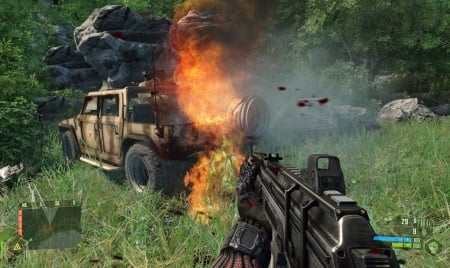
From the makers of Far Cry, Crysis offers FPS fans the best-looking, most highly-evolving gameplay, requiring the player to use adaptive tactics and total customization of weapons and armor to survive in dynamic, hostile environments including Zero-G.
Real time editing, bump mapping, dynamic lights, network system, integrated physics system, shaders, shadows and a dynamic music system are just some of the state of-the-art features the CryENGINE™ 2 offers. The CryENGINE™ 2 comes complete with all of its internal tools and also includes the CryENGINE™ 2 Sandbox world editing system.

Crysis is certainly not a game you will want to be playing on your IGP, but we can see at low resolutions that it's playable on the 785G and 790GX with SidePort or Sideport+UMA, but UMA alone simply isn't going to cut it.
Final Thoughts
When the first Integrated Graphics Processors made their way into the market back when Intel Pentium III was around, the performance of these so called 3D graphics cards were extremely poor. Their overall usability was for Windows 2D only and any attempt of 3D would simply frustrate. Even Quake would run slow on them.
Since then graphics processors have come a long way. With ATI and NVIDIA, real graphics card producers, getting their hands into the chipset market, rather than leaving them to the likes of Intel and S3. Things have started to pick up since then, especally when it comes to ATI. One thing is for sure, they have managed to really put alot of work into their AMD chipsets; especially their IGP based ones.
AMD has really managed to raise the bar when it comes to IGPs. The 780G really showed us that power could be had with their Hybrid Crossfire design and while the IGP was restricted to UMA Only, its performance over the previous generation chipset, including any from NVIDIA, was going the way things should go. 790GX really showed us that ATI was listening. I don't know how many times i have said to put a small cache memory on the IGP to help it along, but SidePort memory is here and it really makes a difference.
785G may be a lower number than 790GX, but its performance is just as good, if not better. Its support for the same Crossfire arrangement in discrete GPU mode is excellent. Its continuation of SidePort memory is fantastic and its DX10.1 graphics additions are fantastic. If you're looking at 790GX or 785G, we recommend 785G hands down.
Our Latest Socket AM3/AM3+ Article Coverage