

Introduction
nVidia has been the biggest name in 3D graphics over the last 10 years. With its dominance of 3DFX with the TNT2 series graphics cards, as well as the eventual acquisition of 3DFX over six years ago, nVidia has really started to show what its able to do for the 3D market. While there have been ups and downs (namely the GeForce FX 5xxx series cards as the big downer), today nVidia is the leader in 3D graphics and with what we can see coming in the future, its going to be for some time.
nVidia was the first 3D graphics designer to start producing chipsets for motherboards based on the AMD architecture. Again there were a few ups and downs (the original nForce AMD Athlon XP chipset), nVidia has pulled its R&D team into the 21st century and introduced a series of chipsets that simply were the envy of any chipset manufacturer out there. nVidia has ruled the AMD Athlon market in terms of sales and performance in its nForce 2 and 3 chipsets and has pushed companies like VIA to the backburners as the chipset of choice.
With new agreements with Intel, nVidia has acquired the licence to produce Netburst supporting chipsets, which has now led to the release of the nForce 4 Intel Edition based chipsets. The first chip based for this technology was simply not fully up to specs and plagued with compatibility problems with the Pentium-D and Pentium Extreme Edition CPU's, nVidia has moved to producing a second generation of chipset supporting Dual PCI Express x16 graphics slots.
We have previously looked at the ASUS Pentium 4 offering and today we're looking at Gigabyte's offering.
Specifications
Specifications of the 8N-SLI Quad Royal
CPU
Supports Intel Pentium 4 500 and 600 Series LGA775
Supports Intel Pentium 4 Extreme Edition LGA774
Supports Intel Pentium D 800 Series LGA775
Supports Intel Pentium Extreme Edition 800 Series LGA775
Supports Intel Celeron D 300 Series LGA775
Chipset
nVidia nForce 4 SLI Intel Edition x16
nVidia C19 Northbridge
nVidia MCP804 Southbridge
Hyper Transport
System Memory
4 DRR2 SDRAM 240pin DIMM Sockets
Supports DDR2-400/533/667Mhz
64/128Bit Dual Channel
Supports up to 8GB Total Memory (4x 2GB)
Bus Frequency
133/200/266MHz Internal
533/800/1066MHz External
Netburst Micro Architecture
Expansion Slots
4 PCI Express x16
2 PCI Express x1
1 PCI
Connectivity
2 Parallel ATA port supporting 4 IDE Drives
4 Serial ATA ports
2 Gigabit Ethernet Ports
Expansion Ports
1 PS2 Keyboard Port
1 PS2 Mouse Port
10 USB 2.0 Ports
1 Serial Ports
1 Parallel Port
6 Stereo Audio Ports
2 SPDIF Audio Ports
3 Firewire-400 Ports
The Motherboard

Our first look at the board shows us a large full sized ATX layout measuring 30x30cm using a 6 layer PCB, there is a lot of packing going on with the Gigabyte board. Placement of connectors is vital for good air flow, especially in Intel based system where temperatures are known to hit well above 70 on the CPU.
As far as power connector placement goes, the 24 pin ATX power connector is located behind the DDR-2 sockets along with the two IDE controllers just below it. With the 8 pin connector, Gigabyte really needs to start listening to good placement suggestions, especially when others out there have. The 8 pin CPU voltage supply connector is once again placed between the Northbridge heatsink and the Rear I/O interface. This means that the extra power cable is run around or across the heatsink, reducing air flow. The 4 pin restricted air enough to be a problem, now with 8 pin, its even bulkier. A better placement would be the upper left or right of the board. Let's hope Gigabyte start to listen to the enthusiasts and cooling freaks out there. Another sour note is the placement of the FDD connector. Located right at the bottom of the board, if you want to use a FDD, you will need to run the cable across just about every slot in the board - another no-no for Gigabyte here.

This is where things start to get very interesting. To date, this is the only motherboard to support more than two graphics cards simultaneously. The layout of the expansion slots incorporates four PCI Express x16 slots, two PCI Express x1 slots and a single PCI slot. In the photo you can see that there are two black PCI Express x16 slots and two blue PCI Express x16 slots.
The two black PCI Express x16 slots are electrically 1x unless the SLI paddle card is set to SLI mode. The two blue slots are electrically x16 speed until the SLI paddle card is set to SLI mode, at this point they are then routed to PCI Express x8 speed. If you plan to use only two graphics cards, you will need to place them into the blue slots and then use the bridge connector. If you want to use four cards, you group them in black and blue configurations with the SLI bridges on each group. While allowing Quad SLI there is also have another practical use - multiple monitor support. If you choose not to enable SLI, or if you use cards not based on nVidia technology (yes, ATI graphics cards can be used in this board to run more than four monitors) you can have up to eight monitors in a single setup, which is not a bad desktop setup we must say!
Currently there are no official drivers to support Quad SLI and from what we've been told from nVidia, they currently don't have any plans at all to release drivers which support Quad SLI. There is a handful of Dell gaming systems which will come with Quad SLI but it remains to be seen if these drivers will be modded and leaked to the public for use on non-Dell systems.
The PCI Express x1 slots are usable when in SLI mode; however, if you use graphics cards with large coolers on them, the PCI Express x1 slots will become unavailable.

The 8N-SLI Quad Royal conforms to the FMB 2.0 power requirements set by Intel for the Dual Core CPU's. This requires a 4 phase voltage regulation system, which Gigabyte has place around the CPU socket. The layout round the CPU is very clean allowing you to install large after market coolers on the board without any interference from high capacitors. While the previous generation of boards (based on the original nForce4 IE chipset) refused to support the Pentium Extreme Edition Dual Core processors, we are happy to confirm that in our testing this board worked flawlessly with our Smithfield Extreme Edition, however, this board does not work with the Pentium Extreme Edition 955 Presler cores and most likely not with the Pentium D Presler or Pentium 4 6x1 Ceder Mill cores either.
The Motherboard Continued

The rear I/O panel give you all the connectors you will need. At the back you get two PS/2, one Parallel, one Coaxial and one Toslink SPDIF Output, one Firewire-400 port, four USB ports, two Gigabit RJ-45 ports and 6 stereo audio analogue ports.
Since nVidia doesn't have Azalia rights, this board lacks Intel HD Audio; however, the quality of the onboard sound is very good, though still not matching HD Audio or SB Audigy 2 levels, it is acceptable. On the board itself you have three yellow headers for six extra USB 2.0 ports, a grey header for two Firewire ports and a white header for a serial port.


At the helm is the two chip nVidia nForce 4 SLI x16 Intel Edition chipset. This chip is the latest to market to support the Netburst architecture as well as twin PCI Express x16 slots for true full speed SLI, which should have been done in the first place. The Northbridge houses the first PCI Express x16 port as well as four additional PCI Express x1 lanes for add-on devices. The Southbridge houses the second PCI Express x16 port as well as the built in Gigabit LAN, SATA-II controllers, IDE controllers, USB, Audio and PCI buses. The two chips connect though the Hyper Transport protocol at 16-bit both direction at 1000MHz each direction for maximum data throughput.
Both chips need to be kept reasonably cool. The Southbridge has an active fan on it from shipping, while the Northbridge can have a fan installed which comes in the box, our sample was pre-release, so we didn't get much in the way of a bundle, however, we cannibalized another Gigabyte board with the same fan setup to install one on for our overclocking tests to get the best results possible.
In addition to the features provided by the nVidia chipset, Gigabyte has added in two extras onto the board. First is a Marvell PCI Express x1 Gigabit LAN controller in order to give Dual Gigabit support. The second add-in is a 3 port Texas Instruments PCI based Firewire-400 controller chip.
Overclocking
Gigabyte uses the Award Modular BIOS version 6, which is pretty much the BIOS of choice for any motherboard these days, as AMI seems to be the less used BIOS on enthusiast motherboards. While being Award branded, it resembles the AMI setup in its simplicity and style, but don't let this fool you as the options for your tweaking and overclocking are vast and numerous.
Gigabyte places all of its overclocking options in the MB Intelligent Tweaker (M.I.T) Menu with two extra sub menu's to tweak the living hell out of your board.
First option is the C.A.M and this option is new. There are three options: High, Low and Auto. According to the menu the explanation for this option is for locked frequency CPU's to high or low mode. Setting this didn't change any of our overclocking results.
Next is the CPU Ratio control. If you purchase a Pentium Extreme Edition CPU this is where you will change your default multiplier, as all Extreme Editions CPU's are multiplier unlocked, a great feature for your money.
On all of Gigabyte's top model boards is the C.I.A.2 automatic overclocking feature. In the C.I.A.2 setup you have Cruise, Sports, Racing, Turbo and Full Thrust options, which overclock the CPU to a set percentage when the load on the CPU is 100% for 10 or more seconds. You can disable this to overclock the FSB manually.
FSB turbo mode is used to keep the FSB from fluctuating when under load, this option should be disabled for manual overclocking, as it tends to cause instability in the system.
System Clock mode is where you start to manipulate memory and FSB speeds. There are three options here. Optimal prevents any changes by the user. Linked mode keeps the memory clock and FSB linked, so any FSB increases overclocks the memory. In Expert mode, the FSB and memory clocks work Asynchronous; this means you can input any FSB speed and the memory will stay at the specified speed the user inputs. And vice versa, if you want to overclock the RAM and not the FSB, you simply change the RAM speed and the FSB remains the same.
After this Gigabyte gives a few readouts such as current FSB speed, Projected FSB speed when changing the clocks as well as current DDR2 speed and projected DDR2 speeds. This lets you gauge what speed you system will be running at even before you save and exit the setup menu, a very helpful thing indeed, after all, who wants to do the math themselves when you can have the BIOS do it for you.
Next you have the PCIe x16 Slot Lanes. This allows you to setup in BIOS the SLI function. You can split the two PCI Express x16 lanes down to the four PCI-Express x8 lanes for Quad SLI. You can split only one of the PCI Express x16 lanes down for three graphics cards - whatever you want to do, this board is extremely flexible.
Robust Graphics Booster is Gigabyte's version of the ASUS PEG Link speed setting. When set to auto, the graphics and memory clocks are left at default speeds. If you set this to fast, the memory and core clocks of the video cards are overclocked by up to 5%. Turbo mode gives you up to 10%, depending on load on the GPU.
Now we get into the voltage section of the board. In order to get to the voltage settings you need access the Advanced Voltage Control sub-menu of the M.I.T menu. The first setting is the CPU voltage. You can adjust the voltage range from 1.0v up to 1.75v in 0.0125v increments. This allows you to use Presler, Prescott, Smithfield and Gallatin cores and give them all a pretty good voltage boost for your overclocking needs.
Next is DIMM voltage. This has been a pretty sore point in Gigabyte's past, as they simply haven't given enough voltage in order to overclock. The 8N-SLI Quad Royal breaks this rule. You can adjust from default voltage up to a max of +0.55v in 0.05v increments. In real world voltage this means you can go from DDR-2's default of 1.8v up to 2.35v, not the highest we have seen, but for quite a few DDR-2 modules out there on the market, it's more than enough. OCZ memory is rated to 2.2v DDR-2 and still warranted, so this board gives just that bit extra for headroom.
Next is the Northbridge voltage. This is used in order to stabilise the Northbridge, PCI Express x1 ports and the first two PCI Express x16 ports when overclocking. You can set it from default up to +0.55v in 0.05v increments. This gives from 1.5v up to a max of 2.05v.
Following the Northbridge voltage is, you guessed it, Southbridge voltage. This is also used to stabilise the Southbridge and the second 2 PCI Express x16 slots when overclocking, and does a great job of keeping the SATA clocks stable when clocks go up. You can raise the voltage from default up to a max of +0.55v in 0.05v increments. This gives you the same as the Northbridge, 1.5v up to 20.5v.
Next comes the front side bus Overvoltage. This one is used to give the Netburst bus a extra voltage jump when overclocking. You can adjust the FSB Overvoltage from its default up to a max of +0.175v in 0.025v increments. This means you get from 1.2v up to 1.35v.
There is one final sub-menu in the Gigabyte M.I.T setup. This is called the Advanced Frequency Control Menu. Here there are two extra options. First is the PCIe Frequency control. You can set the PCIe Frequency from 100MHz to a maximum of 200MHz in 1MHz increments. PCIe buses are extremely sensitive to overclocking and cause the most instability in overclocked situations. PCIe is known to fail at even 7% overclocks. Best idea is to leave it at 100MHz to keep all PCIe devices at stock speeds.
The final option is the LDT Frequency. AMD users will know this setting; it is used to control Hyper Transport multipliers. Now a lot of people might ask why there is an AMD Hyper Transport used on the Intel system. Hyper Transport is used to interconnect the North and Southbridges. They are clocked using the exact same setup as the AMD Athlon 64 CPU to External Northbridge at 1000MHz, 800MHz, 600MHz and so on. This gives the most robust and fastest interconnect speed of any chipset out there on the market. Under this menu you have the ability to change the multiplier from 1x up to 5x. This gives you a 2000MT/s connection between to the two chipsets, more than enough to handle the extra PCIe x16 graphics system used on the Southbridge.
We stuck a Pentium Extreme Edition 840 into our system. We managed to get a FSB clock of 325MHz out of the system, CPU voltage of 1.45v, DDR-2 voltage set to 2.0v, Northbridge and Southbridge voltages at stock and the FSB voltage at maximum and we left the LDT speed at 4x.
In all we were very impressed with the overclockability of the Gigabyte 8N-SLI Quad Royal, it has plenty to offer.
Benchmarks - Test System Setup and Sandra
Test System Setup
Processor: Intel Pentium Extreme Edition 840 (800MHz FSB) (Supplied by Intel)
Memory: 2x 512MB Corsair DDR2-800
Hard Disk: 2x Seagate 7200.9 RAID 0 on supported boards (Supplied by Seagate)
Graphics Card: ATI Radeon X800XT Platinum (Supplied by ASUS)
Operating System: Microsoft Windows XP SP2
Unfortunately at this time, nVidia only supports Quad SLI on Dell based systems.
This means there are no current or planned drivers to come out with Quad SLI support, so we weren't able to test this out. However, we are expecting to see Dell's nVidia drivers leaked into the overclocker's community and hope they will work on other systems with a few mods. When this happens, we will re-visit this area and give you and update on its Quad SLI ability.
In our testing we'll be comparing the 8N-SLI Quad Royal against Gigabyte's 955X Royal which is based on Intel's 955X chipset.
SiSoft Sandra
Version and / or Patch Used: 2005 SR3a
Developer Homepage: http://www.sisoftware.co.uk
Product Homepage: http://sisoftware.jaggedonline.com/index.php?location=home&a=TTA&lang=en
Buy It Here
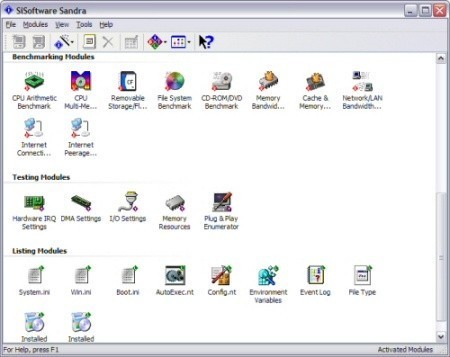
SiSoft Sandra (System ANalyser, Diagnostic and Reporting Assistant) is a synthetic Windows benchmark that features different tests used to evaluate different PC subsystems.
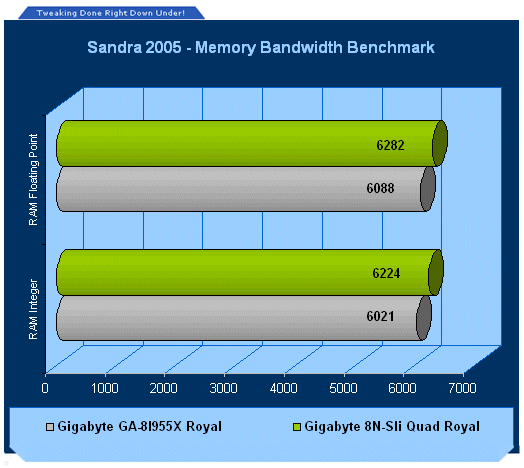
Compared to the Gigabyte GA-955X Royal, the 8N-SLI Quad Royal has the advantage in memory bandwidth.
Benchmarks - PCMark
PCMark
Version and / or Patch Used: 1.1.0
Developer Homepage: http://www.futuremark.com
Product Homepage: http://www.futuremark.com/products/pcmark04/
Buy It Here
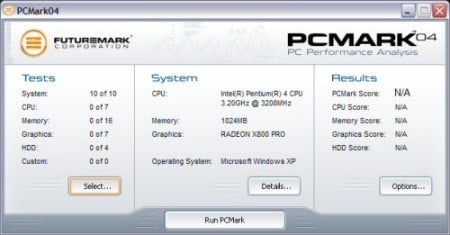
PCMark is a multipurpose benchmark, suited for benchmarking all kinds of PCs, from laptops to workstations, as well as across multiple Windows operating systems. This easy-to-use benchmark makes professional strength benchmarking software available even to novice users. PCMark consists of a series of tests that represent common tasks in home and office programs. PCMark also covers many additional areas outside the scope of other MadOnion.com benchmarks.
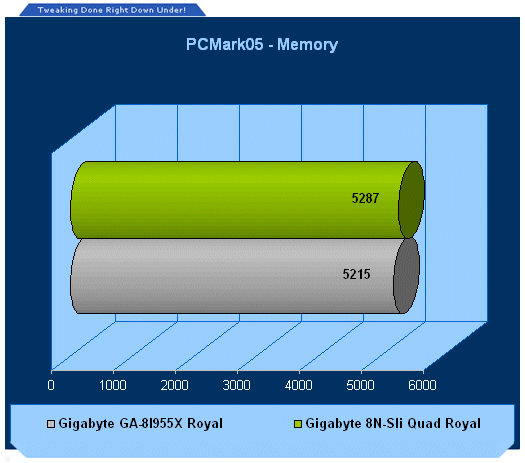
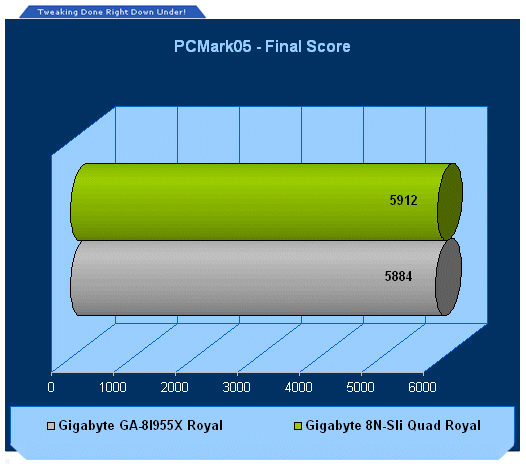
Memory scores also benefit the 8N-SLI Quad Royal as does the final result.
Benchmarks - 3DMark Series
3DMark03
Version and / or Patch Used: Build 360
Developer Homepage: http://www.futuremark.com
Product Homepage: http://www.futuremark.com/products/3dmark03/
Buy It Here

By combining full DX8 and partial DX9 support with completely new tests and graphics over the previous version, 3DMark03 continues the legacy of being the industry standard 3D benchmark.
Please Note: Due to recent events with the 3DMark03 series, we are adding results purely for those who are still in favor of 3DMark03. These results should not be taken too seriously and are only added for interest sakes.
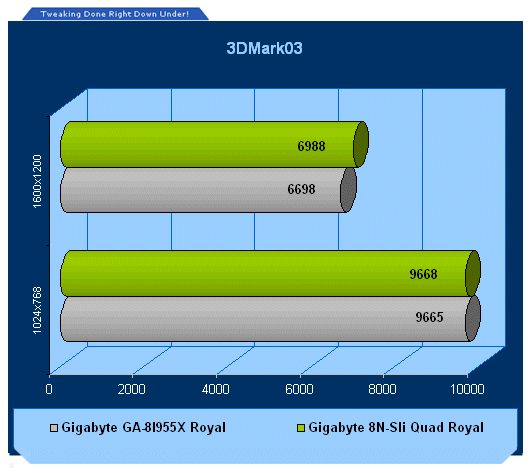
3DMark03 isn't as intense on today's systems as it was only 6 months ago, thus it really doesn't make the greatest benchmark of the day.
3DMark05
Version and / or Patch Used: Build 120
Developer Homepage: http://www.futuremark.com
Product Homepage: http://www.futuremark.com/products/3dmark05/
Buy It Here

3DMark05 is the latest version in the popular 3DMark "Gamers Benchmark" series. It includes a complete set of DX9 benchmarks which tests Shader Model 2.0 and higher.
For more information on the 3DMark05 benchmark, we recommend you read our preview here.
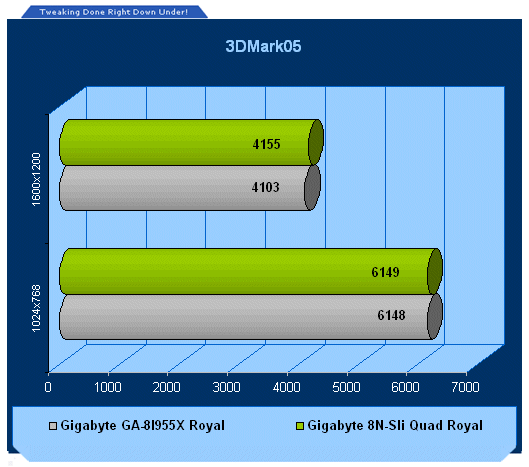
3DMark05 is a far better benchmark in today's world. This shows the Quad SLI ahead of the 955X based Gigabyte board.
Benchmarks - Doom 3
Doom 3
Version and / or Patch Used: Unpatched
Timedemo or Level Used: Custom Timedemo
Developer Homepage: http://www.idsoftware.com
Product Homepage: http://www.doom3.com
Buy It Here
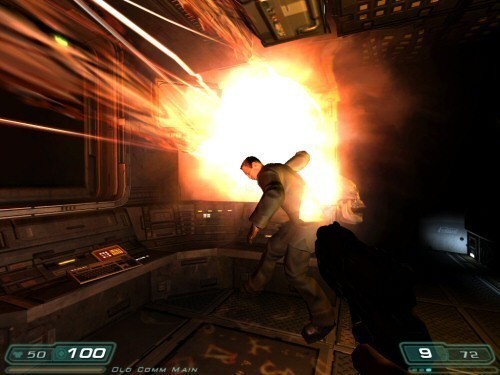
Doom 3 is the latest game to hit our test lab and is one of the most intensive games to dates. With our own custom time demo we are able to give a realistic rating on what kind of FPS you will be achieving.
For more information on benchmarking Doom 3 we recommend you check out our extensive article regarding it here.
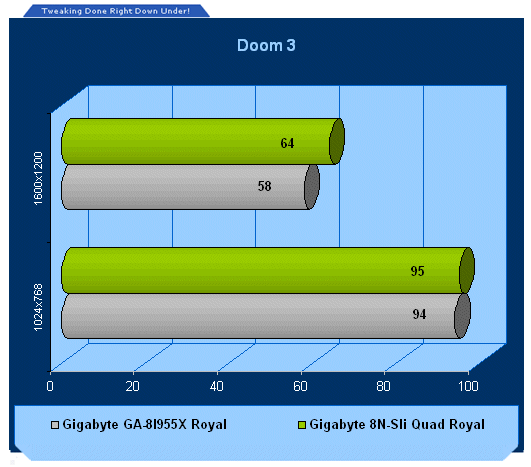
Doom 3 shows a light lead to the 8N SLI Quad Royal, but nothing spectacular.
Benchmarks - Half Life 2
Half Life 2
Version and / or Patch Used: Unpatched
Timedemo or Level Used: Custom Timedemo
Developer Homepage: http://www.valvesoftware.com
Product Homepage: http://www.half-life2.com
Buy It Here

By taking the suspense, challenge and visceral charge of the original, and adding startling new realism and responsiveness, Half-Life 2 opens the door to a world where the player's presence affects everything around him, from the physical environment to the behaviors even the emotions of both friends and enemies.
We benchmark Half Life 2 with our own custom timedemos as to avoid possible driver optimizations using the "record demo_name" command and loading the timedemo with the "timedemo demo_name" command - For a full list of the commands, click here.
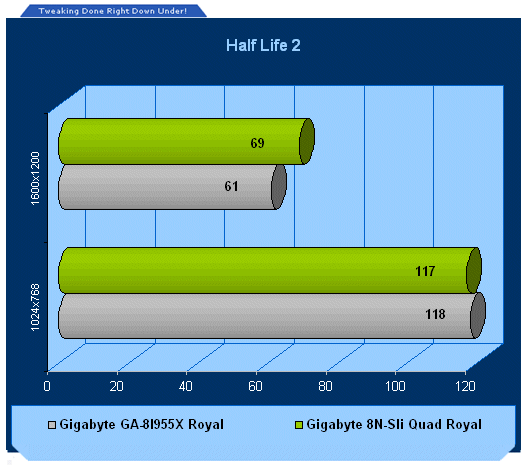
Again Half Life 2 shows a slight lead to the 8N SLI Quad.
Benchmarks - F.E.A.R.
F.E.A.R.
Version and / or Patch Used: Unpatched
Timedemo or Level Used: Custom Timedemo
Developer Homepage: http://www.vugames.com
Product Homepage: http://www.whatisfear.com/us/
Buy It Here
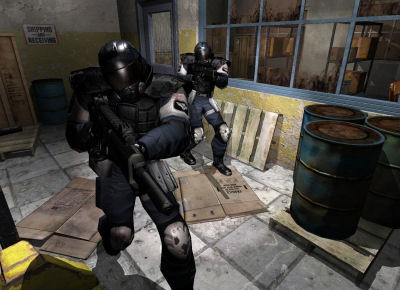
F.E.A.R. (First Encounter Assault Recon) is an intense combat experience with rich atmosphere and a deeply intense paranormal storyline presented entirely in first person. Be the hero in your own spine-tingling epic of action, tension, and terror...and discover the true meaning of F.E.A.R.
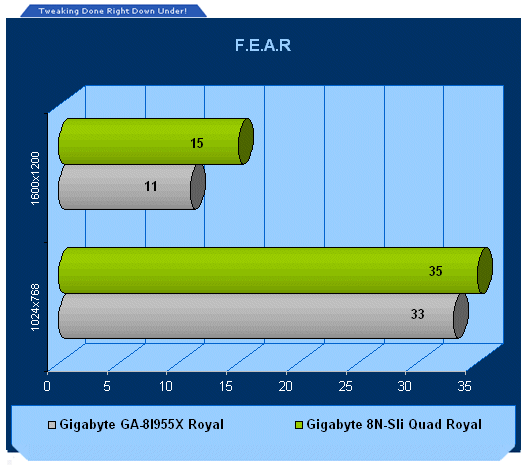
In our last test, F.E.A.R puts the graphics, CPU and memory to the test and shows the 8N-SLI Quad the ultimate winner.
Final Thoughts
While not able to take advantage of the Quad SLI function of the 8N-SLI Quad Royal at this present time, nVidia may introduce Quad SLI support to the public in the future and this is the first retail board to support such a setup.
nVidia's own statements show that Dell is currently the only manufacturer to get qualifications for this as a retail offering, but how long till these drivers leak to the market and are modded to work with any Quad SLI setup? This is something even we can't answer, but Gigabyte is ready for that day already with the 8N-SLI Quad Royal. Even still, don't forget if you're using this motherboard for SLI, you're using the latest nForce IE chipset from nVidia: this means, you're using full speed SLI (2 x 16 times slots) and being assured of the maximum performance possible from your graphics cards.
If you aren't the type of user who wants Quad SLI but want more desktop room on the PC, then this motherboard with its eight monitor support is simply the way to go. With four graphics cards supporting two monitors each, it's hard to go past this as the ultimate in 3D rendering and graphical presentation setup, and with the Hyper Threading and Dual core Pentium Extreme running the show, you can do almost everything at once on this board.
Even if you don't want multi-monitor support, you've got plenty of room for expansion in the future for PCI Express devices such as high-speed LAN, RAID controllers and TV tuners which require higher bandwidth PCI Express slots.
To sum things up, if you want Quad SLI now, you will need to wait for a Dell desktop gaming system to hit your doorstep but for the future market Gigabyte is clearly thinking ahead and as always providing you with plenty of choice and flexibility in their product.
- Pros
Fast
Supports up to 8 monitors
Universal PCI Express x16 slots support any add in PCI-E card
Supports Presler core CPU
Supports Dual PCI-E x16 SLI (full speed SLI)
Great overclocking support and options
Very future proof
- Cons
No Quad SLI drivers available yet
Only a single PCI Slot
No HD Audio
Rating - 9 out of 10 and TweakTown's "Must Have" Editors Choice Award

 United
States: Find other tech and computer products like this
over at
United
States: Find other tech and computer products like this
over at  United
Kingdom: Find other tech and computer products like this
over at
United
Kingdom: Find other tech and computer products like this
over at  Australia:
Find other tech and computer products like this over at
Australia:
Find other tech and computer products like this over at  Canada:
Find other tech and computer products like this over at
Canada:
Find other tech and computer products like this over at  Deutschland:
Finde andere Technik- und Computerprodukte wie dieses auf
Deutschland:
Finde andere Technik- und Computerprodukte wie dieses auf  MSI no longer interested in under performing AMD Radeon GPUs, now exclusive to NVIDIA
 SDC's new 27-inch 4K 165Hz Nano-IPS monitor features DisplayPort 2.0, costs just $415
 Sabrent wants you to enhance your tech with special savings on SSD, RAM, and enclosure bundle
 LG's 32-inch gaming OLED monitor with 480Hz refresh rate is imminent, with pre-orders live now
 Google Pixel 8a leak boasts 7 years of security updates but leaves one question unanswered
 SteelSeries Arctis Nova 4X Wireless Gaming Headset Review
 ACEMAGIC AD08 "Core i9 11900H" Mini PC Review
 Lenovo ThinkPad X1 Carbon Gen 12 Review
 ASUS ROG Swift Pro PG248QP Gaming Monitor Review - Frames, frames, and more frames
 FlexiSpot C7B-Mesh Ergonomic Office Chair Review
 Samsung G8 34-inch QD-OLED Gaming Monitor Review - 175Hz for $900
 ASRock NUCBOX-155H Mini PC Review
 NuPhy Air96 V2 Wireless Mechanical Keyboard Review
 TEAM T-FORCE Siren DUO360 RGB Liquid CPU Cooler Review
 AVerMedia Live Streamer ULTRA HD Review
 Building the Ultimate Home Entertainment Server with an ASUSTOR NAS and Viper Gaming NVMe SSDs
 Everything you need to know about the latest ASUS NUC Mini PCs - NUC 14 Pro and ROG NUC
 How to Overclock Your GPU and Boost Your PC Gaming with ASUS GPU Tweak III
 ASUS's AMD Radeon RX 7000 Series GPU lineup has something for every gamer
 ASUS OLED Premium Care defends the ROG Swift OLED PG32UCDM gaming monitor from burn-in