









Introduction
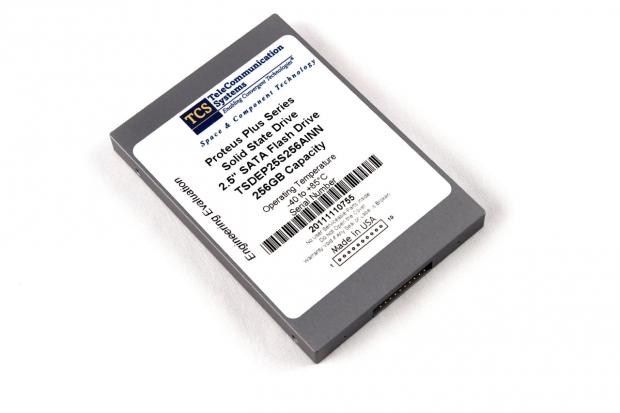
Every day the war for data rages and much of it is out of the public eye. Lately hackers seem to attack at will and this high profile type of data theft is rampant. The most sensitive of government data isn't as vulnerable as data that proliferates in the private sector, but the data is still definitely at risk.
Today we are delving into new territory, the land of Military/Ruggedized and Industrial SSDs. These can be among the most interesting of SSDs, simply because of some of the features added to make them survive some of the harshest environments in the world and protect sensitive data at all costs.
Last year the Iranian government was able to capture a top-secret US drone never viewed by the public. The most discussed topic pertaining to the capture was the data that was contained on the drone itself. Encrypted data transmissions and the codes themselves, could allow the Iranian government to capture further top-secret data and drones and snoop on encrypted communications. On the other hand, they could even sell that data to more nefarious countries with the technology to exploit it further.
This event had members of the government and the media questioning how this data is stored and protected. Do we just have drones flying about with top-secret information out there? The simple answer is yes; all governments have sensitive data stored in laptops, vehicles, drones and satellites. The trick is to protect this type of information from those that would seek to capture it.
This is where the militarized and ruggedized SSD products come into the picture. SSDs by their very nature are best suited for the industrial and militarized space. They are more resilient than HDDs, which have moving parts that can be susceptible to failure by many factors in tough environments that simply do not budge an SSD. By tough environments, we are speaking of being launched into space under tremendous G-Forces, flying through the stratosphere in drones and taking enemy fire in tanks and other combat vehicles.
The SSD is well suited to these types of applications, but the business of making ruggedized SSDs requires that there are steps taken to make these SSDs function under even more extreme circumstances.
The TeleCommunication Systems base model comes ready for a rough life, but also has specialized options available and one that even allows for the SSD to work while totally submerged in water. Let's take a look inside at some of the features that make this SSD stand out from the crowd.
Our Latest SSD Article Coverage
- Memblaze PBlaze 7 7A40 Ocean 61.44TB Enterprise SSD Review - Oceans of QLC at 3.3 million IOPS
- KIOXIA CD9P-R 7.68TB E3.S Review - The Best-In-Class Data Center SSD
- DapuStor Roealsen6 R6060 E1.L 245.76TB SSD Review - Massive Capacity with Fast Retrieval
- Phison Pascari X200P 7.68TB Enterprise SSD Review - Sequential Read Champion
- Micron 9550 Pro E1.S 15mm 7.68TB SSD Review - G8 Flash for Read-Intensive AI Storage Compute
Ruggedized Internals
[img]2[/img]Lifting the drive for inspection it becomes clear by the heft that this isn't your garden variety SSD from Amazon. The SSD has a solid feel to it due to its precision-machined aluminum alloy case.
The rear of the case at first appears unremarkable, but closer inspection reveals some non-standard screws rarely seen in consumer SSDs.
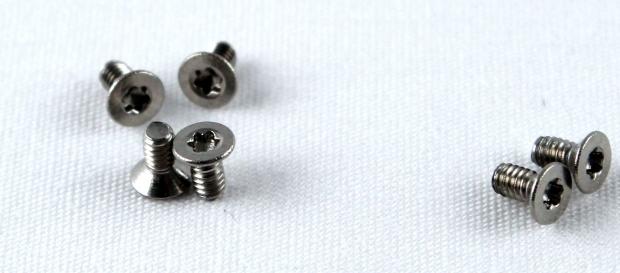
These Torx screws were installed into the drive without normal thread locking to ease our ability to remove them and conduct the review. In actual deployments the screws will be thread locked, making them nearly impossible to remove with standard approaches.
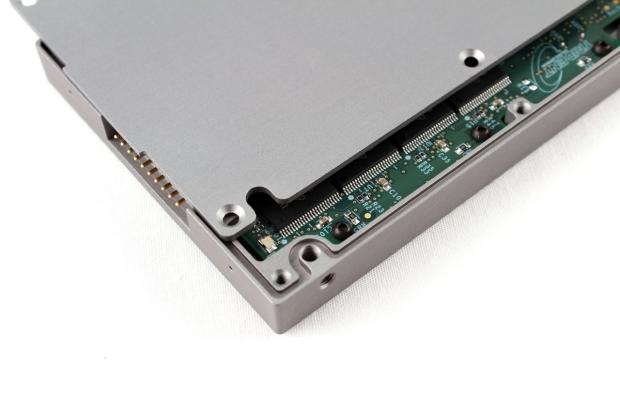
As we start to open up the SSD, we can see that the case has a channel milled between the two sides of the case. This channel allows for gel fills that can seal the case for waterproofing purposes if the customer desires that option. These types of seals provide for moisture proofing in very humid environments and dustproofing for dry sandy environments.
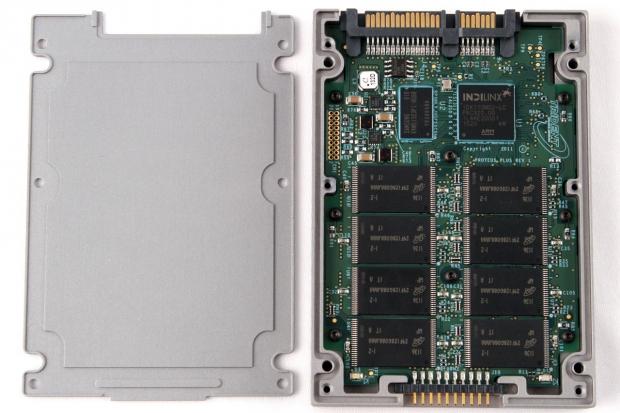
Once we pop off the rear panel, we can observe the additional fasteners that hold the circuit board down securely. The eight additional fasteners hold this board down tightly. This makes the PCB extremely resistant to any type of vibration or G-Forces that would potentially cause the PCB to move out of place or crack.
We also notice the odd-looking pins that protrude from the front of the case. These headers are for different methods of secure erasing, which we will cover shortly.
Internals Continued
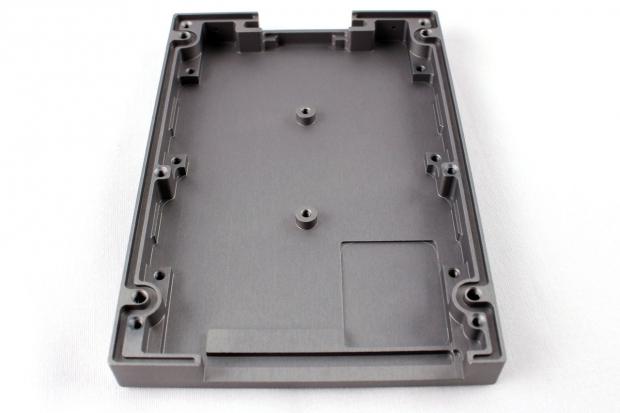
Once we remove the PCB from the bottom of the case, we note that the PCB does not rest directly on the surface of the case. There is a gap between the PCB and the bottom of the case as well. This allows the entire case to be injected with silicone gel, which will encapsulate the PCB and all vital components. This protects it from any type of water or dust hazards.
There is also the option of silicone, urethane or polymer conformal coating to round out the various forms of protecting the internals and the external case itself.
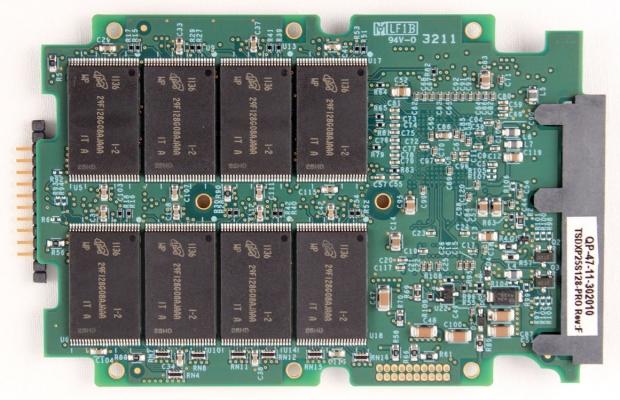
The rear of the PCB holds eight packages of Micron 25nm SLC NAND. The NAND, 29F128G08AJAAA, reveals that this is asynchronous NAND. SLC is utilized because of not only its excellent wear characteristics, it can withstand 100,000 P/E cycles compared to 5,000 cycles from premium MLC, but also the performance in high heat conditions. SLC has much better data retention performance at higher temperatures, along with lower bit error rates and superb latency. For this capacity of drive, it could tolerate a rough estimate of 35 Petabytes in transfers.
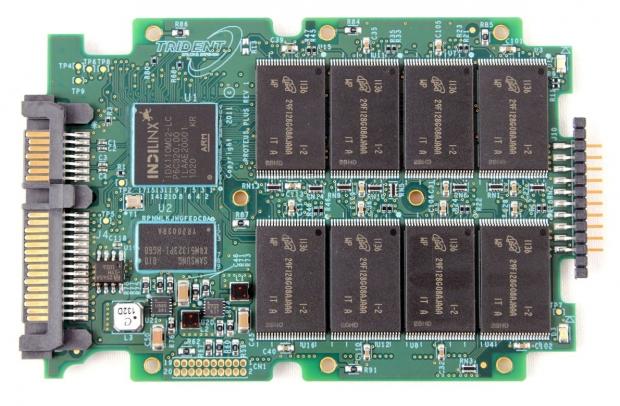
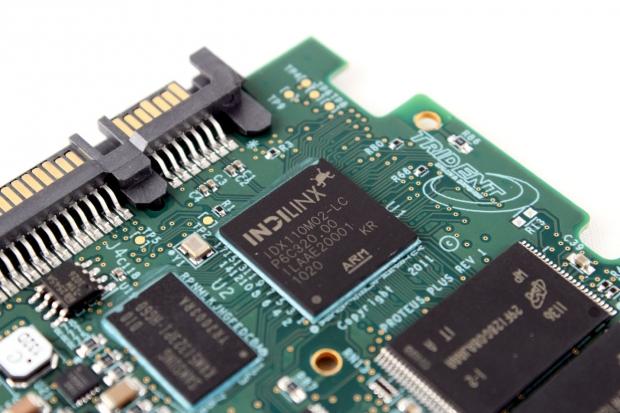
Finally, we get to the front of the PCB, which contains the Indilinx Barefoot controller. This controller, utilized for years now, is as stable as they come. Most commercial and enterprise SSDs released today are obsolete within a year. For the Militarized segment, the design and testing phase alone for these SSDs takes roughly a year. This approach guarantees 100% reliability.
The choice to use a SSD controller with such low specifications might be surprising to many. The key here is the reliability.
In the militarized and industrial segments performance takes a back seat to reliability. Lives can literally be on the line so it is crucial for the SSD to have reliable and predictable performance. Coupling this controller with SLC is going to provide for more than enough speed for its application in deployments.
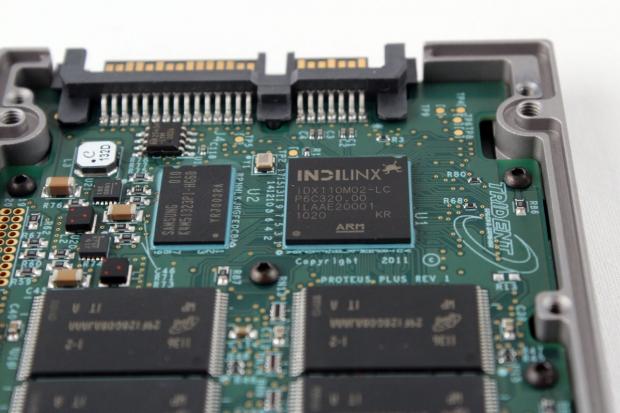
Blue BGA underfill surrounds both the Indillinx controller and the 64MB cache chip. This allows for a higher resistance to shock and temperature changes over the life of the device than solder alone can provide. This underfill adds additional rigidity to ensure the solder points do not fatigue significantly, limiting the risk of additional failure. For further protection, there is also the option for each component to have staking applied.
Secure Erase Features
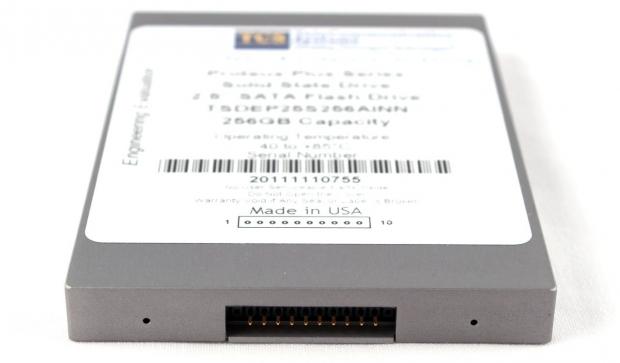
Finally we come to the header that is located on the front of the Proteus Plus case. This is not standard fare on consumer SSDs, but is certainly a crucial component for the Proteus. The Indillinx Barefoot controller does not provide for hardware level encryption, though using software encryption will be common.
This lack of hardware level encryption makes it critical that the fast destruction of the data contained on the SSD is possible. This is where the secure erase functionality, enabled via either software or hardware triggers, comes into play.
This header is a General Purpose I/O header. This allows the SSD to be secure erased via a number of methods, including jumpers or hardware triggers. The hardware triggers can be either physical buttons or remote triggers that assure data destruction. Other possible uses could be triggers activated when panels are removed or when the SSD is removed from the location that it is installed within. There are a number of possibilities, but that is up to the end-user or agency. TCS simply provides them a port to connect the device of their choice.
There are two holes to either side of the GPIO port. One is for a green LED power indication light and the other is for a blue LED to indicate that a secure erase is taking place. If the secure erase is interrupted by a loss of power, it will simply continue upon power restoration.
The Proteus Plus SSD has eight different methods of data destruction. While this may seem over the top, several different governmental agencies have their own specifications for handling data destruction. This includes a bevy of military and governmental agency approved data destruction methods, which range from a fast erase (under eight seconds for our model) to secure erase + overwrite methods in a variety of flavors.
Methods that confirm to US Army, Navy, Air Force, Department of Defense and the National Security Agency specifications round out the list of erasure methods:
Fast Erase, DoD NISPOM 5220.22-M, DoD NISPOM 5220.22-M Sup 1, NSA/CSS 9-12, Army AR 380-19, Navy NAVSO P-5239-26, Air Force AFSSI-5020 and RCC-TG IRIG 106-7.
Test System
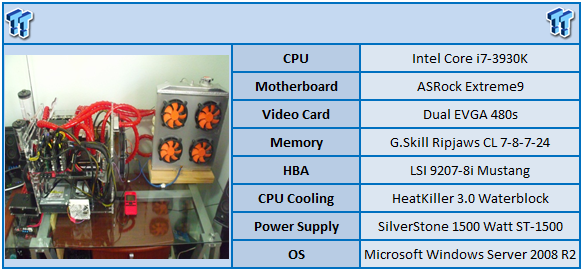
We will not be testing this SSD under our normal Enterprise Storage Bench. The reasoning behind this different approach to our testing regimen is that this Military/Industrial/Ruggedized SSD isn't utilized in typical enterprise scenarios by any means. These SSDs will not spend their lives doing anything as mundane as chugging away in a server rack nonstop.
Instead, they will subject to wild extremes. Shot into space, placed into combat situations and conducting top-secret missions. The majority of applications that will utilize this SSD will not require the highest specifications or need to operate under enterprise steady state conditions for an extended time. The data loads placed upon this type of SSD are typically going to be light, such as data logging and telemetry data in aircraft and recording in satellites. These applications will require performance that will be closer in line with consumer testing than our Enterprise Storage Bench, so we will use several consumer benchmarks that are available to the public.
As much as we would like to go skeet shooting with this SSD or even just go throw it in the pool, we aren't allowed to do any hardcore environmental testing. This falls to independent laboratories certified by governmental agencies to handle this type of testing.
Since we have no other SSD of this type to compare to we will be simply presenting the test results by themselves. Perhaps as we receive more SSDs for the industrial or military space we can begin to do some apples-to-apples testing, which unfortunately will not involve shooting at them with rocket launchers.
Specifications
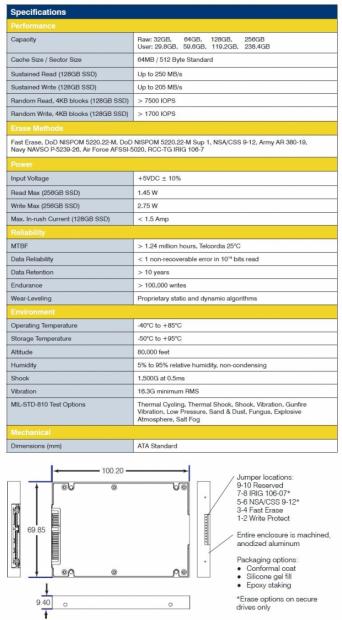
A brief synopsis of the finer points of the Proteus Plus, then off to testing. It is interesting to see that some of the MIL-STD-810 options include Explosive Atmosphere and Gunfire Vibration.
ATTO and Crystal Disk Mark
ATTO
ATTO is a test that operates outside of the file system installed on the host system. This allows the benchmark to test the performance of the drive without the limitations that some file systems can impose on the storage device. The typical file system does have some overhead and restrictions that can hamper readings of the sequential bandwidth in particular.
This approach gives a clear view of the sequential performance of the drive under testing and used by the majority of manufacturers to generate the specifications that they market.
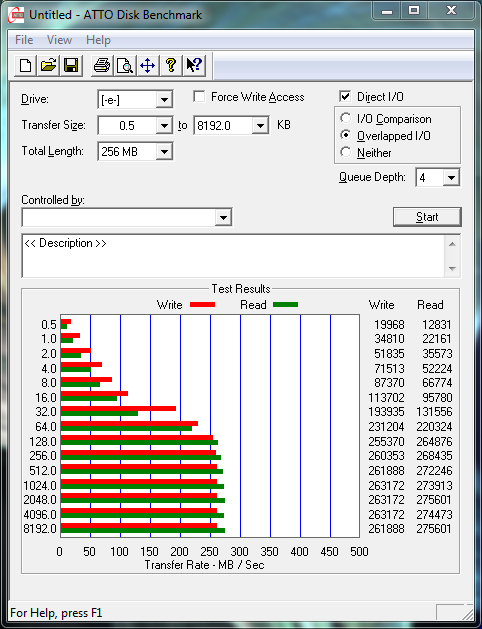
The Proteus Plus easily meets its marketed specifications in the sequential testing with ATTO. The SSD performs well in the lower Queue Depths and then scales very nicely up to a maximum of 275MB/s in read speed and 263MB/s with the sequential write testing. These results are at the maximum that the SATA 2.6 interface can provide.
Crystal Disk Mark
Crystal Disk Mark measures a number of various types of file access patterns to the data storage device under testing. The benchmark uses both sequential and random data, along with varying Queue Depths for the random data, creating a compelling disk benchmark for users. There is also the ability to select between testing with compressible and incompressible data.
The Indilinx Barefoot controller performs the same regardless of the compressibility of the data at hand, so we will be using the standard default benchmark mode with Crystal Disk Mark.
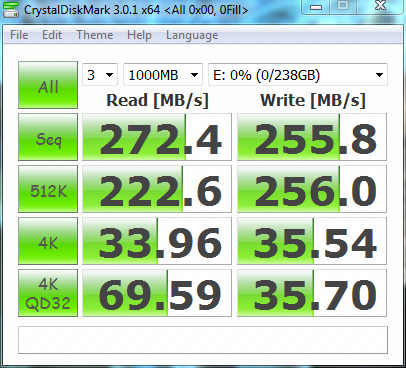
The sequential read and write results are close to the results that we achieved with ATTO. The random 4K read at the Queue Depth of is 33.96, which is comparable with even current generation SSDs at that same Queue Depth. The write speed is considerably slower than today's models and the SSD does not scale well with the 4K write results at the higher QD. This is typical behavior expected from this generation of SSD.
The typical applications for the Proteus will typically not consist of heavy random write workloads.
AS SSD and Anvil Storage Utilities
AS SSD
AS SSD is one of the few benchmarks that was actually designed with the SSD solely in mind. It tests with many of the same metrics that are included with Crystal Disk Mark with the notable inclusion of latency measurement. AS SSD tests latency with a 512B file size at a Queue Depth of one, while the industry specification is actually 4k QD1.
AS SSD testing consists of incompressible data in the main benchmark. There is testing with varying levels of compression with one of the subtests. We will not be including that test as the Barefoot processor performs the same regardless of the compressibility of the data.
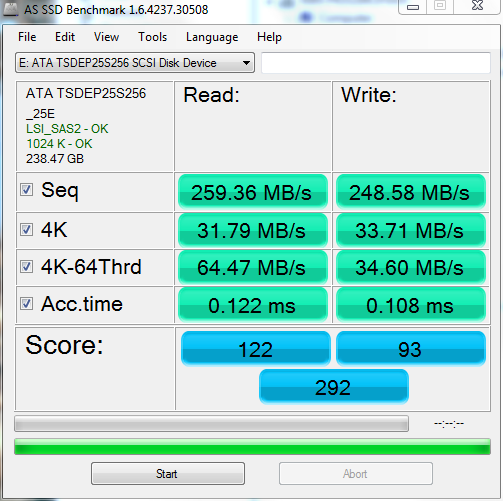
The AS SSD results show the same relatively good low QD write performance and the lack of scaling with the 4K random write speed. This result is a hallmark of previous generations of SSDs. These relatively low scores are miles ahead of even the fastest HDDs on the market.
Anvil Storage Utilities
Anvil Storage Utilities is the other premier SSD-centric benchmark. Anvil measures the file system performance with a variety of file sizes and focuses on providing latency measurements for each type of data access. This is very important, as latency is the key advantage that SSDs have over their HDD competitors. Latency is the driving force behind that feeling of "˜snappiness' from the attached storage.
Anvil also has other built-in utilities that test with more specific user defined parameters. Threaded read and write testing is possible with manual QD settings. There is also an endurance application and the ability to test with varying levels of compression. Anvil also does a great job of illustrating the type of system and drivers used in the testing of the storage right on the face of the benchmark screen. This can help when comparing results with different drivers and firmware revisions.
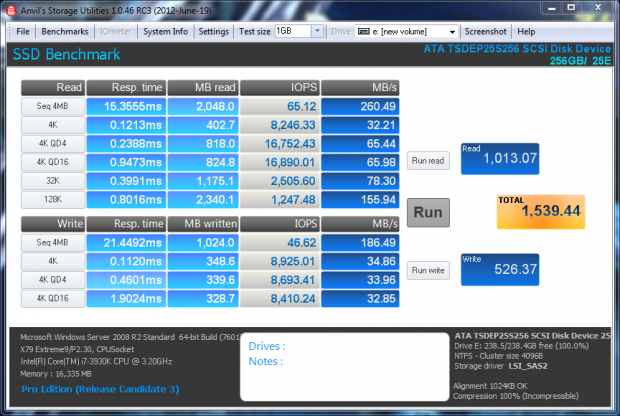
Overall, the SSD performs within expected parameters for this paring of controller and NAND.
HD Tune and Quick Bench
HD Tune
HD Tune tests over the entire surface of the drive or NAND in this case, by systematically writing or reading over every LBA on the attached storage. The initial design for HD Tune was for the testing of hard disk drives. As the drive progresses in the test, it would illustrate the loss of speed as the head moved from the outer portion of the platter to the inner regions.
This approach can also be uniquely suited for SSDs, as it will highlight any inconsistent or erratic behavior in the SSD as it fills with data.
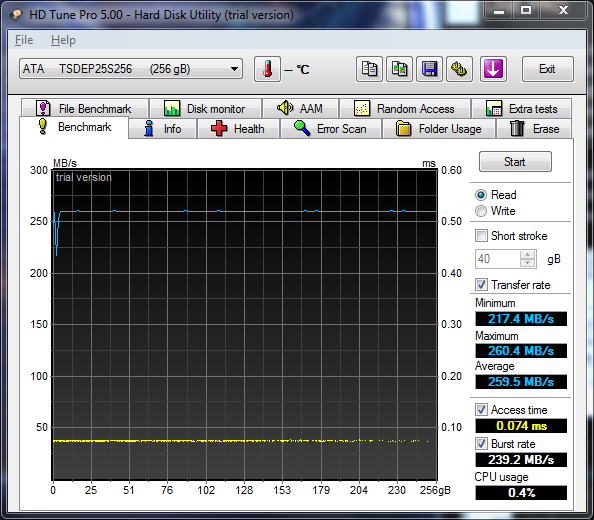
The read only average latency remains remarkably consistent across the entire drive during testing, an expected result when using premium SLC NAND. There is very little variability between the minimum, maximum and average read speeds.
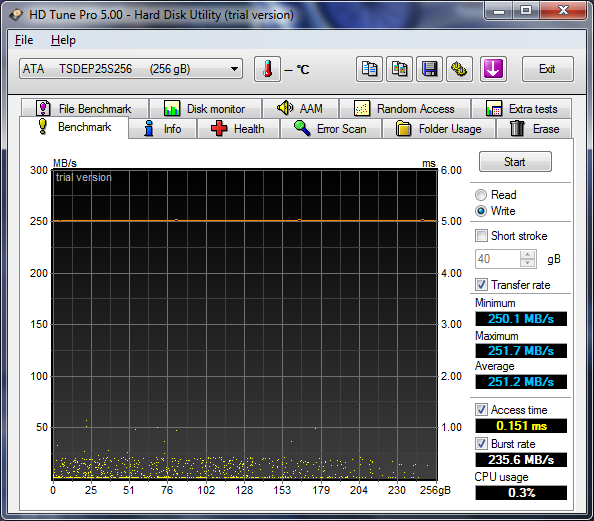
The write speed is remarkably consistent, with a flat line of 250MB/s across the entire surface of the NAND. This isn't surprising with the implementation of SLC NAND.
Quick Bench
Quick Bench conducts a user configurable number of runs (termed Cycles) and then provides the average of those cycles as the result. This can blur out any peak values and show results that are indicative of continued usage. This is particularly relevant when assessing write performance. There is also the option to perform a variety of testing at various file sizes. The option to allow disk cache effects injects pauses between write commands to clear the write cache. Unchecking this box removes the testing of the write caching entirely.
Providing results across numerous file sizes in both random and sequential access both graphically and numerically provides a great representation of the overall storage performance.
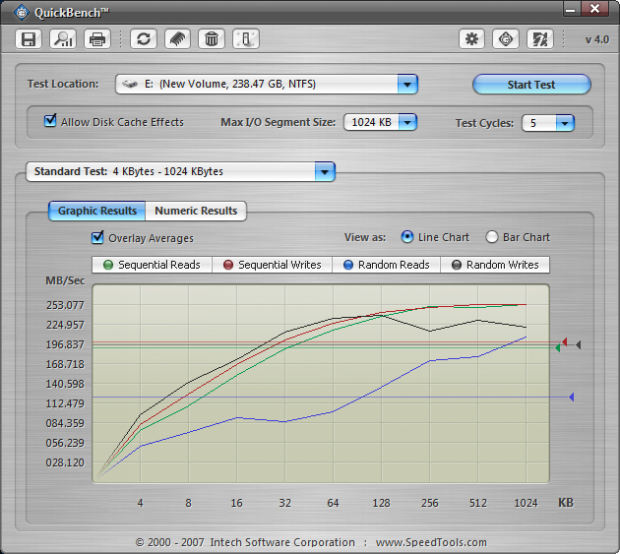
The straight lines represent the average speed of the different variations and the curved lines represent the average of the five combined cycles. The random and sequential write speed is remarkably consistent, regardless of the size of file tested.
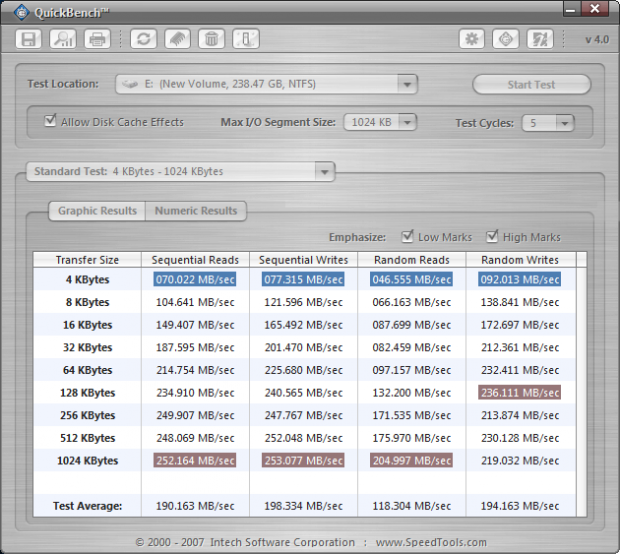
The highlighted areas indicate both the highest and lowest marks for each test. Here we can note that the random read and write speed with larger file sizes is surprisingly good.
Final Thoughts
The mobile explosion has created a huge problem for the various government agencies tasked with creating, storing and protecting classified data. Reality can be scary. On March 15th of this year a nuclear scientist's laptop went missing on a train in India. The implication of missing sensitive nuclear data in this volatile region of the world is simply alarming. This loss isn't just a threat to the security of India, it could be a threat to the entire world.
In June of this year, a top-secret laptop containing Taiwanese plans for a stealth ship went missing and presumably is in the hands of the Chinese government. Unfortunately, these aren't isolated events and well publicized security breaches with laptops have happened in the UK and the US as well. Loss of equipment such as the top secret US drone in Iran also brings the relevance of data security to light.
Maybe what is the scariest are the losses of data that we aren't even aware of. Information that is so sensitive that even the loss will never be confirmed nor denied. Protecting data that can cost human lives brings a tremendous responsibility along with it. In these types of applications, reliability comes to the forefront and speed is a secondary consideration. That is the purpose of utilizing the Indilinx Barefoot controller with the Proteus Plus SSD. It is stable and a proven performer that has stood the test of time. Making this controller forward compatible with the newer generations of NAND is an important step to making this a relevant NAND/controller combination.
The only notable feature that is lacking is power capacitors for data protection in the event of power loss. This may have been lost to price constraints as power capacitors typically add quite a bit of cost to the end product.
Features that harden the SSD abound with the base design of this SSD providing a tremendous amount of protection from the majority of environmental hazards. The added ability to customize this SSD to withstand the most violent of forces adds an extra layer of protection. BGA underfill, staking of components, conformal coating and gel encapsulation will support just about any use.
Perhaps most important are the steps taken to ensure that the data contained on the SSD is safe. While the device does not support encryption at the hardware level, the majority of secure applications will employ software encryption as a standard.
What is important is the ability to destroy the data immediately. The plethora of secure erase methods provides a means to please even the most scrutinizing of government agencies. Triggering these different types of data destruction with either software or hardware is a neat feature that will allow for multiple methods of destruction with a single SSD. Anything from too many password attempts, remote triggers or physically moving the SSD could delete the data.
It can be frightening to think of the power that a bunch of ones and zeros can have when they fall into the wrong hands, but the advent of technology and devices such as the Proteus Plus can help keep that data secure under the most demanding scenarios.
Update from manufacturer: "The Proteus Plus does not feature tantalum capacitors, but instead uses a Power Management Circuit designed to protect the data resting in the volatile SDRAM cache at any moment. This is done by a power monitoring circuit in lieu of a passive RC circuit. The power monitoring circuit issues an early reset generated up to 200ms earlier as power is removed. The reset is used to both reset the controller IC as well as write protect the flash chips, leading to less chance of data corruption by an attempted write with unstable power. TCS System engineering has tested tens of thousands of power failures with this Power Management Circuitry and has not observed a loss of data with this technique."

 Memblaze PBlaze 7 7A40 Ocean 61.44TB Enterprise SSD Review - Oceans of QLC at 3.3 million IOPS
 KIOXIA CD9P-R 7.68TB E3.S Review - The Best-In-Class Data Center SSD
 DapuStor Roealsen6 R6060 E1.L 245.76TB SSD Review - Massive Capacity with Fast Retrieval
 Phison Pascari X200P 7.68TB Enterprise SSD Review - Sequential Read Champion
 Micron 9550 Pro E1.S 15mm 7.68TB SSD Review - G8 Flash for Read-Intensive AI Storage Compute
 'Radically different' business models coming to Xbox, CEO Asha Sharma says
 GEEKOM's new GeekBook M16 brings a Core Ultra 9 and a 99.9Wh battery to the business laptop market for $899
 AMD warns DDR5 prices won't recover until 2028 as AI demand continues pulling supply away from consumers
 SEGA under fire for using gen AI in new Crazy Taxi game
 Halo Studios quietly establishes innovative new business model for legacy game remakes
 Zelda Ocarina of Time remake confirmed for 2026 launch on Switch 2
 ID Cooling shows off wooden PC cases and matching AIO coolers at Computex 2026
 Formula V Line's Ice Nova Pro 3 air cooler could be perfect for brass-themed PC builds
 SAMA's Computex 2026 lineup includes a curved-glass case and AIO coolers with swappable screens
 Master Chief crashes the Covenant's vacation in new Halo remake prequel missions
 Navman MiVue Smart True 4K Surround Dashcam Review - Seeing In All Directions At Once
 IQUNIX Magi96 Pro Aluminum Low Profile Mechanical Keyboard Review - Premium Build, Satisfying Sound
 Asetek Forte S-Series Racing Simulator Bundle Review
 Razer Pro Type Ergo Wireless Split Ergonomic Keyboard Review - Built for Comfort and Support
 ASUS ROG Strix Morph 96 Wireless Gaming Keyboard Review - Great Performance, More Affordable
 SAPPHIRE Radeon RX 9070 GRE PULSE OC Review - A New 1440p Challenger Has Arrived
 NZXT H6 RGB+ Compact Dual-Chamber Chassis Review
 ASRock Radeon RX 9070 GRE Steel Legend Review - The RDNA 4 Mid-Range Reshuffle
 ASRock Z890 Taichi Aqua Motherboard Review - Flagship features without the flagship price
 GIGABYTE Z890I AORUS Ultra Motherboard Review - Mini-ITX with surprisingly good thermals
 The PowerToys utilities I keep enabled on every Windows 11 PC, and the ones I turned off within a week
 TweakTown's Best of Computex 2026 Awards - The Best Hardware, Gaming Gear, and AI
 Phison E37T SSD Controller Exclusive Preview - The Fastest DRAMless SSD Platform Yet
 USB Ports Not Working in Windows 11? Try These Fixes
 ASUS WiFi Routers and Networking Solutions Deliver Long-term Security and Reliability with No Additional Cost
 Second Monitor Not Detected in Windows 11? Try These Fixes
 Turn Your Old Smartphone Into a Dedicated Webcam for Your Windows PC
 The Send To menu is the right-click feature on Windows 11 that nobody bothers to customize
 Windows 11 will not let you pin a folder to the taskbar, but a 30-second workaround does
 ASUS ProArt Displays Unlock Creativity with Professional Monitors for Everyone