






RAM
Stay updated on the latest RAM news, including DDR5 and DDR6 memory developments, next-gen memory chip tech, overclocking trends, and more.
Stay Updated
Follow TweakTown for breaking tech news, reviews, and daily updates.


As an Amazon Associate, we earn from qualifying purchases. TweakTown may also earn commissions from other affiliate partners at no extra cost to you.
GIGABYTE claims a DDR5 world record for hitting 13556 MT/s at Computex 2026
It looks like DDR5 overclocking records are falling fast at Computex 2026, and GIGABYTE just claimed the biggest one yet. GIGABYTE's in-house overclocking team hit DDR5-13556 MT/s at Computex 2026, setting a new world record for memory overclocking. The run used Corsair Vengeance DDR5 memory paired with the Z890 AORUS TACHYON DUO X ICE motherboard.

The team was led by well-known overclocker Hicookie, alongside teammates Sergmann, Saltycroissant, Madness777, and Exaberries. That same team was also invited to G.SKILL's 12th Annual OC World Record Stage at Computex, where they took 10 global first places in CPU frequency and other benchmark categories, this time using the newly launched X870 AORUS INFINITY motherboard with AMD Ryzen 9 9950X3D2 processors.
The Z890 AORUS TACHYON DUO X ICE is a two-DIMM board purpose-built for extreme memory overclocking. It uses GIGABYTE's CQDIMM technology, which is designed to improve signal integrity and push memory performance well beyond what standard platform configurations can achieve. The two-DIMM layout is key here, as fewer slots mean less electrical load on the memory controller, which is how these extreme numbers become possible.
KLEVV's 256GB DDR5 kit maxes out Arrow Lake memory capacity with just two DIMMs
KLEVV, one of the leading memory companies, has showcased a selection of new memory and storage products at Computex 2026, demonstrating high speeds and high capacities.

At their booth, KLEVV walked me through each of the new memory kits, starting with the CRAS V RGB Prime. The company's very first kit adds an AMD EXPO-ULL (Ultra Low-Latency) profile. According to KLEVV, the new high-end memory kit offers DDR5-6000 speeds with a CAS latency of 26. KLEVV showed a 32GB kit that was running on a Ryzen 9 9950X3D. Moving on, we have the CRAS Va RGB kit, which KLEVV explained is its high-performance kit as it features DDR5-10000 speeds.
Next is the LITE V RGB, a new memory kit that comes in capacities up to 64GB and speeds up to DDR5-6400. Additionally, the heat spreader features a nice RGB crown for some aesthetic flair. However, what was easily the most impressive kit KLEVV showcased was a 256GB (128GB x 2) kit featuring stunning 4R CUDIMMs.
Patriot reveals its Viper Steel 5 Infinite RGB memory at Computex 2026, with a focus on affordability
Patriot Memory came to Computex 2026 with some new products including DRAM, SSDs for handheld devices, and some external storage solutions. But rather than try to dazzle with attention-grabbing high-end kits or impressive overclocks, Patriot highlighted a more mainstream kit.

The Viper Steel 5 Infinite RGB memory kits range from 6000 MT/s to 8000 MT/s speeds, with capacities of 2x16GB, 2x24GB and 2x32GB. These are regular DIMMs, and not the more expensive CUDIMM variety.
The kit looks really lovely, with the individual LEDs barely visible. It creates a true infinity effect.
AMD announces new EXPO Ultra Low Latency memory overclocking for more FPS when gaming
At Computex 2026, AMD announced its new AMD EXPO Ultra Low Latency (ULL) technology for automated DDR5 memory overclocking that it says is specifically designed to boost gaming performance. Although AMD says that gamers leveraging EXPO Ultra Low Latency can expect to see a 4% increase in FPS compared to non-AMD EXPO ULL memory, in the era of "every frame matters," it's still enough to make an impact, as there's also an improvement to the all-important 1% lows.

Yes, as noted above about non-AMD EXPO ULL-compatible memory, to take advantage of the new technology, you will need to use compatible memory kits. The good news on that front is that AMD EXPO ULL memory kits will be available starting this month, in June 2026, from its certified memory partners, including G.SKILL, Kingston, KLEVV, Lexar, TeamGroup, V-Color, and XPG.
Digging a little deeper into the expected performance gains, AMD notes that when compared to standard JEDEC non-overclocked memory, you can expect a 13% improvement to the average FPS, and a 4% improvement to the average FPS when compared to standard AMD EXPO memory. And it's a similar situation with the 1% numbers, with AMD confirming it obtained its figures by benchmarking 30+ games on a Ryzen 7 9700X CPU.
GIGABYTE's new D5 Single Boost can push a single DDR5 stick to 8,400 MT/s
GIGABYTE has introduced D5 Single Boost, a new BIOS-level feature for its Z890 and B860 motherboards that automatically overclocks a single DDR5 module to up to 8,400 MT/s. Running a single DDR5 module has always come with a bandwidth penalty. With only one module installed, the memory controller has fewer sub-channels to work with, which means lower overall throughput regardless of clock speed.

GIGABYTE is trying to close that gap as much as possible for builders who are starting with a single stick and plan to add another later, or for those who would rather spend their budget on a better CPU or GPU. That is especially useful amid the ongoing "RAMapocalypse" and rising memory costs, which have made getting into PC building more difficult than ever.
D5 Single Boost automatically detects Hynix M-Die memory chips as soon as a compatible module is installed. From there, an Adaptive BIOS Tuning Engine profiles the module in real time and applies precision timing and voltage adjustments calibrated to that specific die, with no manual configuration required. The settings persist across every boot without any user input.
G.Skill unveils 9200 MT/s Trident Z5 CK 'CUDIMM' DDR5 memory modules
G.Skill is back with another showcase of high-end DDR5 performance, and this time the company is turning heads ahead of Computex 2026. The memory maker has unveiled a Trident Z5 CK CUDIMM DDR5 kit running at a blistering 9200 MT/s, and the headline spec is not just the speed itself but how it gets there.

The kit is a 32GB (2x16GB) CU-DIMM configuration running at DDR5-9200 with CL74-74-74-148 timings, and it does all of that at just 1.1V DRAM voltage. That last part is what makes this announcement notable. Running at the standard JEDEC voltage figure of 1.1V at this speed is a serious engineering achievement. High-frequency DDR5 kits typically require higher voltages to remain stable, resulting in higher power draw and more heat. G.Skill is managing to sidestep both of those trade-offs at 9200 MT/s.
So how does CUDIMM factor into this? CU-DIMM is a newer DDR5 variant that integrates a built-in Clock Driver (CKD) chip directly into the memory module. The CKD chip strengthens the clock signal traveling from the memory controller to the DRAM chips, improving signal integrity and overall stability during high-frequency operation. Without the CKD on board, sustaining these kinds of speeds cleanly would be a much harder problem to solve.
Continue reading: G.Skill unveils 9200 MT/s Trident Z5 CK 'CUDIMM' DDR5 memory modules (full post)
Former Samsung boss says when the memory crisis will be over
The memory crisis may finally be on the verge of ending by the second half of 2027, driven by a surge in Chinese manufacturing capacity.

That's at least according to former Samsung Electronics semiconductor division president Kyung Kye-hyun, who spoke at the National Academy of Engineering in Seoul. Kyung pointed to a coming wave of new memory production from China that could alleviate the ongoing shortage and stabilize pricing.
Kyung emphasized that the increase in Chinese manufacturing is expected to flood the market with additional memory chips, potentially lowering prices for consumers. This comes as Samsung and SK Hynix continue to ramp up production to meet surging demand, particularly from AI applications.
Continue reading: Former Samsung boss says when the memory crisis will be over (full post)
ASUS enters the memory business and launches its first 'ROG' DDR5 RAM modules
ASUS has officially thrown its hat into the desktop memory ring. After months of speculation, the company finally confirmed its entry into the enthusiast memory market with the launch of its very first Republic of Gamers-branded kit, the ROG DDR5 RGB Edition 20. The announcement landed during the ROG 20th Anniversary event in China, which makes sense given the module's gold, red, black, and silver anniversary color scheme.

The new ROG DDR5 RGB Edition 20 was co-developed with BIWIN, one of ASUS' ROG Certified memory partners. It comes in a single configuration for now: two 24GB modules for a total of 48GB, built on SK Hynix M-Die ICs. ASUS rates the kit at DDR5-6000 with CL26-36-36-76 timings at 1.45V, and it supports both Intel XMP and AMD EXPO profiles, so it should work out of the box across current Intel and AMD platforms.
The more interesting addition, however, is what ASUS calls "ROG Mode." This is a dual-profile system exclusive to ROG motherboards, including the Crosshair, Maximus, and Strix lineups. It lets users switch between a low-latency 6000 MT/s mode tuned for gaming and a high-bandwidth 8000 MT/s mode running at CL36-48-48-110 at 1.40V. The lower-latency option is the better pick for most gamers, while the 8000 MT/s mode trades tighter timings for raw memory bandwidth.
Origin Code unveils liquid-cooled DDR5-6200 memory that also has an LCD screen
Computex 2026 is right around the corner, and ahead of the show, Origin Code has announced the new Vortex 48GB DDR5-6200 Memory Kit with low CL28 timings that will undoubtedly draw a crowd when people see it in person. The reason is fairly obvious: this is a DDR5 memory kit equipped with a Vortex Water Block that, yes, delivers a liquid-cooling thermal solution that reportedly improves heat dissipation by 50%.

And with that, the average memory temperature while operating at 1.55V drops from 66.3 degrees Celsius without liquid cooling to only 31.5 degrees Celsius. The custom water block features a dual-inlet, dual-outlet setup with standard G1/4 threads for custom closed-loop systems. In addition to delivering something that you don't normally see, RAM liquid cooling, the Vortex Water Block also features a small LCD wide-view screen with a 222 x 480p resolution and 60 Hz refresh rate that can be configured to showcase real-time system information for monitoring.
The Vortex Water Block is designed specifically for Origin Code's DDR5 line-up, which includes multiple kits with capacities going up to 256GB. Aside from the whole liquid cooling add-on, a 48GB DDR5 kit with 6200 MT/s speed and CL28 timings is impressive, as is the company's 48GB 6000 MT/s kit that supports CL26 or 8000 MT/s at CL36 with AMD EXPO.
Micron ships its fastest DDR5 RDIMMs yet, with 256GB modules hitting 9,200 MT/s and 40% better power efficiency
Micron has confirmed it has begun shipping its fastest-ever DDR5 Registered Dual In-Line Memory Modules to customers, featuring 256GB capacities and speeds of up to 9,200 MT/s. At more than 40% faster than DDR5 RDIMMs currently in volume production, these modules represent a meaningful jump in what server memory can deliver.

The new modules are built on Micron's leading-edge 1-gamma process technology and use advanced 3D stacking alongside through-silicon-via packaging to meet those capacity and speed targets. Micron also claims that a single 256GB module delivers 40% power savings compared to running two 128GB modules together to achieve the same capacity, providing a significant efficiency gain for data center operators running thousands of servers.
With its new 256GB DDR5 RDIMM modules, Micron aims to deliver higher bandwidth and greater DRAM density by maximizing memory capacity per CPU socket. This helps provide the performance and power efficiency required for high-end AI servers.
GeIL brings plug-and-play DDR5 memory, offering 8000MT/s speeds without EXPO or XMP needed
GeIL has announced what it describes as the industry's first DDR5-8000 memory fully compliant with JEDEC standards. These new modules will be on show at Computex 2026 and will not require XMP, EXPO, or manual BIOS tuning on supported platforms. The memory is optimized for the latest Intel systems, including Z890 and B860 motherboards.

Unlike older high-speed DDR5 kits, these JEDEC DDR5-8000 modules do not rely on BIOS adjustments or overclocking profiles. Instead, the speeds are built directly into the modules' JEDEC SPD profiles, allowing supported systems to boot at DDR5-8000 with no additional configuration required.
In other words, these modules aim to deliver a true plug-and-play experience on compatible platforms, eliminating the need for manual tuning. The memory runs at JEDEC-standard CL64-64-64-128 timings at 1.10V, offering high bandwidth and improved efficiency for gaming, content creation, and AI-related workloads.
XPG's new NOVAKEY RGB DDR5 memory includes a 'world first' infinity mirror design
In the modern era of PC builds with panoramic views and tempered glass panels as standard, choosing the right memory requires more than a glance at a spec sheet. For those who care about aesthetics, choosing the right DDR5 memory kit now also means taking stock of the physical design. And when it comes to looks, XPG's new NOVAKEY RGB DDR5 memory presents something we haven't seen before.

According to the company, the NOVAKEY RGB DDR5 series includes the world's first patented 'Infinity Mirror' design. The infinity mirror look has been growing in popularity in recent years, as it blends reflective glass with RGB lighting to create an impressive 3D effect. So, in a way, it was only a matter of time before it hit the DDR5 market for PC gamers and enthusiasts. And it's compatible with all major lighting software, covering ASUS, ASRock, GIGABYTE, MSI, and more.
Spec-wise, you're also looking at solid performance and options for gamers, creators, and enthusiasts, with speeds of up to 6,400 MT/s and capacities up to 32GB per module. XPG notes that NOVAKEY RGB DDR5 memory kits will also be available with ultra-low latencies and CL30 timings, with Power Management IC (PMIC) and On-die ECC (Error Correction Code) for reliability.
DDR6 development starts with Samsung, SK Hynix, and Micron aiming for shipments by 2028
We have heard rumblings about DDR6 in the past, mostly centered around early design plans and targets. However, it now seems the next generation of Double Data Rate (DDR) memory is moving closer to production. Apparently, major memory manufacturers have already begun initial development of DDR6 memory, and the launch window could be around two years away.

According to a report from South Korean media outlet TheElec, the memory makers have asked substrate suppliers to prepare designs for DDR6. The report states that memory manufacturers and substrate makers typically engage in this kind of joint development about 2 years before the product is supposed to launch. It is also important to note that the JEDEC DDR6 standard has not yet been finalized.
JEDEC pushes DDR5 server memory to 12,800 MT/s with new MRDIMM Gen2 standard for AI and data center workloads
JEDEC's JC-40 and JC-45 committees have announced a major new step for the DDR5 MRDIMM ecosystem, a memory standard introduced a few years ago to support bandwidth-intensive data workloads. The MRDIMM Gen2 module standard is nearing completion and targets up to 12,800 MT/s. JEDEC has also published a new DDR5 multiplexed-rank data buffer standard and is preparing a matching clock driver standard.

The headline performance number is the 12,800 MT/s target for Gen2 DDR5 MRDIMM raw card designs. First-generation DDR5 MRDIMM platforms currently top out at 8,800 MT/s, which means the new spec is roughly 45% faster. Standard consumer DDR5 tops out at a considerably lower frequency under JEDEC specs, even with CUDIMMs.
The standards progress behind that number is equally important. The newly published JESD82-552 DDR5MDB02 Multiplexed Rank Data Buffer standard defines next-generation data-buffer capabilities and improved scalability for MRDIMM architectures. JEDEC is also preparing specifications for the DDR5 Multiplexed Rank Registering Clock Driver, which will improve signal integrity and timing control in MRDIMM module designs. Together, these two standards are expected to finalize the MRDIMM Gen2 specification.
Microsoft recommends 16GB RAM as baseline, 32GB as a 'no worries' upgrade for gaming PCs running Windows 11
In a recently surfaced support document, Microsoft now positions 16GB of RAM as the minimum baseline for gaming on Windows 11, while pushing 32GB as the "no worries" upgrade that removes all doubt. The reasoning isn't purely about in-game performance either.

Microsoft blames the modern gamer's broader usage patterns, with voice chat applications running in the background, multiple browser tabs open, streaming and recording software, platform launchers, and an ever-growing layer of background services that quietly eat up available memory. Once a game is added to that pile, 16GB starts looking a bit thinner than it used to.
With this new recommendation, Microsoft is clearly implying that 32GB of RAM is no longer an enthusiast luxury. They are normalizing it as the sensible, future-proof choice for anyone serious about PC gaming. Microsoft openly states that moving to 32 GB "helps if you run Discord, browsers, or streaming tools alongside your games" and gives newer titles some breathing room. However, this recommendation lands at arguably the worst possible moment for consumers.
ASUS AEMP lets users optimize mixed JEDEC DDR5 memory kits without XMP on Intel Z890 and B860 boards
At a time when buying DDR5 RAM is a tough call given current prices, ASUS is making it easier to mix DDR5 memory on its Intel Z890 and B860 motherboards. In a Reddit post, ASUS community manager MKTLeeM highlighted the company's automatic overclocking tool, AEMP, and why it could be worth trying for users running mixed memory setups.

For those unfamiliar with JEDEC RAM, these modules don't come with fancy lighting or aluminum heatsinks. They are bare green PCBs with DRAM ICs stacked on top, which is why they are often called "green" RAM. They typically run at lower clock speeds out of the box than Intel XMP- or AMD EXPO-enabled modules, and operate at fixed frequencies, timings, and voltages.
The main drawback of JEDEC modules isn't the transfer rate - it's the memory timings. Even compared to cheap XMP kits, JEDEC modules run incredibly loose timings. A DDR5-6000 kit might have a CAS latency of 34, while JEDEC timings for DDR5-5200 can be 46 cycles or higher, resulting in memory access latencies that can noticeably hurt gaming performance.
Synthetic DDR5 'HUDIMM' testing suggests gaming performance won't be seriously impacted by new modules
HUDIMMs are a new type of DDR5 module designed to make DDR5 more affordable, but at the cost of memory performance and density. YouTuber Tech Yes City benchmarked a simulated HUDIMM memory configuration with a single UDIMM DDR5 module in games to see if gaming performance takes a hit when using these lower-performing modules.

To recap, HUDIMM memory stands for Half-Unbuffered DIMM, and as the name states, it cuts the amount of subchannels a traditional DDR5 module has in half. Instead of two 32-bit subchannels, HUDIMMs only have one 32-bit subchannel. This helps memory manufacturers make cheaper sticks, as HUDIMMs only need half the amount of memory ICs to make a working product, but it also cuts memory bandwidth in half, making DDR5 HUDIMMs barely any better than DDR4 memory (depending on memory speeds).
For testing, Tech Yes City used a Ryzen 7 9800X3D and Core Ultra 7 265K paired with a single DDR5 UDIMM. He initially tried to simulate HUDIMM memory by taping off half of the pins on a DDR5 UDIMM, but couldn't get it to work. Luckily, using a single fully functioning DDR5 UDIMM (with no tape) was still sufficient for testing, as one DDR5 UDIMM has the same amount of subchannels as two HUDIMMs paired together in a traditional dual-channel configuration.
AMD launches EXPO 1.2 for CUDIMM and low-latency DDR5 memory, with ASUS among the first to enable support on X870 boards
AMD has officially launched version 1.2 of its Extended Profiles for Overclocking (EXPO). This release adds support for more memory profiles, CUDIMM, and other features. AMD overclocking tool developer 1usmus confirmed that this revision adds support for module geometry, allowing users to mix and match various memory capacities. CUDIMM and CSODIMM support are also part of the EXPO 1.2 roadmap, though CUDIMM support remains limited on current firmware.

For those unfamiliar, AMD's EXPO profiles make memory overclocking simple by offering pre-made speed and timing profiles that can be enabled to boost memory performance. With newer CUDIMM memory standards, which use a Client Clock Driver to stabilize higher memory frequencies, AMD has so far only offered support in "Bypass mode," which disables the onboard clock tuner and prevents sticks from running at higher rated speeds.
EXPO 1.2 does not change this yet. CKD bypass mode stays in place for now, although support is improving. The developer notes that the existing AGESA 1.3.0.0 and 1.3.0.1 BIOS releases include DDR5 CUDIMM support on AM5 motherboards, but it's not what you'd call "full." AMD is reportedly saving full support for Zen 6 and newer AM5 motherboards that are fully compatible with the memory technology.
YouTuber makes his own RAM in garden shed - which is certainly a novel way to beat the memory crisis
You may have debated the pros and cons of building your own PC, as opposed to buying a prebuilt, in the past - but have you ever considered building your own RAM sticks?

Well, it's the obvious solution to the memory crisis and sky-high RAM prices, after all. Isn't it?
As improbable as this seems, it is actually possible to fashion your own memory as a DIY effort, with Tom's Hardware having spotted a project from an intrepid YouTuber with a very well-equipped garden shed.
SK hynix begins mass production of 192GB SOCAMM2 memory for NVIDIA Vera Rubin
As per the headline, SK hynix has announced that it has begun mass production of 192GB SOCAMM2 memory modules, the company's next-gen standard based on the 1cnm process, or sixth-gen 10nm technology. This LPDDR5X low-power DRAM, a technology typically associated with low-power mobile devices, is poised to become a primary memory solution for next-gen AI servers.

The reason for the move to SOCAMM2 modules is clear when you look at the benefits: more than double the bandwidth and a 75% improvement to power efficiency when compared to conventional RDIMM memory modules. SK hynix notes that this delivers an "optimized solution for high-performance AI operations."
And when it comes to cutting-edge AI operations, SK hynix confirms that these 192GB SOCAMM2 memory modules and other SOCAMM2 products are designed for NVIDIA's upcoming Vera Rubin platform, where they will help mitigate memory bottlenecks during training and inference. SK hynix has been closely collaborating with NVIDIA on the development of its next-gen SOCAMM2 memory modules for this very purpose.
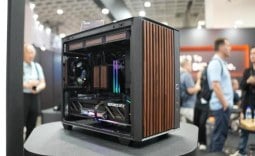 ID Cooling shows off wooden PC cases and matching AIO coolers at Computex 2026
 Formula V Line's Ice Nova Pro 3 air cooler could be perfect for brass-themed PC builds
 SAMA's Computex 2026 lineup includes a curved-glass case and AIO coolers with swappable screens
 Master Chief crashes the Covenant's vacation in new Halo remake prequel missions
 Highlights from MSI's impressive 40th Anniversary Exhibition in Taipei
 Halo: Campaign Evolved PC requirements revealed, RTX 4080 and 32GB of RAM required for 4K 'Ultra' settings
 HP's new limited edition Ferrari laptop is made from carbon fiber and glass
 GeForce RTX 50 SUPER Series is now rumored to be coming in early 2027
 COLORFUL's new slim RTX 5070-powered iGame M15 and M16 Origo laptops automatically lock when you're away
 Apple is adding a Liquid Glass slider in iOS 27 after a year of user complaints about readability
 Navman MiVue Smart True 4K Surround Dashcam Review - Seeing In All Directions At Once
 IQUNIX Magi96 Pro Aluminum Low Profile Mechanical Keyboard Review - Premium Build, Satisfying Sound
 Asetek Forte S-Series Racing Simulator Bundle Review
 Razer Pro Type Ergo Wireless Split Ergonomic Keyboard Review - Built for Comfort and Support
 ASUS ROG Strix Morph 96 Wireless Gaming Keyboard Review - Great Performance, More Affordable
 SAPPHIRE Radeon RX 9070 GRE PULSE OC Review - A New 1440p Challenger Has Arrived
 NZXT H6 RGB+ Compact Dual-Chamber Chassis Review
 ASRock Radeon RX 9070 GRE Steel Legend Review - The RDNA 4 Mid-Range Reshuffle
 ASRock Z890 Taichi Aqua Motherboard Review - Flagship features without the flagship price
 GIGABYTE Z890I AORUS Ultra Motherboard Review - Mini-ITX with surprisingly good thermals
 The PowerToys utilities I keep enabled on every Windows 11 PC, and the ones I turned off within a week
 TweakTown's Best of Computex 2026 Awards - The Best Hardware, Gaming Gear, and AI
 Phison E37T SSD Controller Exclusive Preview - The Fastest DRAMless SSD Platform Yet
 USB Ports Not Working in Windows 11? Try These Fixes
 ASUS WiFi Routers and Networking Solutions Deliver Long-term Security and Reliability with No Additional Cost
 Second Monitor Not Detected in Windows 11? Try These Fixes
 Turn Your Old Smartphone Into a Dedicated Webcam for Your Windows PC
 The Send To menu is the right-click feature on Windows 11 that nobody bothers to customize
 Windows 11 will not let you pin a folder to the taskbar, but a 30-second workaround does
 ASUS ProArt Displays Unlock Creativity with Professional Monitors for Everyone