






Displays - Page 4
Display and projector news - gaming monitors, OLED panels, 4K projectors, and refresh-rate innovations from TweakTown. - Page 4
Stay Updated
Follow TweakTown for breaking tech news, reviews, and daily updates.


As an Amazon Associate, we earn from qualifying purchases. TweakTown may also earn commissions from other affiliate partners at no extra cost to you.
MSI unveils world's first Mini-LED gaming monitor at CES 2026
MSI has unveiled two new 5K gaming monitors at CES 2026, one is only capable of 75Hz at such a heavy resolution, but the other can push up to a 165Hz refresh rate.

CES 2026 is officially underway and MSI has showcased us two new gaming monitors it will be offering in 2026, the first the MAG 271KPD7, a 27-inch Rapid IPS dual mode gaming monitor that's capable of switching between 5K at 75Hz and 1440p at 300Hz. The 271KPD7 has a 0.5ms GtG response time, and 218 pixels per inch, making it an extremely impressive display purely based on image clarity.
The 271KPD7 also comes with an array of connectivity options, such as 2x HDMI 2.1 inputs, 1x DisplayPort 1.4a, 1x USB-C Type-C with 15W PD, 2x USB 5Gbps Type-A ports, 1x USB-B 5Gbps, and 1x headphone jack. The more premium model of the two is the MPG 271KRAW16, which is the display that MSI has claimed is the world's first 5K Mini-LED gaming monitor.
Continue reading: MSI unveils world's first Mini-LED gaming monitor at CES 2026 (full post)
MSI pulls back the curtain on 5th generation QD-OLED gaming monitors at CES 2026
MSI has kicked off CES 2026 with a new generation of QD-OLED technology, marking the 5th iteration of the pixel technology.

MSI debuted the new QD-OLED panel generation with the MPG 341CQR X36, a 34-inch ultra wide that rocks a 3440 x 1440p resolution maximum refresh rate of 360Hz. The 341CQR X36 is debuting MSI's new RGB Stripe sub-pixel layout, which is a new design of how the sub pixels are arranged within an individual pixel. The introduction of Tandem OLED utilizing RGB Stripe technology is to improve color fringing and significantly enhance the clarity of text.
In addition to better color reproduction, the 341CQR X36, alongside the MEG X, will be receiving DarkArmor film, a new technology that is designed to absorb light and improve the deepness of blacks. MSI explains the film reduces purple or reddish tints that are commonly found across QD-OLED panels, and that it estimates the film can improve pure black levels by up to 40%. By reducing the black levels and significantly improving contrast MSI estimates DarkArmor film monitors will deliver superior image performance.
MSI's MEG X is an OLED monitor equipped with AI-powered gaming hacks
MSI has unveiled the MEG X gaming monitor at CES 2026, and the QD-OLED ultrawide display isn't just easy on the eyes, it is also equipped with an array of AI-powered features designed to assist a user while gaming.

The MEG X was unveiled alongside the MPG 341CQR QD-OLED X36, with both of these new ultrawide gaming monitors rocking MSI's 5th generation QD-OLED panel that has taken advantage of Tandem OLED technology, resulting in improved color reproduction and accuracy. The MEG X is MSI's flagship gaming monitor, and comes with a suite of AI functions such as AI Tracker, AI Vision+, and AI Goggle.
Each of these features has a different impact on gameplay, with AI Tracker highlighting in-game characters, or AI Scope that automatically zooms in on targets for precision with optional Night Vision. There is also AI Goggle, a feature dedicated to improving the recovery time from flashbangs. Additionally, the MEG X comes with a SpectrumBar on the chin of the display. This light bar can be synced with an in-game status, such as health or stamina.
Continue reading: MSI's MEG X is an OLED monitor equipped with AI-powered gaming hacks (full post)
NVIDIA-powered gaming monitors now automatically adapt like a smartphone
NVIDIA has unveiled G-Sync Pulsar at CES 2026, and besides being able to turn 360Hz refresh rate monitors into 1000Hz refresh rate displays, Pulsar also comes with G-Sync Ambient Adaptive Technology.

The Ambient Adaptive Technology is very similar to the technology within most smartphones that automatically changes the brightness on a screen depending on the ambient lighting hitting the display. An example of this would be the screen brightness reducing when entering a dark room and then increasing when using the device in direct sunlight.
NVIDIA's Ambient Adaptive Technology brings those same principles to gaming monitors, with the technology being able to adjust the brightness and temperature of the colors the monitor is displaying based on the ambient lighting of a room. Every G-Sync Pulsar monitor will come with Ambient Adaptive Technology, which adds a sensor to the display that detects the level of brightness in the room and will adjust the brightness and color temperature of the display accordingly.
NVIDIA transforms 360Hz gaming monitors into 1000Hz displays with G-Sync Pulsar
NVIDIA has unveiled G-Sync Pulsar, a new display technology coming to select 27-inch 1440p 360Hz panels, which NVIDIA claims achieves motion clarity performance equivalent to 1000Hz refresh rate displays.

NVIDIA explained during a press briefing that G-Sync Pulsar is one of the company's latest and most impressive technologies it's releasing at CES 2026. Pulsar is launching with select monitor brands such as Acer, AOC, ASUS, and MSI. The feature will be exclusive to 27-inch IPS WQHD 2560 x 1440p 360Hz refresh rate models, and availability is set right after CES 2026.
So, how does Pulsar actually work and how can it take a 360Hz monitor and make it feel like a 1000Hz monitor? NVIDIA explains Pulsar introduces a rolling backlight that when a single frame is produced initiates a scan when a frame is generated. Traditionally, during a scan out in VRR backlight strobing blur can be produced as the image within frames does not perfectly line up with the previous and next few frames, which is perceived as a blur effect.
ASUS expands OLED gaming monitor capabilities in new CES 2026 lineup
ASUS ROG has unveiled its new line up of products scheduled to be showcased at CES 2026, and three of them are brand new OLED gaming monitors that are pushing the envelope forward for the pixel technology.

Introducing the ROG Swift OLED PG27UCWM and PG34WCDN, two new QD-OLED gaming monitors that have received the Tandem RGB OLED upgrade, improving color reproduction and accuracy. For example, the PG27UCWM, a 27-inch QD-OLED gaming monitor that can either run in 4K 240Hz or 1080p at 480Hz, features the Tandem RGB OLED strip introduces improvements to the subpixel layout of the panel, resulting in sharper text edges and much more accurate color reproduction.
Additionally, Tandem RGB OLED introduces higher brightness levels for both color and white light, while also maintaining consistent brightness levels across the panel. ASUS explains the result of the Tandem OLED is no color fringing, distortion, or image sticking. The PG34WCDN also comes with the RGB strip, which ASUS claims can deliver a 27% larger color volume, especially at higher luminance levels.
Continue reading: ASUS expands OLED gaming monitor capabilities in new CES 2026 lineup (full post)
LG unveils the world's thinnest True Wireless OLED TV at CES 2026
LG is kicking off CES 2026 with something undeniably impressive, the Wallpaper TV, a paper-thin OLED TV that was first released in 2017, but is now back six years later with the new and improved W6.

LG fired off a press release that explained the company has reengineered the internal architecture of the Wallpaper TV, beginning with the lengthy process of reducing the size of components down to miniature levels. By successfully shrinking internal components, LG was able to reduce the width of the display to just 9mm, making the Wallpaper TV the world's thinnest True Wireless OLED TV.
LG explains the existence of the Wallpaper TV is to prove that thin silhouette design doesn't require a sacrifice in the viewing experience. Paired with its thin design is the integration of Brightness Booster Ultra, which LG writes is capable of achieving luminance levels up to 3.9 times brighter than typical OLED panels. Powering this impressive TV is the new Alpha 11 AI processor Gen 3, which features a new Neural Processing Unit (NPU) that is 5.6 times more powerful than LG evo TVs released last year.
Continue reading: LG unveils the world's thinnest True Wireless OLED TV at CES 2026 (full post)
Samsung unveils gigantic 130-inch Micro RGB TV at CES 2026: near IMAX feels, but at home
Samsung has just unveiled its 2026 family of Micro RGB, QLED, and OLED TVs, with a new gigantic flagship 130-inch Micro RGB TV. Check it out:

The new Samsung 130-inch Micro RGB TV (R95H) is the largest Micro RGB display ever released, features a Timeless Frame, and a handful of internal hardware innovations including Micro RGB AI Engine Pro, Micro RGB Color Booster Pro, and Micro RGB HDR Pro.
Samsung says that the new AI features will enhance dull tones and refine contrast, providing more vivid color and increased realistic detail for an even more immersive viewing experience. The huge 130-inch Micro RGB TV also includes Samsung's proprietary Glare Free technology, which minimizes reflections, further preserving clear color and contrast in a bunch of different lighting conditions for another leap in viewing experience.
HKC launches the world's first 1080Hz gaming monitor, for intensive 1080FPS gaming
Chinese monitor manufacturer HKC has just redefined the competitive esports gaming monitor with the launch of the ANTGAMER ANT275PQ MAX, the world's highest refresh rate 1440p LCD monitor, allowing an insane 1080Hz refresh rate.

The upgraded ANTGAMER ANT257PQ MAX features a native 1440p resolution @ 540Hz refresh, but can drop down to 720p @ 1080Hz, meaning you're going to want to make sure you have the most powerful GPU you can afford, in order to push upwards of 1080FPS+ even if it is at 720p.
HKC is using a "FAST TN" panel for the new 1080Hz gaming monitor, with the ANTGAMER ANT257PQ MAX gaming monitor when used in its 1080Hz FHD mode, uses AI-powered image processing for extreme-speed FPS performance. The company will have its new 1080Hz gaming monitor beast on display at CES 2026, and the TweakTown team will be there hoping to get some hands- and eyes-on with the 1080FPS+ gaming monitor behemoth.
LG teases new Tandem WOLED panels: new 39-inch 5K ultrawide, 27-inch 4K panel coming in 2026
LG Display has teased its upcoming 2026 roadmap video that shows off a new 39-inch ultrawide immersive 5K and 27-inch 4K panel that both use its new Tandem WOLED panel.

We should expect LG to properly unveil its new monitors at CES 2026 in Las Vegas in the first few days of 2026, with the new 39-inch 5K panel expected to feature a 5120 x 2160 resolution (around 142 PPI), which means it'll look around as sharp as high-end 31.5-inch 4K monitors on the market.
LG should be using an easier-on-the-eye 800R curvature that it used on previous 34-inch and 39-inch ultrawide WOLED panels, and on its bigger 45-inch 5K2K WOLED displays. The less aggressive curve on the 39-inch panel should look very nice in the flesh, and I can't wait to get some hands on (well, eyes on) at CES 2026.
Samsung unveils new 6K glasses-free 3D gaming monitor, world's first 1040Hz display, and more
Samsung has just unveiled a slew of new 2026 gaming monitors, including the industry's first 6K glasses-free 3D gaming monitor with a blistering 1040Hz refresh rate, and more. Check them out:

The new Samsung Odyssey G9, Odyssey G6, and trio of new Odyssey G8 gaming monitors include technologies that simply "weren't possible" last year says Hun Lee, Executive Vice President of the Visual Display (VD) Business at Samsung Electronics, who added: "With this year's Odyssey lineup, we're introducing display experiences that simply weren't possible even a year ago. From the industry's first 6K glasses-free 3D monitor to breakthrough 1,040Hz speed, we designed these monitors to meet the ambitions of today's gamers and deliver a level of immersion that fundamentally changes how content looks and functions on screen".
Starting with Samsung's new Odyssey 3D G9 gaming monitor, which is the world's first 3D 6K gaming monitor, which features a 32-inch IPS-based 6K panel with real-time eye-tracking technology to adjust the depth and perspective in visuals depending on the users' viewing position. The new Odyssey 3D G9 gaming monitor features a dual-mode configuration, switching behind native 6K @ 165Hz and 3K @ 330Hz with a 1ms GTG response time.
Microsoft's Copilot AI is automatically installed on LG TVs and can't be removed
LG previously announced it would integrate Microsoft Copilot into its webOS platform for its TV lineup. Still, there hasn't been any indication of when this might happen. However, if, like us, you've got one of LG's impressive OLED TVs, you might have noticed that Microsoft Copilot has been added to the app lineup as part of a recent webOS update that rolled out globally last week.

As spotted by 'defjam16' on the aptly-titled 'mildlyinfuriating' thread on Reddit, a Microsoft Copilot app is not only automatically installed as part of the latest webOS update, but it can't be removed. This is something we've verified, but we've also noticed that the Copilot app simply opens a browser interface so you can interact with the AI assistant.
Naturally, a new app you can't remove (and a Microsoft AI one at that) has been met with backlash from several LG TV owners, who wonder why Copilot is showing up next to the apps they actually use, like Netflix and YouTube.
Corsair's popular XENEON EDGE second screen is now available in Atomic Purple and White
Corsair's XENEON EDGE 14.5″ LCD Touchscreen is a versatile second screen with a five-point capacitive multi-touch touchscreen, 2560x720 native resolution, and a 60 Hz refresh rate. With the XENEON EDGE's USB Type-C with DisplayPort Alt Mod, full-sized HDMI port, and its ability to sit on your desk, next to your display, or in your PC case, it's no wonder the portable display sold out almost immediately when it debuted earlier this year.

In fact, the Corsair XENEON EDGE has quickly become an incredibly popular add-on thanks to its ability to serve as a second display for real-time monitoring of PC hardware like CPUs, GPUs, cooling, and storage, as well as a dedicated, compact window for communication apps or as a dedicated window for the Virtual Stream Deck. With its AHVA panel optimized for text and images, and its wide viewing angle, clarity is one of the XENEON EDGE's key features.
And now we can add multiple colorways to the list, as Corsair has announced it's releasing two new variants: Atomic Purple and White. "These finishes give PC builders, enthusiasts, and creators more ways to personalize their setups while retaining the same compact, versatile display that has become a favorite for system monitoring and customization," Corsair writes in the announcement.
ASUS claims the #1 position in OLED monitor market share with 21.9%
ASUS has announced that it has claimed the No. 1 position in global OLED monitor market share, which has surged throughout 2025, to a leading 21.9% market share.

In a report from TrendForce on November 18, we learned that global OLED monitor shipments hit 644,000 units in Q3 2025, which is up 12% quarter-over-quarter, and up 65% year-over-year. TrendForce also projects that total 2025 OLED monitor shipments will hit 2.62 million units, representing 84% growth from 2024.
ASUS announced: "ASUS today announced that it has claimed the No. 1 position in global OLED monitor market share, following a surge in sales throughout 2025. According to independent market research firm TrendForce, ASUS now holds an estimated 21.9% share, surpassing competitors and cementing its leadership in this fast-growing market".
Continue reading: ASUS claims the #1 position in OLED monitor market share with 21.9% (full post)
HKC teases the world's first RGB Mini-LED monitor, expect it to debut at CES 2026 in January
HKC teases its next-gen RGB Mini-LED technology that will be presented to the world at CES 2026 in a few weeks time, using new RGB Mini-LED tech that will unleash ultra-bright, ultra color-accurate displays, overcoming the limitations of conventional Mini-LED technology.

The Chinese display maker has introduced what it's calling "the world's first" RGB Mini-LED display, but we did see Hisense launch its massive 116-inch RGB Mini-LED TV at CES 2025 at the beginning of the year, but HKC will use the new RGB Mini-LED technology inside of new gaming monitors in 2026. This is how RGB Mini-LED technology differs from regular Mini-LED tech:
If we compare this to Hisense RGB Mini-LED tech that has over 20% more color volume, even when compared to high-end QD Mini-LED displays, that shows that RGB Mini-LED tech should rival OLED and its advantages.
Philips unveils new 27-inch dual-mode gaming monitor: 1440p at 500Hz or 720p at bonkers 1000Hz
Philips has just unveiled a monster new gaming monitor with the introduction of the new EVNIA 27M2N5500XD, which sports a 27-inch panel with a native 1440p resolution @ 500Hz refresh rate, but with its Dual-Mode function, it can switch to 720p at an incredibly fast 1000Hz refresh.

Philips' new EVNIA 27M2N5500XD gaming monitor was recently shown off at an event in China, where it was shown off alongside AOC's new AGON AGP277QK -- which uses a similar dual-mode panel -- with both of the gaming monitors designed for competitive PC gamers who want motion clarity and input lag over image detail (resolution).
The 27-inch panel on its regular setting will provide 1440p @ 500Hz, which is great for most people, but for the bleeding-edge users and gamers who want nothing but speed: 720p @ 1000Hz is going to feel incredibly smooth. Chinese media reports that the new Philips EVNIA 27M2N5500XD gaming monitor features a 1ms GtG response time, and a 2000:1 static contrast ratio, meaning we're looking at an IPS panel (OLED would be great in the future).
Samsung's HDR10+ Advanced TVs to offer up to 5,000 nit brightness
HDR, or High Dynamic Range, is now commonplace in modern smart TVs, offering brighter images with more realistic color and generally more detail. Samsung, the company behind the popular HDR10+ format, has just announced HDR10+ Advanced, featuring new features and technologies for movies, TV shows, and games.

One of the new features is called HDR10+ Bright, which adds new metadata to images to enable displays to better render tonal differences in the source, resulting in an overall brighter HDR output. Like HDR10+ before it, HDR10+ Advanced will be open for display makers and platforms like Prime Video (which has already signed on to adopt the new tech) to integrate, with Samsung's next-generation of TVs set to include HDR10+ Advanced with additional AI tools and algorithms that will offer a peak brightness of up to a massive 5,000 nits.
Although this brightness relates to HDR intensity and not the overall uniform brightness of a display, it's more than enough to make whatever takes advantage of this level of HDR10+ Advanced brightness visible in bright daylight. Samsung also notes that with HDR10+ Bright, its next-generation TVs will deliver 100% of the BT.2020 color spectrum, which is the industry standard for mastering 4K and 8K HDR content.
Continue reading: Samsung's HDR10+ Advanced TVs to offer up to 5,000 nit brightness (full post)
ASUS showcases world's fastest OLED gaming monitor
ASUS has unveiled what is now considered its best OLED gaming monitor when it comes to refresh rates. Introducing the ROG Swift OLED PG27AQWP-W, a new 26.5-inch dual-mode OLED gaming monitor capable of reaching a 720Hz refresh rate.

The PG27AQWP-W was first unveiled at Gamescom 2025, and then we heard ASUS was quietly preparing to launch the new dual-mode monitor in China, where the company unveiled a brief list of enticing specifications. Now, ASUS has updated its website with a full specification list, showcasing what it has put under the hood of the PG27AQWP-W.
The upcoming monitor takes advantage of LG's cutting-edge 4th generation Tandem WOLED technology, which boosts peak brightness by 15%, increases color volume by 25%, and extends the life of the panel by 60% when compared to previous WOLED generations.
Continue reading: ASUS showcases world's fastest OLED gaming monitor (full post)
AOC to announce 2026 gaming monitors: 1440p @ 500Hz and a 1080p with an insane 1000Hz refresh
AOC is reportedly gearing up to unveil a slew of new gaming monitors at CES 2026, including a new 27-inch 1440p @ 500Hz with dual-mode switching to 1080p at an insane 1000Hz refresh rate.

In a new report from ITHome that cites "VisionTang", we can expect AOC to unveil 6 new AGON gaming monitors in the new year, which we presume could be teased at CES 2026 in Las Vegas in January. There would be five new 27-inch gaming monitors, and a smaller 24.5-inch TN panel unveiled.
AOC is expected to unveil a slew of new gaming monitors in 2026, including a 27-inch 5K @ 165Hz that also features a 1440p @ 330Hz dual-mode functionality, while it will release a high-end 27-inch 4K @ 160Hz that has "dual-mode with AI". Then comes the super-exciting model, with a 27-inch 1440p @ 500Hz and its dual-mode switching to 1080p @ 1000Hzrefresh, which will be incredible to see in the flesh.
TCL's massive OLED factory will see the arrival of more affordable displays
OLED panel technology is quickly becoming the gold standard for displays used for entertainment. Whether that's gaming on a PC at a high refresh rate at 1440p, 4K, or an ultrawide resolution, or sitting back on a couch playing Ghost of Yotei in 4K on PlayStation 5, OLED displays are a game-changer. From their near infinite contrast levels to color accuracy and response times, OLED panels present a massive step up for getting immersed in games, movies, and everything else.

In recent years, OLED displays using panel technology from companies like Samsung and LG have become increasingly affordable, and this trend is expected to continue. According to a new report (via flatpanelshd), TCL has begun construction on a new multi-billion OLED production facility in Guangzhou, China, for its 8.6-generation OLED technology.
These panels will use a "novel inkjet printing method" for manufacturing, which is a world first. Apparently, this will reduce manufacturing costs by around 20%, delivering high-performance and energy-efficient OLED panels for "tablets, laptops, and monitors."
 OLED buyer becomes victim of Amazon scam, receives broken 240Hz OLED screen instead of 540Hz OLED they initially ordered
 Google taps MediaTek to build its next Triggerfish TPU chip launching in 2027
 Samsung announces world's first UFS 5.0 chip with 10.8 GB/s read and 9.5 GB/s write speeds
 GTA 6 will feature a story chapter system like Red Dead Redemption 2
 AMD confirms Adrenalin 26.6.2 driver fails to launch on Windows 10, recommends rolling back
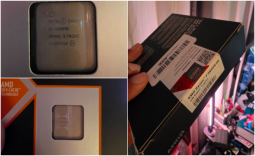 User receives Intel Core i9-10900K in sealed AMD Ryzen 7 9800X3D box from Amazon in CPU swap scam
 GTA 6 'plays best' on PS5, Sony confirms PS5 Pro enhancements
 GTA 6 is a 'singleplayer experience,' GTA Online may be sold separately
 Rockstar confirms GTA 6's price, no physical disc version
 Ausom discounts three electric scooters by up to $100 in new soccer promotion
 Dell XPS 14 (2026) Laptop Review - Premium Quality, Impressive Performance
 Ocypus Sigma F36 BK ARGB Cooling Fan Review: high airflow and unified design in one frame
 PCCooler CPS RZ820 Display Review: a flagship-level CPU air cooler with an LCD screen
 UGREEN FineTrack Mini 2 Air Tracker Tag Review - Long battery life, lesser performance
 Speed Racer (2008) 4K Ultra HD Blu-ray Review: a stunning remaster of the cult classic
 MOAIPLAY ORA PRO G1 850W ATX 3.1 PSU Review: high efficiency and 10-year warranty for $119.99
 Navman MiVue Smart True 4K Surround Dashcam Review - Seeing In All Directions At Once
 IQUNIX Magi96 Pro Aluminum Low Profile Mechanical Keyboard Review - Premium Build, Satisfying Sound
 Asetek Forte S-Series Racing Simulator Bundle Review
 Razer Pro Type Ergo Wireless Split Ergonomic Keyboard Review - Built for Comfort and Support
 Level Up Your PC Gaming with these Fantastic ASUS Prime Day Deals on GPUs, Motherboards, and More
 GIGABYTE Wants to Kickstart Your New Gaming PC or Upgrade with These Limited-Time Deals
 7 Windows settings to change right after installation for better privacy, security, and performance
 I stopped Windows 11 notifications from interrupting me with Do Not Disturb, Focus, and a priority list
 7 ways to transfer data from Android to Windows PC quickly and easily
 I read the Windows Backup app screen carefully, and it does not back up what most people think
 Low Sound Volume on Windows 11? How to fix audio issues and restore normal volume
 8 Critical Warning Signs You Should Never Ignore in Windows 11
 This Windows security feature protects Documents from ransomware, but it is off by default
 Windows 11 already has a voice typing tool, and it is the one most people are not using