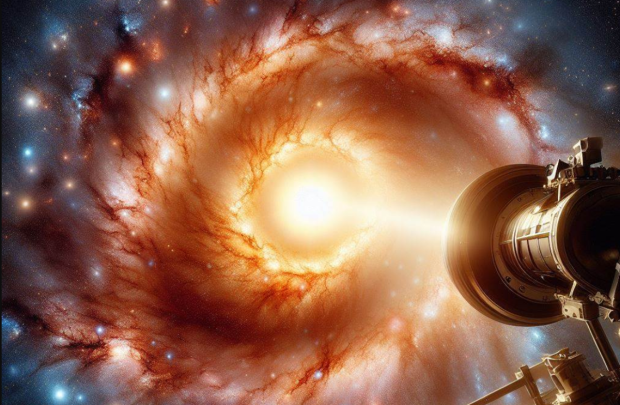




The world's most powerful space telescope, the James Webb Space Telescope, has pointed its extremely sensitive infrared instruments at the heart of a galaxy that's teeming with newly born stars.
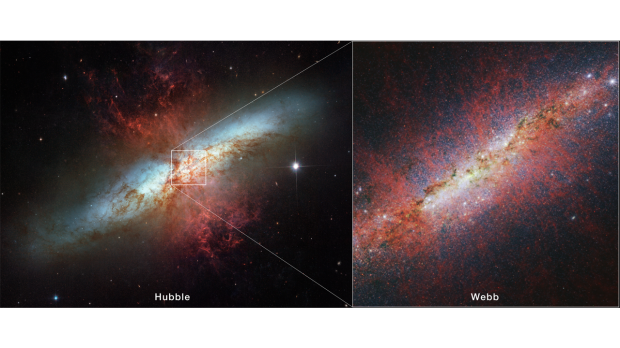
NASA's Webb telescope captured the Cigar Galaxy, scientifically known as Messier 87 (M87), to capture the region of space in gorgeous high detail. M87 is located 12 million light years away from Earth within the constellation Ursa Major, and according to NASA this region of space is forming stars 10 times faster than our own galaxy the Milky Way. M87 was captured with Webb's infrared instruments, giving researchers a new look into the heart of the region of space that other telescopes typically can't see due to it being obscured by dust and gas.
Infrared light is able to penetrate the dust and gas, making Webb an incredible telescope to see further in space than ever before. The different colors seen in the above image represent different aspects of the galaxy. For example the dark, reddish-brown colors represent dust, while the green specks indicate the presence of iron leftover from supernovas, or stars that run out of fuel and end their in a violent explosion.
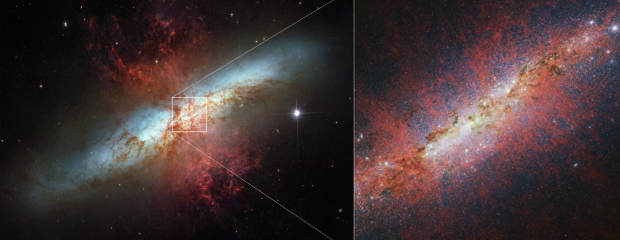
The red patches show molecular hydrogen being heated by radiation emitted by young stars. As for the white, every single spec of white light seen in the image is either a star or a star cluster.
"This image shows the power of the JWST," team member and University of Arizona scientist Rebecca Levy said in the statement. "Every single white dot in this image is either a star or a star cluster. We can start to distinguish all of these tiny point sources, which enables us to acquire an accurate count of all the star clusters in this galaxy."
"With these amazing JWST images and our upcoming spectra, we can study how exactly the strong winds and shock fronts from young stars and supernovas can remove the very gas and dust from which new stars are forming," team member and European Space Agency (ESA) scientist Torsten BÜker said in the statement. "A detailed understanding of this 'feedback' cycle is important for theories of how the early universe evolved because compact starbursts such as the one in M82 were very common at high redshift."
![Photo of the $25 PlayStation Store Gift Card [Digital Code]](https://m.media-amazon.com/images/I/41cEZpeUA1L._SL160_.jpg)