









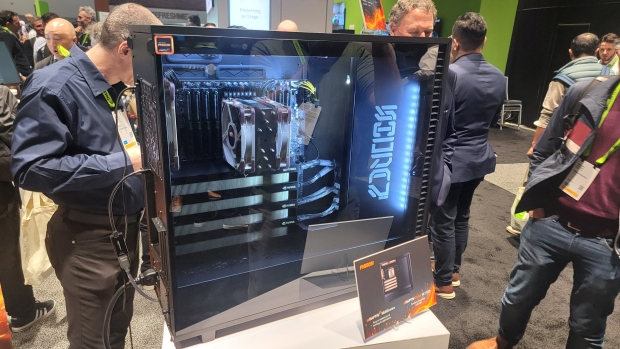




Phison had something very cool to show off at NVIDIA GTC 2024 last week, with a single MAINGEAR PRO AI workstation PC packing 4 x NVIDIA RTX 6000 Ada workstation GPUs using its in-house aiDaptiv+ software to use SSDs and DRAM to make up for the lack of VRAM, using it to super-speed AI workloads on the cheap.
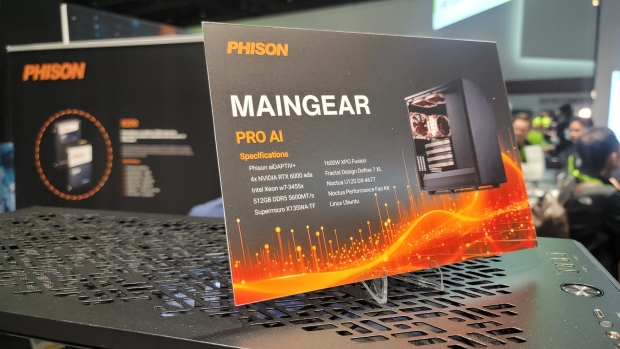
By cheap, we mean cheaper than using full-fledged NVIDIA Hopper H100 or new H200 AI GPUs, let alone the next-gen Blackwell B100 and B200 AI GPUs that will be very hard to come by this year, and a huge chunk into 2025. Phison's aim with its aiDaptiv+ platform is to lower the (cost) barrier of AI LLM training by using systems' already-there DRAM and SSDs to augment the amount of GPU VRAM available for AI training.
Phison says that achieving intense generative AI training workloads at a far lower cost than using standard GPUs will come at a cost: reduced AI training performance and longer training times. If you want the best, you'll spend magnitudes more money on it, but more off-the-shelf AI systems from the likes of MAINGEAR and its PRO AI system, putting Phison's new aiDaptiv+ platform in between is a big win.
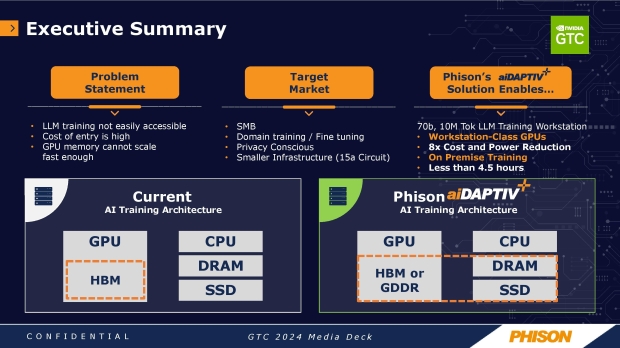
With customers like small and medium-sized businesses and companies without hundreds of millions, and sometimes billions of dollars for high-end DGX AI GPU workstations from NVIDIA, AI training upgraded through SSDs and DRAM already in the system is very appealing. There are huge cost savings involved, with aiDaptiv+ speeding along the process.
Phison showed off a demo of its aiDaptiv+ platform running on a MAINGEAR PRO AI workstation PC at GTC 2024 last week, with its 4 x NVIDIA RTX 6000 Ada workstation GPUs running a gigantic 70 billion parameter model. Phison estimates that the size to train 70 billion parameters is around 1.4TB/sec VRAM used through a massive 24 x GPU system across 6 x servers in a server rack.
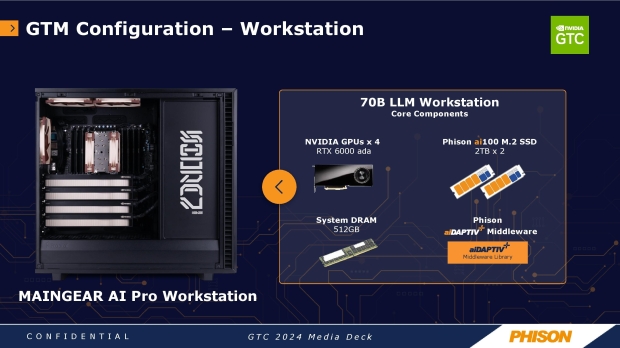
This is a lot of hardware, power, and cooling that needs to be worked out, with Phison's new aiDaptiv+ system acting as as middleware software library that the company says "slices" off layers of the AI model from the VRAM that isn't actively being computed, and shoots them over to the system DRAM.
From there, the data can stay on the DRAM, or, if it's needed sooner, it can be sent over to the SSDs if they've got a lower priority. The data is then recalled and shifted back over to the VRAM on the GPU for computation tasks as required, with the newly-processed layer flushed to the DRAM and SSD to make room to process the next layer.
MAINGEAR used its new PRO AI workstation PC for Phison's new aiDaptiv+ platform test, powered by an Intel Xeon W7-3435X processor, 512GB of DDR5-5600 memory, and two specialized Phison SSDs in 2TB. MAINGEAR starts the pricing of its PRO AI workstation at $28,000 with a single GPU, or up to $60,000 if you equip it with a monster 4-way RTX 6000 Ada workstation GPU.

Phison's new aiDaptiveCache ai100E SSDs are found in the regular M.2 form factor, but are specially designed for caching workloads. We don't know much about the new SSDs, but we do know they pack SLC flash that improves performance and endurance, with the drives rated for 100 drive writes per day over 5 years.
The new aiDaptive+ middleware sits beneath the Pytorch/Tensor Flow layer, with the company adding that its middleware is transparent and doesn't require any modifications of the AI applications that owners will use.


 Phison president promises AI training and AI tuning with a $50K workstation system
 Phison's world-first 6nm AI computing SSD solution wins Best Choice Golden Award at Computex
 AMD preps China-specific AI chip to battle NVIDIA, Huawei: cut-down Radeon AI PRO R9700 rumored
 NVIDIA RTX PRO 6000 Blackwell GPU leaks: 24064 CUDA cores, 96GB GDDR7, nearly a new TITAN GPU
 A mystery NVIDIA Blackwell GPU with insane 96GB of GDDR7 on a 512-bit bus has been spotted
 Iconic N64 shooter GoldenEye 007 is getting a native PC port
 Diablo 4 is coming to the Switch 2 with both expansions in a special Age of Hatred Collection
 CXMT DDR5 memory hits 9,000 MT/s speed milestone on AMD AM5 motherboard
 Sony says PlayStation 6 release date and pricing are still up in the air
 Lexar's DRAM-less Thor Ultra series PCIe Gen 5 SSDs are built for desktop and laptop PC gaming
 Gaming monitors are next in line for a price hike as manufacturers can no longer absorb costs
 Linux 7.2 makes TSC support mandatory for x86 CPUs, but it's not like Windows 11's TPM 2.0 check
 ChatGPT can now build a timeline of everything you do on your Mac
 Redditor finds a working RTX 2080 Super in the dump, gets a huge free upgrade
 Redditor sends a gaming laptop with 64GB RAM for repair, comes back with 32GB RAM
 ASUS ROG Strix XG129C Review: A $199 Gaming Monitor You Don't Play Games On
 Cooler Master HAF II 500 Mid-Tower Chassis Review
 Corsair HS35 v3 Wireless Gaming Headset Review - An Affordable Winner
 D-Link F518 5G Wi‑Fi 6 AX1800 Mobile Hotspot Review: All-Day Mobile Hotspot
 Bose Lifestyle Ultra Speaker Review - Impressively Detailed Room-Filling Sound
 MSI Z890 Gaming Plus WIFI6E Review - Z890 for under $200
 Mortal Kombat (1995) 4K Ultra HD Blu-ray Review
 CPS PCCOOLER YS1200 ATX 3.1 80 PLUS Gold PSU Review
 ASRock X870E Taichi White Review: a premium AM5 motherboard with 10G LAN and WiFi 7
 Asetek Initium Pedal Modular Upgrades Review
 Using Multiple Monitors? Change these Windows settings for a Better Experience
 Windows Sandbox is The Windows Security Feature Most People Never Use
 I ditched the Windows 11 context menu for this open-source tool, and here's why
 Windows 11 may be encrypting your drive already, and I checked where my recovery key went
 GIGABYTE's 40 Days of INFINITY celebrates 40 Years of Innovation with stunning GeForce RTX graphics cards and rewards
 I swapped File Explorer for this free file manager and finally got the layout I wanted
 How to tell if someone has been using your Windows PC without your permission
 6 Task Manager tips for troubleshooting Windows performance problems
 ASUS ROG's 20th Anniversary Line-up of Premium PC Gaming Gear has Arrived - Here's Everything You Need to Know
 Six File Explorer tips every Windows user should know