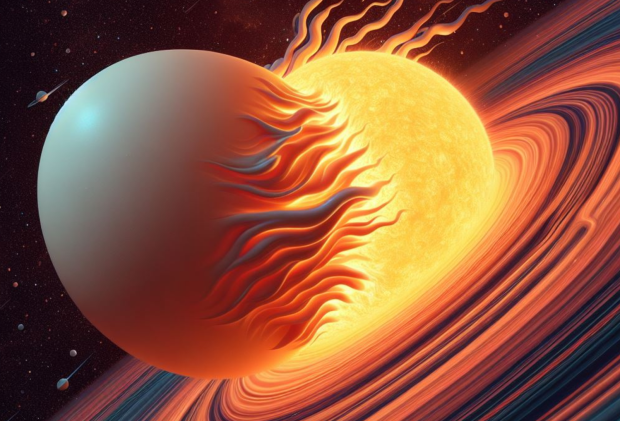




WASP-12b was originally discovered in 2008 and since then has been a point of interest for many astronomers around the world due to its strange and relatively close proximity to Earth.
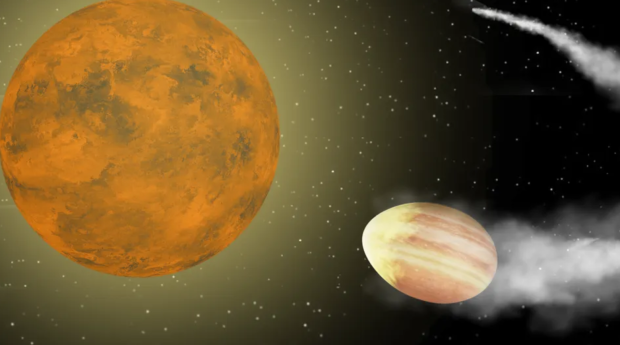
WASP-12b is an exoplanet orbiting its host star WASP-12, and the reason for its interest by astronomers is its strange egg shape and proximity of just 1,400 light years from Earth, which is close in astronomical terms. Additionally, astronomers have predicted that WASP-12b will eventually be consumed by its host star as its trajectory indicates a death spiral will occur, which will result in the exoplanet approximately twice the size of Jupiter being completely consumed by WASP-12.
Researchers previously estimated that WASP-12b would be consumed by its host star in approximately 10 million years, but new research suggests it will happen in just 3 million years. Notably, WASP-12b has such a narrow orbit that almost one year for the exoplanet, or one full orbit around its host star, is a single Earth day. Its extremely close proximity of just 2.1 million miles to its host star results in surface temperatures around 4,000 degrees Fahrenheit (2,210 Celsius) and such a strong gravitational pull from the star that it warps the exoplanet into an egg shape.
"According to our calculations, the planet will crash into the star [WASP-12] in just 3 million years, an incredibly short amount of time considering the star only appears to be 3 billion years old," said Pietro Leonardi, research lead author and University of Padova scientist told Space.com.
"When the planet inevitably crashes into the star, the first indication will be an outburst of luminosity, which will see the star become hundreds of times brighter than it is today," Leonardi said. "This increase will not last long and will quickly fade away. But maybe the humans of the future could be there to see it and study it."
![Photo of the $25 PlayStation Store Gift Card [Digital Code]](https://m.media-amazon.com/images/I/41cEZpeUA1L._SL160_.jpg)