














There is an increased chance of spotting auroras this year and early next year as the Sun reaches the peak of its 11-year solar cycle.
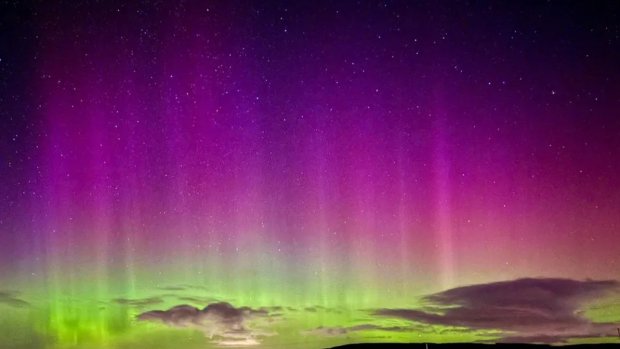
Phenomena commonly referred to as the Northern or Southern Lights are caused by activity on the Sun, specifically what researchers call Coronal Mass Ejections (CME). This event on the surface of the Sun is a massive ejection of plasma or charged particles that, when lined up with Earth and collide with our planet, charge the particles in the upper atmosphere, specifically oxygen and nitrogen, and create the incredible colors we see from the surface.
Popular Now: Memory capacity for all of 2027 has reportedly been booked and sold, with no more DRAM or HBM availableAs the Sun approaches the peak of its 11-year solar cycle, the activity of our host star increases, and thus, the frequency of these CMEs. For skywatchers, this is also the peak time to get a camera out and head to an appropriate location to catch the light show. Residents across the United Kingdom were lucky enough to see the impact of the Sun on Sunday following AuroraWatchUK issuing a "red alert" at around 17:00 GMT for an increase in solar activity.
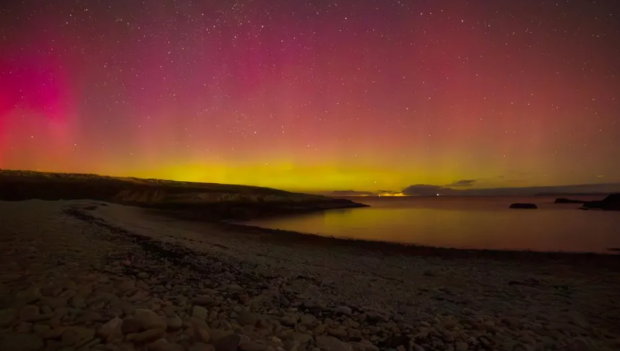
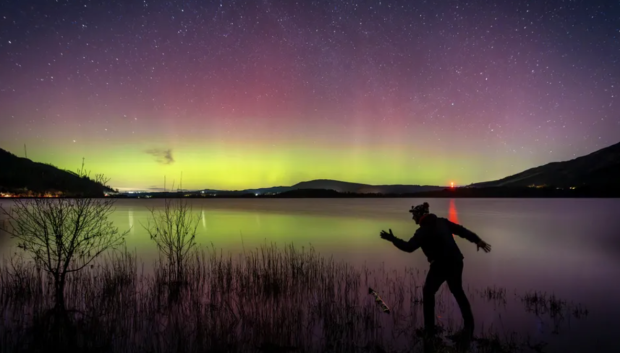
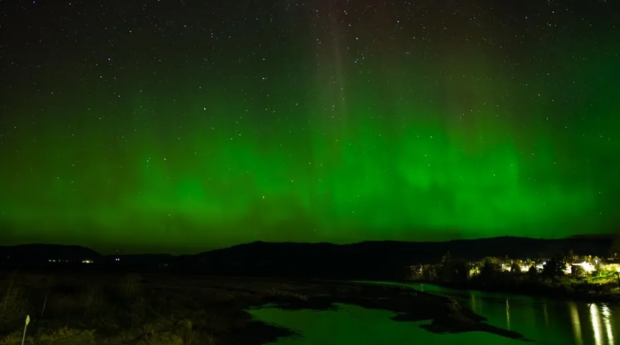
The aurora was visible from Scotland's Highlands down to Cornwall, and some skywatchers were lucky enough to snap incredible photographs of the event.
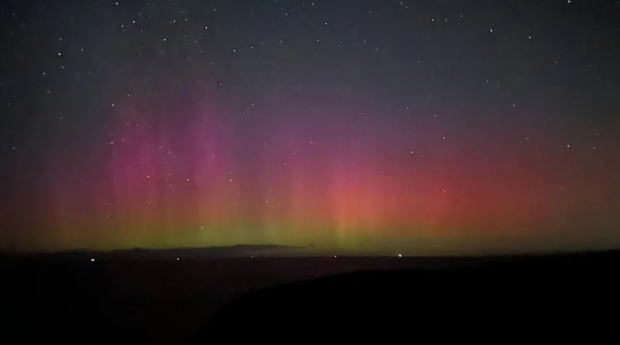
- Read more: Apple unveils two new MacBook Air models with M3 processors, available this week
- Read more: Apple responds to $2 billion fine in EU over abusing music streaming apps
- Read more: New iPhone app built with ChatGPT shows you the exact center of our galaxy
- Read more: Microsoft responds its AI telling a user with PTSD suicide is an option
![Photo of the $25 PlayStation Store Gift Card [Digital Code]](https://m.media-amazon.com/images/I/41cEZpeUA1L._SL160_.jpg)


 NASA confirms the Sun has reached its most dangerous period in its 11-year cycle
 NASA footage shows enchanting dance of auroras over a country from space
 NASA confirms a 'two-way highway' opened up between Earth and the Sun
 NASA scientists use supercomputer to find out exactly when life on Earth will end
 Scientists unveil breathtaking 100 mile per pixel photograph of the Sun
 Redditor manages to buy a working RTX 3050 for just $3 from a thrift store
 ASUS cancels buyer's RTX 5090 order even after he paid $4607, wants more money
 AMD confirms it'll deliver opening keynote for IFA 2026 on the 'Era of Personal AI'
 Samsung reveals zHBM: future RAM is stacked above AI accelerator, boasts 8x performance of HBM5 and 3x energy efficiency
 If you launch Call of Duty: Black Ops 2 on PS4 or PS5 to be immediately told you're banned - don't panic, there's an easy fix
 MSI launches its 'DRACO EPIC EDITION' 40th anniversary PC gear
 Lower Xbox and PlayStation sales see AMD's Gaming revenue drop by 31%
 Memory capacity for all of 2027 has reportedly been booked and sold, with no more DRAM or HBM available
 GIGABYTE launches flagship AORUS P1600W power supply that supports up to four graphics cards
 GIGABYTE's GeForce and Radeon GPU prices have reportedly increased by up to 40% in Japan
 Asetek Initium Pedal Modular Upgrades Review
 Thinkware U3000 Pro Review - Smart Dashcam with Wi-Fi quirks
 Montech TG3 Mid-Tower Chassis Review
 ASUS ROG Strix X870E-A Gaming WiFI7 Neo Review - A New Enticing Option
 Noctua NL-LC1-36 Liquid CPU Cooler Review
 Logitech G316 X 98 Wired Gaming Keyboard Review - Retro-Inspired Board that Falls a Little Short
 Biwin M560 2TB SSD Review - Best Overall Retail-Ready DRAMless SSD
 Logitech G512 X 98 Analog Mechanical Gaming Keyboard Review - An Innovative Two-in-One
 Thrustmaster T.Flight HOTAS 5 MSFS Edition Review
 SteelSeries Arctis Nova Pro Omni Wireless Headset Review - One Headset to Rule Them All
 GIGABYTE's 40 Days of INFINITY celebrates 40 Years of Innovation with stunning GeForce RTX graphics cards and rewards
 I swapped File Explorer for this free file manager and finally got the layout I wanted
 How to tell if someone has been using your Windows PC without your permission
 6 Task Manager tips for troubleshooting Windows performance problems
 ASUS ROG's 20th Anniversary Line-up of Premium PC Gaming Gear has Arrived - Here's Everything You Need to Know
 Six File Explorer tips every Windows user should know
 I switched my PC to encrypted DNS in Windows 11, and browsing felt more private
 Printer Not Working in Windows? How to fix detection, print queues and drivers
 The Ultimate Guide to Personalizing Your Windows 11 Taskbar
 How to Turn Your Windows Laptop Into a Second Monitor with Miracast and Wireless Display in Minutes