









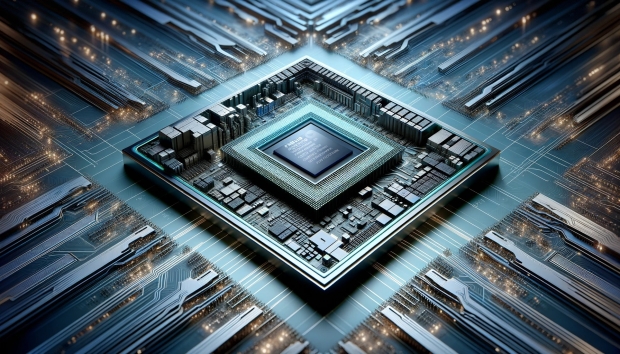




Samsung Foundry will be using its new SF2 (2nm-class) manufacturing process as its first with a backside power delivery network (BSPDN), according to the latest reports.
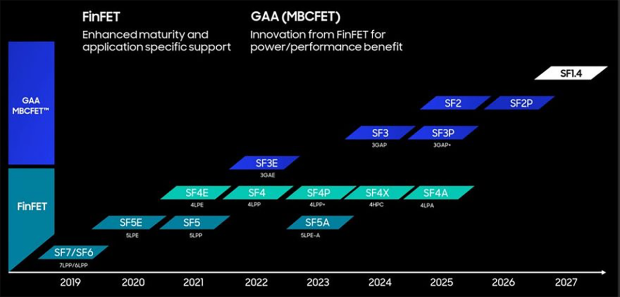
Chosun.com is reporting that the promising results that were achieved by using backside power delivery changed Samsung's thoughts on the technology, seeing the company rethink the use of BSPDN into a commercial process technology. Samsung was expected to introduce a backside power delivery network with its 1.7nm-class fabrication node, but it will arrive with its SF2 process node in 2025.
As Tom's Hardware points out: there is no 1.7nm-class nodes on Samsung's current roadmaps, where we can only see SF2, SF2P, and SF1.4 process nodes. Samsung has used two Arm-based test chips with backside power delivery, achieving a 10% and 19% die area reduction without telling the world which process node it's using.
- Read more: Intel unveils new Intel 14A process node, ready for future AI chip production
- Read more: Analyst: TSMC the world's biggest semiconductor maker by revenue
- Read more: Samsung wants to beat TSMC in 3nm manufacturing, 2nm coming in 2025
- Read more: Samsung to invest $151 billion into chip manufacturing through to 2030
Backside power delivery allows for thicker, lower-resistence wires, which are capable of delivering more power, and thus more performance, with less power used. Samsung's research paper saw that backside power delivery has benefits like a 3.6% Fmax improvement, a 2.4% standard block area reduction, and 1.6% standard block performance improvement.
Samsung getting backside power delivery into its upcoming SF2 process technology seems like a reaction to Intel's advancements with its Intel 20A and Intel 18A fabrication technology coming in 2025, and TSMC's upcoming N2P process that rolls off fabrication plant lines in 2026-2027.



 Apple 'not yet in talks with TSMC' to use bleeding-edge A16 process, no 1.6nm for Apple yet
 Intel announces its cutting-edge 18A process node has entered 'risk production'
 Intel 18A process is 'finally ready' with chips to tape-out in 1H 2025 to battle TSMC
 Intel's new Fab 52 is fully operational, capable of making advanced 18A chips on American soil
 Intel announces next-gen Core Ultra 300 'Panther Lake' CPUs launch in 2H 2025
 Linux support is coming to the reworked Epic Games Launcher, new app will run on Tauri instead of Unreal Engine
 Steam Frame launch is 'just around the corner,' VR game developer confirms
 Pokemon Pokopia becomes the Switch 2's second-best-selling exclusive
 The Witcher multiplayer project dubbed 'Sirius' hit with a new round of layoffs
 Xbox Elite Series 3 controller gets leaked with a built-in screen, quickly gets taken down
 Redditor improves his gaming laptop temps by 15C simply by changing the table
 Phantom Blade Zero on PC will launch with DLSS 4.5 and Ray Tracing on day one
 Razer announces its first Artisan Keycap with the Triple-Headed Snake Edition
 ZOTAC's 20th Anniversary Edition GeForce RTX 5080 features a titanium colorway and mirror-like backplate
 GeForce NOW app for Linux leaves beta, while DLSS Frame Generation cloud latency also improves
 Corsair HS35 v3 Wireless Gaming Headset Review - An Affordable Winner
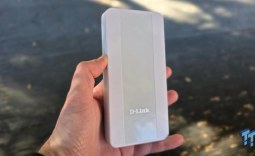 D-Link F518 5G Wi‑Fi 6 AX1800 Mobile Hotspot Review: All-Day Mobile Hotspot
 Bose Lifestyle Ultra Speaker Review - Impressively Detailed Room-Filling Sound
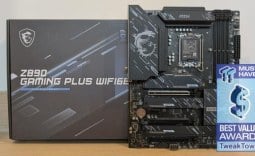 MSI Z890 Gaming Plus WIFI6E Review - Z890 for under $200
 Mortal Kombat (1995) 4K Ultra HD Blu-ray Review
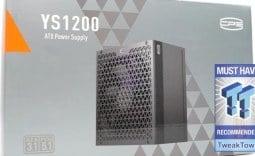 CPS PCCOOLER YS1200 ATX 3.1 80 PLUS Gold PSU Review
 ASRock X870E Taichi White Review: a premium AM5 motherboard with 10G LAN and WiFi 7
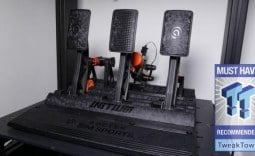 Asetek Initium Pedal Modular Upgrades Review
 Thinkware U3000 Pro Review - Smart Dashcam with Wi-Fi quirks
 Montech TG3 Mid-Tower Chassis Review
 I ditched the Windows 11 context menu for this open-source tool, and here's why
 Windows 11 may be encrypting your drive already, and I checked where my recovery key went
 GIGABYTE's 40 Days of INFINITY celebrates 40 Years of Innovation with stunning GeForce RTX graphics cards and rewards
 I swapped File Explorer for this free file manager and finally got the layout I wanted
 How to tell if someone has been using your Windows PC without your permission
 6 Task Manager tips for troubleshooting Windows performance problems
 ASUS ROG's 20th Anniversary Line-up of Premium PC Gaming Gear has Arrived - Here's Everything You Need to Know
 Six File Explorer tips every Windows user should know
 I switched my PC to encrypted DNS in Windows 11, and browsing felt more private
 Printer Not Working in Windows? How to fix detection, print queues and drivers