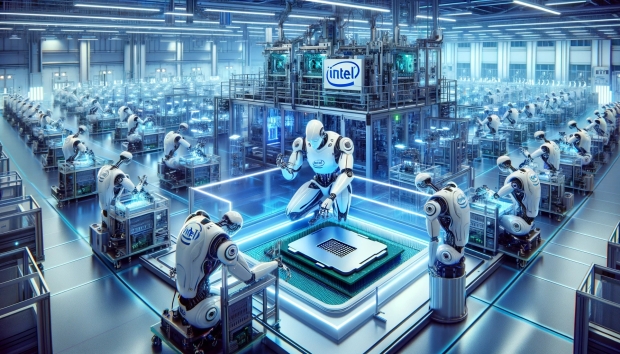





Intel has announced it plans to use AI in all of its foundries, from production flows, capacity planning, forecasting, yield improvements, and floor-level production operations, which will be done by AI and what it's calling "Cobots" of the future.
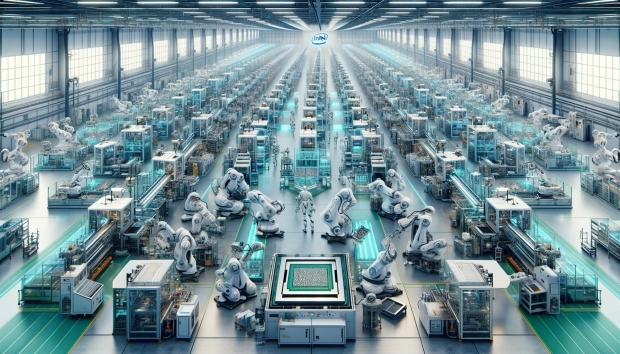
The company is referring to this as a "10X moonshot" program, where it wants to impact each and every segment of its operations in the future. Intel plans to use AI-powered Cobots, which will be robots that can work with humans side-by-side, as well as extensive robot automation in manufacturing. It won't happen overnight, but Intel is planning this "10X moonshot" for the future of AI-powered chip production.
NVIDIA first announced its "AI factories" in 2022, teaming up with Chinese manufacturer Foxconn on the AI factories project. NVIDIA CEO Jensen Huang said the "production of intelligence" would be the new wave of manufacturing, managed by huge AI-powered data centers filled with NVIDIA hardware, technologies, and software.
AI factories were teased as being built across the planet, with Foxconn handling that side of the AI factory business. NVIDIA and Foxconn were eyeing off making self-driving cars, where an AI-powered data center would handle everything from receiving, processing, and more. NVIDIA would power the AI factories with its new Grace Hopper DGX H200 Superchips.
- Read more: Intel unveils its new Intel 14A process node, ready for the future of AI chips
- Read more: TSMC: next-gen 1nm-class monolithic chips with 1 trillion transistors by 2030
- Read more: TSMC preps for 1nm production, next-gen facility in Taiwan
- Read more: Intel: 2026 until it beats TSMC at making the world's fastest chips
- Read more: Intel targets 1 trillion transistors on a single package by 2030
- Read more: Intel CEO: we want 1 trillion transistors in a single package by 2030
Intel announcing that robots helping out in chip-making factories is a different kind of cool, scary and exciting kinda cool. Firstly, it could hurt jobs in the area... robots can work 24/7 without a break, humans can't do that. Not only is it impossible for humans to work 24 hours a day, labor laws in most countries wouldn't allow it... unless you're in Japan and working on Nightless Castle, building TSMC's latest fab in Japan.