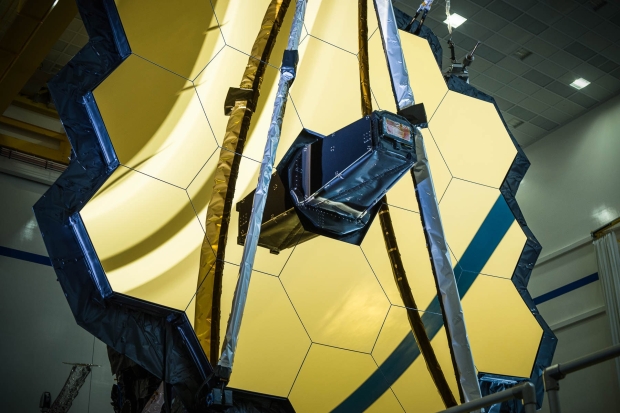




NASA's James Webb Space Telescope (JWST) has discovered a galaxy in the early universe that's so massive that its mere existence challenges current theories of the evolution of the universe.
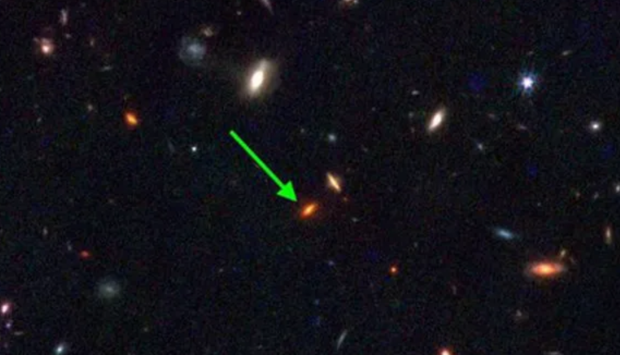
According to the authors behind the study, which has recently been published in the scientific journal Nature, astronomers diving through Webb's data discovered a galaxy called ZF-UDS-7329. This galaxy contains more stars than the Milky Way and formed just 800 million years after the occurrence of the Big Bang (13.8 billion years ago).
The discovery of this galaxy poses a "significant challenge" to current cosmological models of the formation of the universe as it appears the galaxy and its stars formed without dark matter due to the period of time in which the formation occurred - something that was previously thought impossible per current cosmological models. Study co-author Claudia Lagos explained early galaxies are typically believed to have formed through massive dark matter structures holding matter together, essentially seeding the emergence of a galaxy.
However, the authors behind the study analyzed light from the galaxy and found it to be 11.5 billion years old, with an even older population of stars within it, approximately 1.5 billion years older than the galaxy itself.
"The observation upends current modelling, as not enough dark matter has built up in sufficient concentrations to seed their formation," writes the team
The cosmic weirdness doesn't stop there as not only did this galaxy take shape without enough dark matter to make it possible, but after its abrupt sequence of star formation, the galaxy became quiescent, which means star formation halted altogether.
"This pushes the boundaries of our current understanding of how galaxies form and evolve," study co-author Themiya Nanayakkara, an astronomer at the Swinburne University of Technology in Australia, said in the statement. "The key question now is how they form so fast very early in the universe, and what mysterious mechanisms lead to stopping them forming stars abruptly when the rest of the universe is doing so."
![Photo of the $25 PlayStation Store Gift Card [Digital Code]](https://m.media-amazon.com/images/I/41cEZpeUA1L._SL160_.jpg)