




Intel has penciled in that it will be making the world's best chips later this year, beating TSMC, and teasing its next-gen Intel 14A process node that will go into production in 2026.

The latest Intel 18A process node is gearing up right now, with Microsoft being the first customer with a next-gen processor made on Intel 18A, but the company was confident in announcing its new Intel 14A process node that will cement its position as the fastest chip maker in the world, toppling TSMC, in 2026.
The news was announced at the Intel Foundry Services (IFS) Direct Connect 2024 event. Intel said its current Intel 7 and Intel 4 process nodes are in the market, with its upcoming Intel 3 preparing for high-volume manufacturing (HVM).
The new Intel 20A (2nm) and Intel 18A (1.8nm) are both on track to arrive as the first chips in the industry to feature Intel's in-house PowerVia backside power delivery, which will optimize power routing to improve performance and transistor density, and feature it'll be Intel's first node with RibbonFET gate-all-around (GAA) transistor switching, but in a smaller area.
ASML recently shipped the industry's first High-NA EUV lithography machine to Intel, something TSMC knocked back through to 2030 over cost concerns. The next-gen Intel 14A process node will be the first to use the new High-NA EUV lithography tool from ASML, allowing the company to print smaller features than ever before, enabling new highs in performance levels.
Intel teased both Intel 14A and Intel 14A-E, with the E standing for Extension, which is a new approach by Intel to provide different customizations of existing process nodes beyond their regular lifecycle. This isn't something new, just something Intel confirmed during the event.
We don't know when Intel will have its new Intel 14A process node up and running, but it will arrive in 2025 if not 2026. The second revision, Intel 14A-E, will go into risk production, meaning the first test processors will be made on A0 silicon sometime in 2027. Intel 14A should debut in 2026; we'll hear more about it as we get closer.
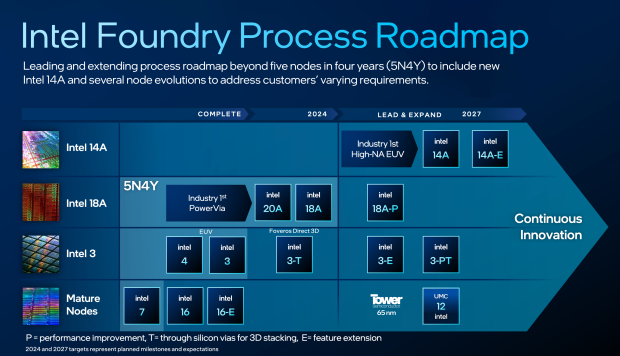
Intel also announced it's extending its Intel 7, Intel 3, and Intel 16 process nodes with the new "line extensions," also planning to deliver a new node every two years, with line extensions every other year... remind anyone of their older Tick-Tock model? There are new suffixes to get used to, obviously.
The new P suffix is a new revision to the node with performance improvements, the T suffix is for TSV-equipped nodes that can be used with hybrid bonding/3D Foveros technology, the E suffix is for specialized new features including tuned operating/voltage ranges, while the PT revisions have both performance and special features.
Intel IFS highlights include:
- Intel Foundry launches as the world's first systems foundry for the AI era, delivering leadership in technology, resiliency, and sustainability.
- Intel Foundry unveils new roadmap featuring 14A process technology, specialized node evolutions and new Foundry Advanced System Assembly and Test (ASAT) capabilities to help customers realize their AI ambitions.
- Intel Foundry announces design win: Microsoft CEO Satya Nadella shares that Microsoft has chosen a chip design it plans to produce on the 18A process.
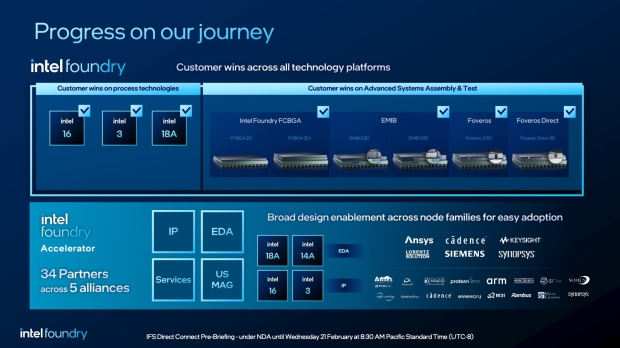
- Ecosystem partners including Synopsys, Cadence, Siemens, and Ansys announce validated tools, design flows, and intellectual property (IP) portfolios ready to enable customer designs.