









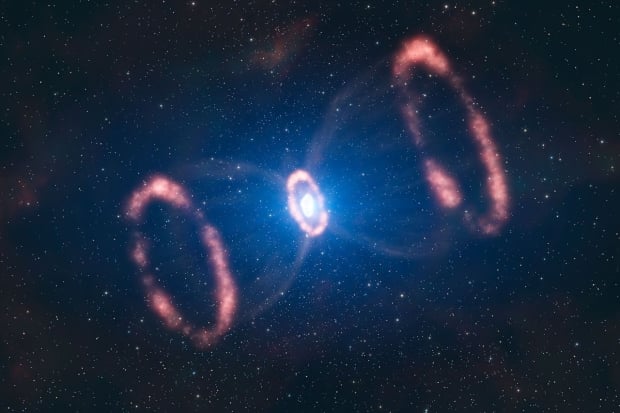




Researchers honed instruments on a star that was originally discovered in 1999 and found that its breaking our understanding of the universe.

The new study published on the pre-print server arXiv on January 4 focuses on a distant red giant star called J0931+0038, or the Barbenheimer Star, nicknamed after the "Barbie" and "Oppenheimer" movies released on the same day last year. Scientists used Sloan Digital Sky Survey telescopes in New Mexico to observe the star, capturing a detailed spectrum of the light it emits. This data was then verified by the Giant Magellan Telescope in Chile.
The results were extremely interesting as the Barbenheimer Star was found to have a very strange chemical composition, specifically a high concentration of heavy elements. Using the data, scientists rewound time through a process called stellar archaeology to find out how the Barbenheimer Star formed, and they discovered that it was birthed out of a star that was between 50 and 80 times the size of the Sun. This parent also featured an unusually high concentration of heavy elements and likely went supernova 13 billion years ago, or just 700 million years after the Big Bang.
Notably, most stars have the opposite chemical composition compared to the Barbenheimer Star, with high stores of lighter elements and low stores of medium and heavy elements. This is due to stars being predominately made up of hydrogen and helium, which fuse together within the star to create heavier elements. These heavier elements then fuse into even heavier elements.
"We've never seen anything like this," study lead author Alex Ji, an astrophysicist at the University of Chicago, said in a statement. "Whatever happened back then, it must have been amazing."
"We sometimes see one of these features at a time, but we've never before seen all of them in the same star," said study co-author Jennifer Johnson, an astronomer at The Ohio State University
Due to this process being scientists' current understanding of star formation, it is quite difficult to explain the overabundance of heavier elements within the Barbenheimer Star when there isn't a high enough concentration of lighter elements to have formed them.
"Amazingly, no existing model of element formation can explain what we see," said study co-author Sanjana Curtis, an astronomer at the University of California, Berkeley. It "almost seems self-contradictory," she said.
"The universe directed this movie, we are just the camera crew," study co-author Keith Hawkins, an astronomer at the University of Texas at Austin, said in the statement. "We don't yet know how the story will end."
![Photo of the $25 PlayStation Store Gift Card [Digital Code]](https://m.media-amazon.com/images/I/41cEZpeUA1L._SL160_.jpg)


 World's most powerful space telescope measures expansion rate of the universe
 World's largest digital camera turns on, can spot a golf ball on the surface of the Moon
 Scientists discover humble planet orbiting one of Earth's closest known stars
 NASA scientists use supercomputer to find out exactly when life on Earth will end
 Scientists detect ring of mysterious objects at the edge of the solar system
 Xbox outage exposed how your physical Xbox game discs aren't completely safe
 GTA 6 could launch without one of its biggest features in Australia
 Victim of first autonomous agent cyberattack explains what happened and why
 Valve promises Steam Machine reservation holders will get their chance to buy before 2027
 KIOXIA's UFS 5.0 embedded flash memory opens the door to powerful, compact, on-device AI
 KIOXIA's next-gen NX1 Series SSDs for AI deliver close to 40% more performance with support for direct liquid cooling
 NVIDIA is giving away 3-Month Discord Nitro subscriptions to all GeForce gamers
 AMD Software Adrenalin 26.7.1 WHQL driver adds support for a brand-new RDNA 4 GPU
 Xbox Helix's biggest feature may be what hurts the Xbox console the most
 ASRock, PowerColor, and SAPPHIRE launch new entry-level Radeon RX 9050 GPUs
 Noctua NL-LC1-36 Liquid CPU Cooler Review
 Logitech G316 X 98 Wired Gaming Keyboard Review - Retro-Inspired Board that Falls a Little Short
 Biwin M560 2TB SSD Review - Best Overall Retail-Ready DRAMless SSD
 Logitech G512 X 98 Analog Mechanical Gaming Keyboard Review - An Innovative Two-in-One
 Thrustmaster T.Flight HOTAS 5 MSFS Edition Review
 SteelSeries Arctis Nova Pro Omni Wireless Headset Review - One Headset to Rule Them All
 SteelSeries Arctis Nova 7 Wireless Gen 2 Headset Review - New and Improved, But Is It Enough?
 AMD Ryzen 7 7700X3D Review - Days of Future Past
 Samsung 990 2TB SSD Review - Ninth Gen QLC at PCIe Gen4 Speeds
 ASUS ExpertBook Ultra (Panther Lake) 14" Business Laptop Review
 Printer Not Working in Windows? How to fix detection, print queues and drivers
 The Ultimate Guide to Personalizing Your Windows 11 Taskbar
 How to Turn Your Windows Laptop Into a Second Monitor with Miracast and Wireless Display in Minutes
 6 Mistakes to Avoid When Buying a Windows Laptop
 I capped Windows Update's bandwidth with Delivery Optimization, and my downloads stopped choking
 I use this decade-old free tool that finds files faster than Windows Search does
 I install and update most of my apps with this Windows command now, and I stopped downloading sketchy installers
 Hisense U6SF 65-inch MiniLED TV: High Performance Meets Leisurely Convenience
 I stopped digging through Windows menus after I set up this one folder
 Don't sell your Windows laptop until you do these things