













Now is an opportune time for video games developers, publishers, and platform-holders to push consumers even further towards digital gaming.
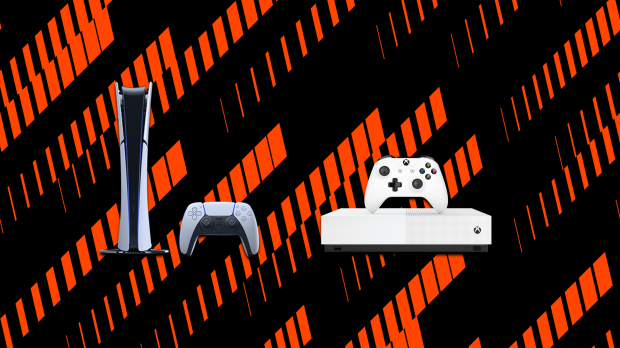
With the help of the billion-dollar microtransaction market, digital has taken over gaming as the largest revenue-generating medium. Console-makers like Sony and Microsoft have released digital-only systems to serve content, subscriptions, and services directly to consumers via digital marketplaces.
The up-side for digital-only games is massive for these companies; digital cuts a lot of costs, including manufacturing/shipping costs of the discs themselves. The trend towards digital has been vastly accelerated on both the hardware and access front, with platform-holders like Sony, Nintendo, and Microsoft offering value-oriented subscriptions to buffer--and, in Microsoft's case, overtake--the traditional business of selling games.
Now publishers and developers have found a new way to exploit current market trends and further push consumers towards digital gaming.
The tactic is pretty simple. Game-makers are prepared to offer their titles at lower prices in exchange for the games being digital-only. Games have become more expensive with Gen9 consoles, and the MSRP of video games is currently at $69.99, a full $10 increase over the $59.99 price of Gen8 console games.
If a game is digital-only, then the price typically drops by $20 to $49.99. We've seen a handful of digital-only games use this pricing, including Alan Wake II, Like a Dragon Gaiden: The Man Who Erased His Name, and Hellblade II's upcoming release in May.
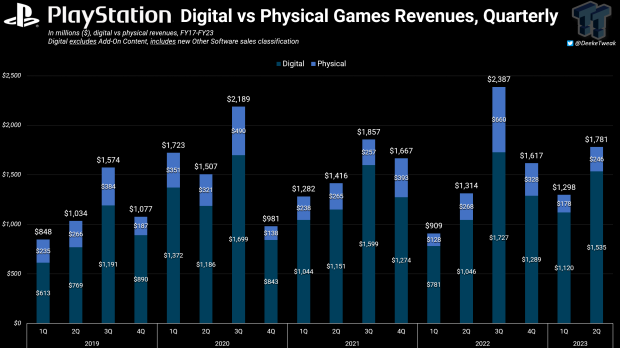
This new standard pricing model is very much like streaming services simultaneously raising the prices of their top subscriptions while offering new lower-cost, ad-supported tiers in the process.
It's a pure price proposition that publishers are offering consumers: Give up physical product ownership in exchange for a lower price. The trend could work, too, but it remains to be seen how well.
Inflation-driven economic conditions have forced consumers to become very price conscious over recent years, and the new pricing strategy could make a significant impact on consumer discretionary funds.
With interest rates still high, and consumer goods prices showing no signs of going down any time soon, now seems like an opportune time for publishers, developers, and platform-holders to attempt to capitalize on digital-only releases as consumers push towards saving money across all dimensions of spending.


 Opinion: PS5 Pro's absent disc drive isn't about choice, it's about profit and future economics
 End of an era: Video game consoles no longer sell multimedia entertainment, only games
 New physical game spending hit all-time low in 2025, analyst says
 PS6 may be disc-less by default, detachable drive sold separately
 Xbox to convert discs to digital games for Project Helix, new reports indicate
 Samsung reveals zHBM: future RAM is stacked above AI accelerator, boasts 8x performance of HBM5 and 3x energy efficiency
 If you launch Call of Duty: Black Ops 2 on PS4 or PS5 to be immediately told you're banned - don't panic, there's an easy fix
 MSI launches its 'DRACO EPIC EDITION' 40th anniversary PC gear
 Lower Xbox and PlayStation sales see AMD's Gaming revenue drop by 31%
 Memory capacity for all of 2027 has reportedly been booked and sold, with no more DRAM or HBM available
 GIGABYTE launches flagship AORUS P1600W power supply that supports up to four graphics cards
 GIGABYTE's GeForce and Radeon GPU prices have reportedly increased by up to 40% in Japan
 Adobe Acrobat Alternative: UPDF AI Workflow for Windows
 Battlefield 6 Season 4 update fixes RTX 50 series crashing without requiring an NVIDIA driver update
 Assassin's Creed Black Flag Resynced's new update will let you hide Edward's blowpipe
 Asetek Initium Pedal Modular Upgrades Review
 Thinkware U3000 Pro Review - Smart Dashcam with Wi-Fi quirks
 Montech TG3 Mid-Tower Chassis Review
 ASUS ROG Strix X870E-A Gaming WiFI7 Neo Review - A New Enticing Option
 Noctua NL-LC1-36 Liquid CPU Cooler Review
 Logitech G316 X 98 Wired Gaming Keyboard Review - Retro-Inspired Board that Falls a Little Short
 Biwin M560 2TB SSD Review - Best Overall Retail-Ready DRAMless SSD
 Logitech G512 X 98 Analog Mechanical Gaming Keyboard Review - An Innovative Two-in-One
 Thrustmaster T.Flight HOTAS 5 MSFS Edition Review
 SteelSeries Arctis Nova Pro Omni Wireless Headset Review - One Headset to Rule Them All
 I swapped File Explorer for this free file manager and finally got the layout I wanted
 How to tell if someone has been using your Windows PC without your permission
 6 Task Manager tips for troubleshooting Windows performance problems
 ASUS ROG's 20th Anniversary Line-up of Premium PC Gaming Gear has Arrived - Here's Everything You Need to Know
 Six File Explorer tips every Windows user should know
 I switched my PC to encrypted DNS in Windows 11, and browsing felt more private
 Printer Not Working in Windows? How to fix detection, print queues and drivers
 The Ultimate Guide to Personalizing Your Windows 11 Taskbar
 How to Turn Your Windows Laptop Into a Second Monitor with Miracast and Wireless Display in Minutes
 6 Mistakes to Avoid When Buying a Windows Laptop