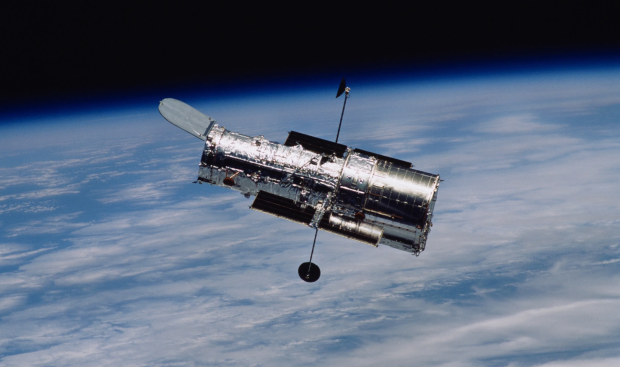




NASA has taken to its website and social channels to share an image captured by the iconic Hubble Space Telescope.
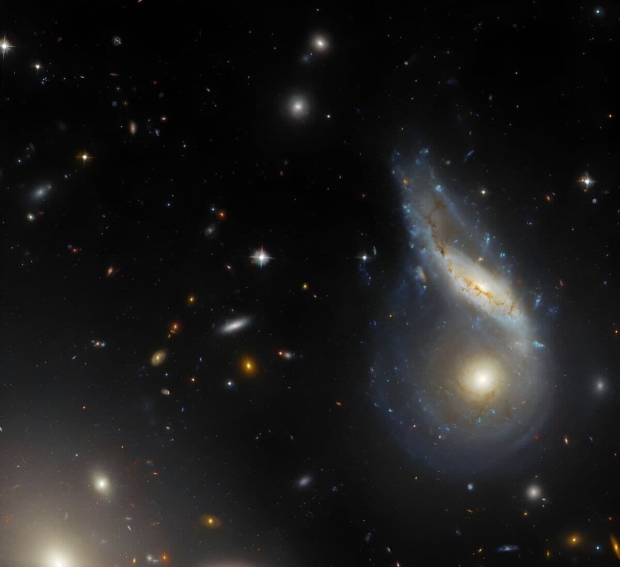
The image features two spiral galaxies known as NGC 6040, the tilted, warped spiral galaxy, and LEDA 59642, which are both shown above. Both of the galaxies are called Arp 122, and what we are looking at here is a cosmic collision that has taken millions of years to achieve. The collision is taking place 570 million miles from Earth and is a result of all of the contents of the galaxy causing a strong gravitational pull.
Notably, our own Milky Way galaxy is scheduled to collide with our nearest galactic neighbor, the Andromeda Galaxy. However, that event won't take place for another 4 billion years, and when it does, it will take hundreds of millions of years for both galaxies to fully envelop each other. Why does it take so long? NASA writes that it's simply because of the great distances the galaxies need to travel in order for them to merge.
"Galaxies are composed of stars and their solar systems, dust, gas, and invisible dark matter. In galactic collisions, therefore, these constituent components may experience enormous changes in the gravitational forces acting on them. In time, this completely changes the structure of the two (or more) colliding galaxies, and sometimes ultimately results in a single, merged galaxy. That may well be what results from the collision pictured in this image.Galaxies that result from mergers are thought to have a regular or elliptical structure, as the merging process disrupts more complex structures (such as those observed in spiral galaxies). It would be fascinating to know what Arp 122 will look like once this collision is complete... but that will not happen for a long, long time," writes NASA
![Photo of the $25 PlayStation Store Gift Card [Digital Code]](https://m.media-amazon.com/images/I/41cEZpeUA1L._SL160_.jpg)