



Some truly impressive high refresh-rate displays have been announced and shown at CES 2024, like the new Alienware AW3225QF, one of the world's first 240Hz 4K OLED gaming monitors.
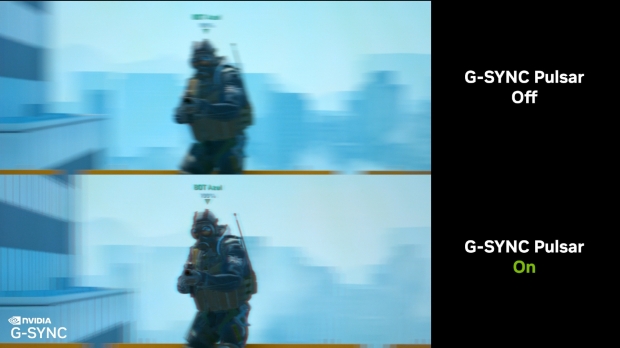
And with the very best displays featuring NVIDIA G-SYNC, G-SYNC ULTIMATE, and G-SYNC Compatible VRR technology, NVIDIA is announcing the latest evolution of its cutting-edge variable refresh rate tech - G-SYNC Pulsar.
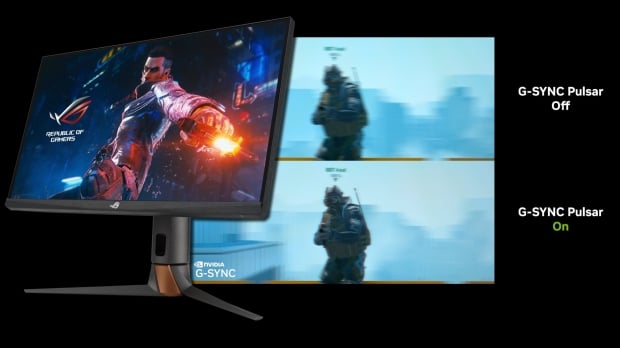
NVIDIA is calling G-SYNC Pulsar the next evolution of Variable Refresh Rate (VRR) technology thanks to adding variable frequency strobing to improve motion clarity dramatically. With G-SYNC Pulsar off, a fast-moving image can look blurry even on a high refresh-rate display. With G-SYNC Pular enabled, that image is now crisp and clear, boosting the "effective motion clarity to over 1000Hz."
G-SYNC Pulsar is similar to the NVIDIA G-SYNC ULMB 2 tech we saw at Computex 2023, except that it combines the clarity Ultra Low Motion Blur with the smooth visuals of VRR performance. NVIDIA has a whole blog post detailing how Pulsar works, with the key being two innovations that the G-SYNC team has been working towards for over a decade - Adaptive Overdrive and Pulse Modulation.
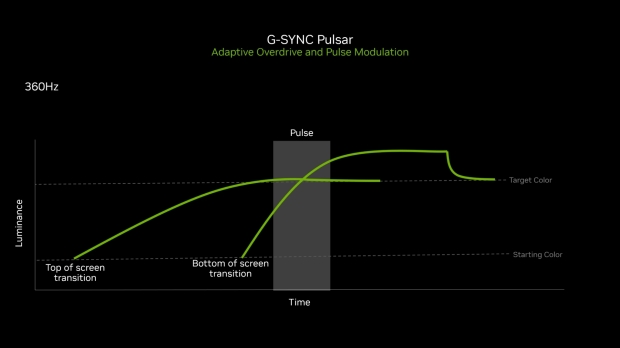
Adaptive Overdrive "adjusts the rate at which pixels transition from one color to another, a vital technique to reduce motion blur and ghosting." Pulse Modulation solves the VRR issue of a fluctuating refresh rate by modulating "overdrive based on both screen location and refresh rate." It also intelligently controls brightness and duration to maintain a comfortable, flicker-free image.
However, there's a catch. Adaptively tuning backlight pulses while keeping track of a game's render rate will require a dedicated G-SYNC chip - and a brand-new one, too. NVIDIA confirms that the first G-SYNC Pulsar capable display will be a new ASUS ROG Swift PG27 Series G-SYNC gaming monitor launching later this year.
All the NVIDIA news from CES 2024.
- Read more: GeForce RTX 4070, RTX 4070 Ti, and RTX 4080 SUPER announced - pricing, specs, and performance!
- Read more: Studios like Tencent and Ubisoft are using NVIDIA ACE to create AI NPCs in upcoming games
- Read more: GeForce NOW is getting new Blizzard games, Day Passes, and G-SYNC technology
- Read more: GeForce RTX 4070 SUPER and RTX 4080 SUPER Founders Edition models look incredible in all black
- Read more: Twitch Enhanced Broadcasting allows for five concurrent streams with a single GeForce RTX GPU
- Read more: GeForce RTX 4070 SUPER Founders Edition unboxing
- Read more: New G-SYNC Pulsar technology brings impressive stutter-free, smooth, motion clarity to monitors
- Read more: Generative AI by iStock is commercially safe image generation powered by NVIDIA Picasso
- Read more: Half-Life 2 RTX gets a new stunning trailer, RTX Remix Open Beta launches later this month
- Read more: Horizon Forbidden West Complete Edition coming to PC 'Early 2024' with DLSS 3, DLAA, and Reflex