




NASA, in partnership with Japan Aerospace Exploration Agency (JAXA), revealed the first look at an X-ray cosmos.
The two space agencies partnered to create the XRISM (X-ray Imaging and Spectroscopy Mission) observatory, which is designed to measure the hottest parts of the cosmos. Scientific operations for the mission began last year, and now the results have been published on NASA's website, revealing one of the targets for the mission was a star, or more accurately, a supernova remnant called N132D.
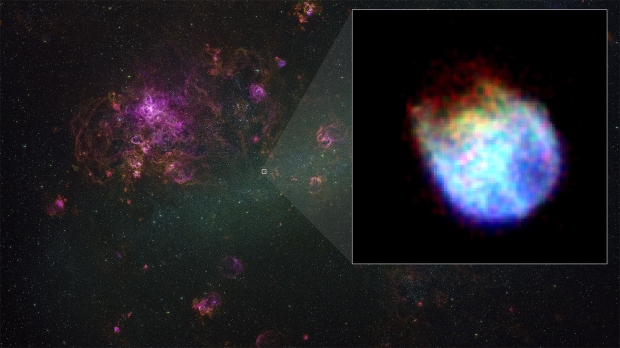
This astronomical object is located 160,000 light years away from Earth within the Large Magellanic Cloud, a dwarf galaxy of our own Milky Way. Using XRISM instruments, researchers studied N132D and found that the once-star exhausted all its fuel around 3,000 years ago, which resulted in a supernova explosion that can still be seen today (above image).
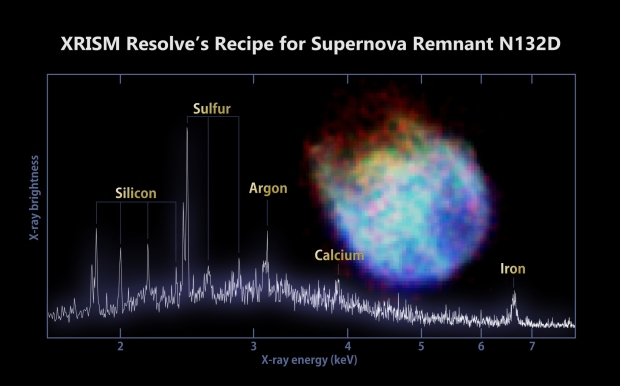
What's interesting is that through analyzing XRISM data, researchers were able to identify elements within the supernova remnant. These elements were forged within the original star when it was operational and then blasted away once all fuel reserves were exhausted.
"These elements were forged in the original star and then blasted away when it exploded as a supernova. Resolve will allow us to see the shapes of these lines in a way never possible before, letting us determine not only the abundances of the various elements present, but also their temperatures, densities, and directions of motion at unprecedented levels of precision. From there, we can piece together information about the original star and the explosion," said Brian Williams, NASA's XRISM project scientist at Goddard