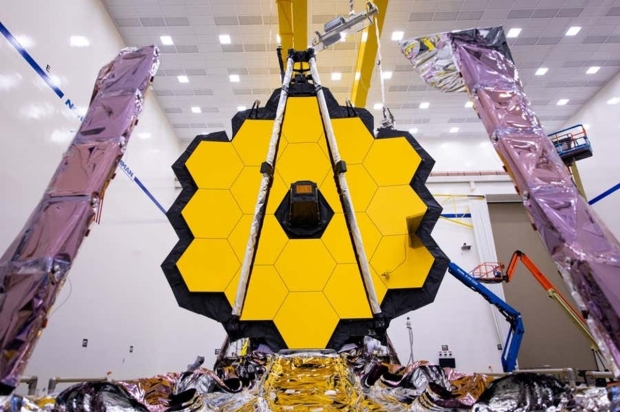




The James Webb Space Telescope (JWST) has pointed its instruments at the exoplanet named WASP-80 b, leading to the first time Webb has discovered methane in the atmosphere of an exoplanet.
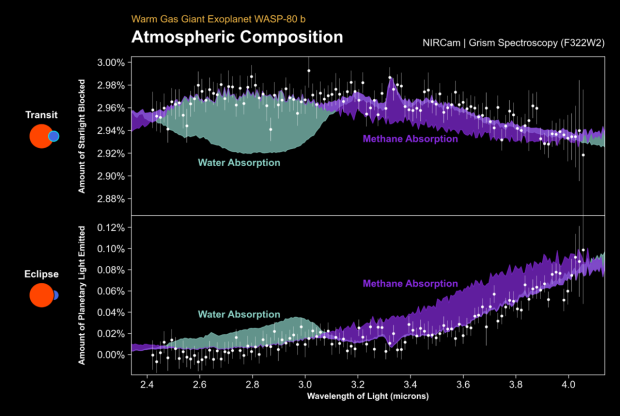
The discovery can be traced back to recently published findings in the scientific journal Nature, and also NASA's website where it explains that while methane has been detected in abundance within our solar system (Jupiter, Saturn, Uranus and Neptune), it hasn't been discovered in the atmosphere of transiting exoplanets by space-based spectroscopy.
Popular Now: DLSS 5 has been modded into Skyrim, and it definitely transforms character facesWebb honed its instruments on the exoplanet WASP-80 b, which researchers describe as a "warm Jupiter" as its similar in size and mass to the planet, but is approximately 1,025 Fahrenheit. WASP-80 b is located 163 light-years away from Earth within the constellation Aquila, and according to the researchers behind the study there is clear evidence for absorption from water and methane within the atmosphere of WASP-80 b.
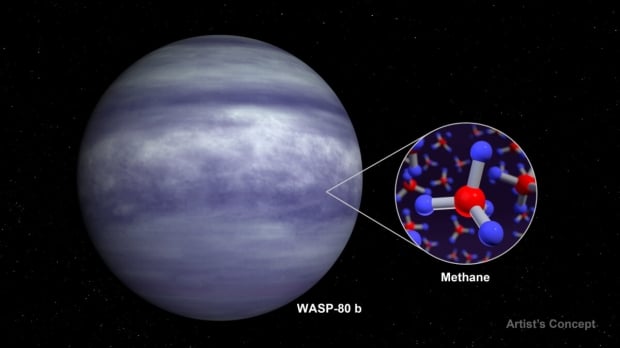
"With such a confident detection, not only did we find a very elusive molecule, but we can now start exploring what this chemical composition tells us about the planet's birth, growth, and evolution. For example, by measuring the amount of methane and water in the planet, we can infer the ratio of carbon atoms to oxygen atoms.This ratio is expected to change depending on where and when planets form in their system. Thus, examining this carbon-to-oxygen ratio can offer clues as to whether the planet formed close to its star or farther away before gradually moving inward," writes Taylor Bell from the Bay Area Environmental Research Institute (BAERI), working at NASA's Ames Research Center in California's Silicon Valley, and Luis Welbanks from Arizona State University
- Read more: CD Projekt Red reveal interesting detail about Witcher 4 as devs shift over to new title
- Read more: World's most powerful space telescope photographs a newborn star within a cosmic crib
- Read more: Leak reveals when Grand Theft Auto 6 preorders could go live
- Read more: Meta served forbidden video content to followers of teen influencers on Instagram
- Read more: NASA announces it discovered 300 objects shooting gamma-rays into deep space
- Read more: Elon Musk confirms when Tesla will start delivering the Cybertruck
- Read more: Students are using AI to make 'terrifyingly' realistic nude images of other students