
NASA's James Webb Space Telescope (JWST) has pointed its extremely powerful instruments at a region of space that contains newborn stars.
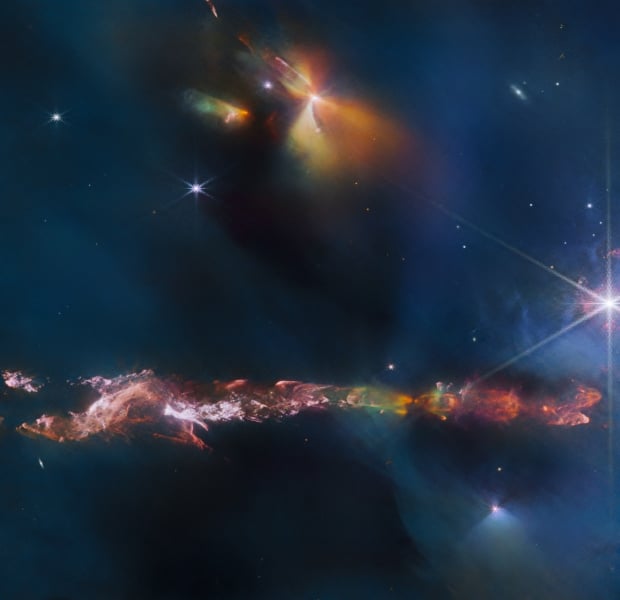
Astronomers have captured an image of a Herbig-Haro object and released it as one of Webb's latest images, explaining the significance of such a photograph and how it plays into the evolution of stars. NASA's JWST has pointed its Near-InfraRed Camera (NIRCam) instrument at HH 797, a luminous cloud of gas and dust that resides approximately 1,000 light years from Earth. HH 797 is the long strip of gaseous material found taking up the majority of the bottom half of the above image.
Joining HH 797 is the young open star cluster called IC 343, located on the right-hand side of the image. So, why is this image so special? Newborn stars, more specifically named protostars, spew out jets of high-speed stellar wind that collide with nearby dust and gas. This collision produces the interaction we can see in the above image. Previously, astronomers believed that the string of gas seen at the bottom of the image was caused by just one newborn star, but Webb's observations have revealed the presence of two newborn stars.
"Webb's infrared vision is particularly suited for studying young stars and their outflows, as infrared light can pierce through obscuring gas and dust," writes NASA on its NASA Webb Telescope X account