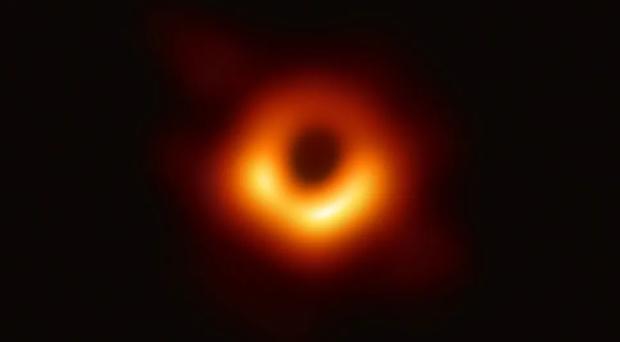




Black holes are almost impossible to observe through telescopes as the massive cosmic monsters have such a strong gravitational pull that light isn't even able to escape them, making them blobs of cosmic darkness that is slowly but surely consuming everything around them.
It was in 2021 that humanity was able to capture the very first photograph of a black hole, specifically the supermassive black hole known as M87. The Event Horizon Telescope (EHT) analyzed the cosmic monster that is located 55 million light years from Earth, and the EHT data was combined with other radio telescopes to discover that M87 was actually spinning.
Researchers have now looked at the M87 image again and found that the black hole's magnetic field can sometimes be strong enough to stop the black hole from consuming matter. Further analysis led researchers to discover that the magnetic field of the black hole could also be responsible for slowing down the rotation of the black hole, similar to how a spinning top eventually begins to wobble after being spun.
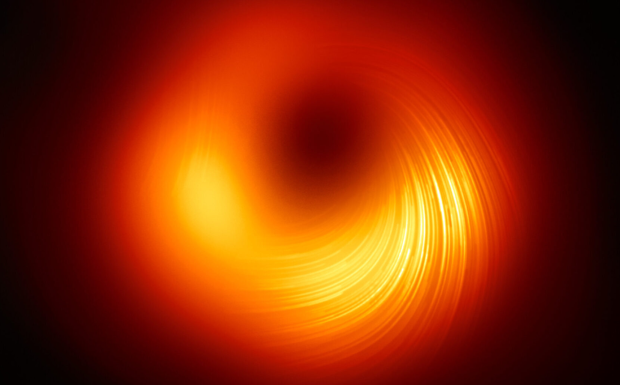
"We were able to conclusively say the 2021 EHT image shows that energy is flowing out close to the black hole," Andrew Chael, who is an astrophysicist at Princeton University in New Jersey and lead author of the new study, told Space.com. "We need future, higher-sensitivity images to determine 100% if the energy is flowing out from the black hole's surface itself."
This energy flowing out of the black hole comes in the form of a "million-light-year-long Jedi lightsabers", or more specifically called relativistic jets.
"If you took the Earth, turned it all into TNT and blew it up 1,000 times a second for millions and millions of years, that's the amount of energy that we're getting out of M87," said study co-author George Wong of Princeton University.