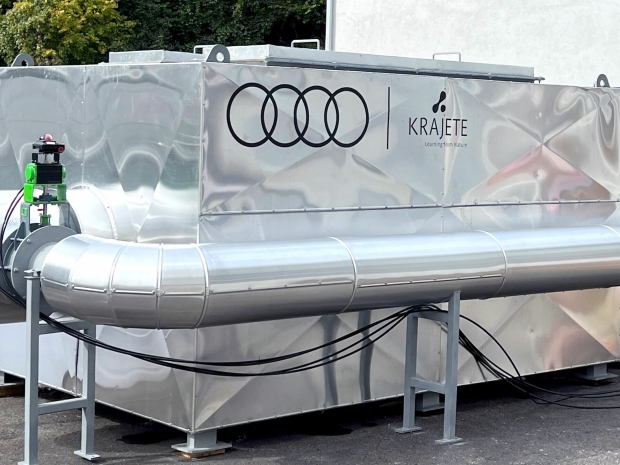




German automaker Audi will work with Krajete, a company specializing in green technology, in an effort to filter CO2 out of ambient air. The modular design of the filtration unit ensures it can be expanded and is suitable for long-term scaling based on the facility's needs.

Both companies are working together at a plant in Austria, with an inorganic filter material used to help maximize the effectiveness of direct air capturing (DAC) technologies. The ambient air to be filtered typically doesn't need to undergo a pre-dry process, which greatly improves efficiency while reducing costs.
The Austrian plant can filter 500 tons of CO2 per year, though researchers plan to add another module before the end of the year - and that will drastically increase processing capabilities up to 1,000 tons of CO2 per year. The cost of sequestration is kept under control because both companies were able to identify an optimal flow rate - so the process runs at ambient pressure before the absorber materials and physical conditions were carefully monitored.
The collected CO2 is a raw material that could be used for industrial applications or for permanent storage, BMW claims. Filtered air is distributed back into the environment once the full absorption process has been completed.
As noted by Hagen Seifert, head of sustainable product concepts at Audi: "The technology makes it possible to remove CO2 directly from the atmosphere, regardless of location, and is therefore an important decarbonizing measure. In addition, the system technology can be expanded in a variety of ways thanks to its modular design."
This is an important step forward as the Volkswagen Group aims to be carbon neutral by 2050, if not even sooner. Through 2025, the Volkswagen Group wants to reduce passenger car and light commercial vehicle ecological footprint by 40%. Audi will continue to look for realistic methods to filter CO2 and other emissions from the world around us.