












The European Space Agency (ESA) has released a new image captured by the famous Hubble Space Telescope.
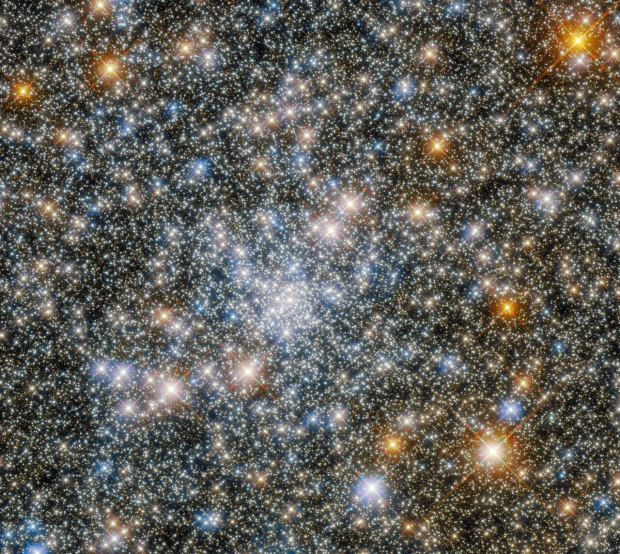
Being 30 years, the Hubble Space Telescope has achieved much during its time in operation, and while being far superseded by the James Webb Space Telescope, Hubble can still produce some incredible images. The ESA has taken to its website to showcase a new image of globular cluster NGC 6540. The photograph was snapped with Hubble's Wide Field Camera 3 and Advanced Camera for Surveys and reveals thousands to millions of stars all bound together by gravity.
NGC 6540 is located within the constellation Sagittarius, and the above composite image displays many bright stars that are defined by their diffraction spikes, which is the cross-shaped pattern seen across various stars. Notably, these cross-shapes are an imaging artefact that is caused by Hubble and not the star.
"The brightest stars in this image are adorned with prominent cross-shaped patterns of light known as diffraction spikes. These astronomical embellishments are a type of imaging artifact, meaning that they are caused by the structure of Hubble rather than the stars themselves. The path taken by the starlight as it enters the telescope is slightly disturbed by its internal structure, causing bright objects to be surrounded by spikes of light," wrote the ESA.
Astronomers pointed Hubble to the heart of NGC 6540 to observe the ancient gas and dust that shrouds the region, with the ESA noting that globular clusters such as NGC 6540 hold secret insights into the evolution of the Milky Way, and by researching them, astronomers can learn about how everything came to be.


 NASA releases jaw-dropping 2.5 billion pixel image that took 10 years to capture
 NASA lifts the veil on the corpse of a star about 20 times as big as the Sun
 NASA telescope photographs planet-transforming grains in deep space
 World's most powerful space telescope measures expansion rate of the universe
 World's most powerful telescope spots an 'Eye of Sauron' in deep space
 The Witcher multiplayer project dubbed 'Sirius' hit with a new round of layoffs
 Xbox Elite Series 3 controller gets leaked with a built-in screen, quickly gets taken down
 Redditor improves his gaming laptop temps by 15C simply by changing the table
 Phantom Blade Zero on PC will launch with DLSS 4.5 and Ray Tracing on day one
 Razer announces its first Artisan Keycap with the Triple-Headed Snake Edition
 ZOTAC's 20th Anniversary Edition GeForce RTX 5080 features a titanium colorway and mirror-like backplate
 GeForce NOW app for Linux leaves beta, while DLSS Frame Generation cloud latency also improves
 Twitch opts streamers into gen AI training by default, faces harsh backlash
 Sean Murray still plays the 2016 launch version of No Man's Sky
 China's YMTC has climbed to third place in global NAND flash shipments
 Corsair HS35 v3 Wireless Gaming Headset Review - An Affordable Winner
 D-Link F518 5G Wi‑Fi 6 AX1800 Mobile Hotspot Review: All-Day Mobile Hotspot
 Bose Lifestyle Ultra Speaker Review - Impressively Detailed Room-Filling Sound
 MSI Z890 Gaming Plus WIFI6E Review - Z890 for under $200
 Mortal Kombat (1995) 4K Ultra HD Blu-ray Review
 CPS PCCOOLER YS1200 ATX 3.1 80 PLUS Gold PSU Review
 ASRock X870E Taichi White Review: a premium AM5 motherboard with 10G LAN and WiFi 7
 Asetek Initium Pedal Modular Upgrades Review
 Thinkware U3000 Pro Review - Smart Dashcam with Wi-Fi quirks
 Montech TG3 Mid-Tower Chassis Review
 I ditched the Windows 11 context menu for this open-source tool, and here's why
 Windows 11 may be encrypting your drive already, and I checked where my recovery key went
 GIGABYTE's 40 Days of INFINITY celebrates 40 Years of Innovation with stunning GeForce RTX graphics cards and rewards
 I swapped File Explorer for this free file manager and finally got the layout I wanted
 How to tell if someone has been using your Windows PC without your permission
 6 Task Manager tips for troubleshooting Windows performance problems
 ASUS ROG's 20th Anniversary Line-up of Premium PC Gaming Gear has Arrived - Here's Everything You Need to Know
 Six File Explorer tips every Windows user should know
 I switched my PC to encrypted DNS in Windows 11, and browsing felt more private
 Printer Not Working in Windows? How to fix detection, print queues and drivers