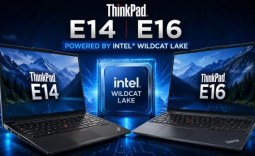
Intel's new Wildcat Lake laptops might have been designed to combat Apple's budget-friendly MacBook Neo, but they're launching alongside an unexpected fire sale on premium hardware. As manufacturers clear inventory, Lunar Lake laptops are now crashing to $600 in China, creating an overlap between the two options.
Wildcat Lake arrives as a budget sibling to Intel's latest Core Ultra Series 3 Panther Lake architecture. Optimized for cost-efficiency, it features a 6-core hybrid configuration (2P + 4LPE) utilizing Cougar Cove P-cores and Darkmont E-cores. To keep costs down, the integrated GPU is scaled to 2 Xe3 cores, and the memory architecture is restricted to a single-channel configuration. While global availability remains scarce, we're seeing a steady influx of these devices in China at $400-$600.
Early benchmarks show that Wildcat Lake is highly competitive against Apple's MacBook Neo. While laptop designs vary by manufacturer, Wildcat Lake laptops can offer more memory, storage, and active cooling at lower costs than the Neo. Despite the current DRAM crisis, Wildcat Lake is a welcome relief for the masses, with Intel's Project Firefly vowing to introduce affordable laptops based on a thin-and-light reference design.
- Read more: Intel Wildcat Lake laptops launch May 18 in China with Honor's MagicBook X14 listed at $650
- Read more: Intel Core 3 304 'Wildcat Lake' CPU appears on PassMark, matches the MacBook Neo
- Read more: Intel's Wildcat Lake Core 3 304 spotted in Geekbench - New benchmarks show performance doubling versus N250
Despite this, Lunar Lake, which debuted two years back, continues to fall in price. We're at a crossroads where older yet more premium Lunar Lake designs are in the same price bracket as newer Wildcat Lake options.

An example is the Mechrevo 16S 2026 with the Core Ultra 5 226V processor, 16GB of RAM, 512GB of storage, a 16-inch 2.5K 120 Hz panel, and a chassis weighing 1.35kg, listed for 4,099 CNY or $600. This directly competes with newer Wildcat Lake options such as the Honor Notebook X14 at around $570, the ASUS Fearless 14SE at around $600, and the HP OmniBook 3 at $660.
Even globally, entry-level Lunar Lake devices such as the Omnibook X Flip and the Acer Aspire AI 14 can be found on sale for $500-$750.
Architecturally, Lunar Lake brings Apple Silicon-like efficiency to the x86 ecosystem. The series features an 8-core layout (4P + 4LPE) that uses the Lion Cove and Darkmont architectures, with IPC similar to Wildcat Lake. Beyond the higher multithreaded headroom, Lunar Lake offers a significantly more potent iGPU with 7-8 Xe2 cores (Arc 130V/140V). Its Memory-on-Package (MoP) design is a double-edged sword, offering better idle power efficiency at the cost of zero future upgradeability. Yet, it remains the superior performer in this $600 price bracket.

Ultimately, this market overlap is a major win for consumers; increased competition rarely fails to drive value. We haven't seen the true price floor for Wildcat Lake yet, though we fear there'll be diminishing returns as manufacturers race to the bottom. At the $400 mark or below, the initial savings often mask steep compromises in build quality, specifications, and quality control.
For now, if you're shopping in this window, the smart choice is to clear out those Lunar Lake devices before the market fully pivots to Wildcat Lake.