


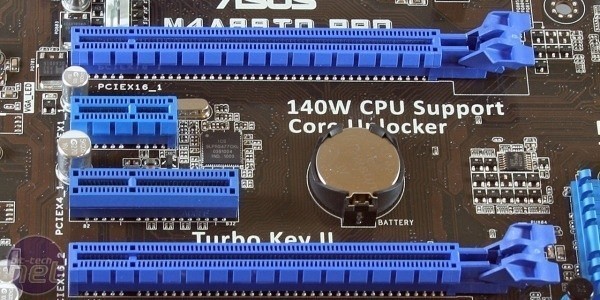
PCI-Express 3.0 is the next gen champion to be on your motherboard. It is rumored to be clashing it's hammer with the Sandy Bridge E 'Patsburg' on LGA2011 which is slated for 2011. Depending on whether the LGA2011 becomes the consumer-targetted replacement. The closest definite for PCI-Express 3.0 is for early 2012 when Ivy Bridge hits.
What will it bring us you say? We see a doubling in speed from PCI-Express 2.0's bandwidth of 4Gbps to a next-gen of 8Gbps, a 100% increase - also remember that is per lane in each direction which means the total bandwidth going to the next gen is going to be 32Gbps. This gives it a huge upgrade to allow GPU's to start running laps around their current high end VGA cards.
In order to get a doubling in speed from the current PCI-Express 2.0 standard - PCI-SIG (the guys behind the spec) have also lessened the encoding overheads to make faster transfers even more efficient.
It's kryptonite? Currently signalling bus devices (like PCI-Express 2.0) use an '8b/10b' encoding - which means ten bits are transferred for eight bits (one byte) of actual data. Obviously this isn't optimal, 10bits used for only 8bits of actual data - which is quite a considerable amount (20 percent). To get out of this issue PCI-Express 3.0 encodes the data in a much larger amount, a 128b/130b amount to be exact.
Following that is 'a known polynomial is applied to a data stream in a feedback topology', with an 'inverse polynomial' sat at the other end to decode the data. In non-nerd speek it's a hardcoded mathematical function that is designed more efficiency for the handling of 0s and 1s - so they don't interfere with each other when transferred. The technique is called 'scrambling'.
The results of this are instead of 5GT/sec of PCI-e 2.0 increasing to 10GT/sec, PCI-Express will only require an 8GT/sec transfer - as the data is also transferring at a great efficiency (think a long drive uses less petrol in a car, then running it around town constantly). This result also uses less power - as it doesn't have to involve higher grade materials, in turn making the product cheaper to make. It's pure genius.
While this is both good and bad news - PCI-Express 3.0 provides not much more power than it's predecessor, but this isn't necessarily a bad thing. Having >300W drawn from each PCI-E 3.0 port is expensive to make, it would increase the thickness of copper traces on the motherboard. Manufactures such as Asus and Gigabyte could possibly need to add extra layers to try and route the high power traces and their associated electromagnetic interference away from sensitive data traces.
Sounds complicated? Well, it means that with greater effiency, comes less power consumption. In a world of GPU's getting to boiling point at a stated 2xxW part, where it and many others reach 300W quite easily - it's a step in a better direction.


 Microsoft accidentally installed Copilot AI app on a version of Windows it wasn't meant for
 AMD unveils AI-powered Ryzen PRO 8040 and 8000 Series processors for laptops and desktops
 No Rest for the Wicked launch trailer presents a stunning take on the Diablo-style action RPG
 TSMC helped Taiwan avoid power outage: 200MW of power provided with diesel power generators
 NVIDIA's new Blackwell AI GPUs drives TSMC to increase CoWoS output by over 150% in 2024
 ASRock NUCBOX-155H Mini PC Review
 NuPhy Air96 V2 Wireless Mechanical Keyboard Review
 TEAM T-FORCE Siren DUO360 RGB Liquid CPU Cooler Review
 AVerMedia Live Streamer ULTRA HD Review
 AVerMedia Live Gamer 4K 2.1 Review
 XPG Invader X Mid-Tower Chassis Review
 Intel Core i9-14900KS CPU Review
 Arbiter Polar 65 Magnetic Gaming Keyboard Review
 ASUS ROG Falchion RX Low Profile Keyboard Review
 MSI MPG 321URX QD-OLED Gaming Monitor Review - 4K gaming at its best
 Everything you need to know about the latest ASUS NUC Mini PCs - NUC 14 Pro and ROG NUC
 How to Overclock Your GPU and Boost Your PC Gaming with ASUS GPU Tweak III
 ASUS's AMD Radeon RX 7000 Series GPU lineup has something for every gamer
 ASUS OLED Premium Care defends the ROG Swift OLED PG32UCDM gaming monitor from burn-in
 Patriot Viper Xtreme 5 Engineering Prototype 48GB Dual-Channel Memory Kit Preview