






Learn about how TweakTown tests and reviews hardware. As an Amazon Associate, we earn from qualifying purchases. TweakTown may also earn commissions from other affiliate partners at no extra cost to you.
Stay Updated
Follow TweakTown for breaking tech news, reviews, and daily updates.


Interstitial ads in full-priced games would be unfair, Take-Two CEO says
Take-Two Interactive has no plans to interrupt gameplay with forced ads in premium-priced games.

Ads are the next horizon for monetization in gaming, especially on consoles...but it's a tricky well to tap. Ad-supported tiers have taken over all streaming services--perhaps the ultimate endgame all along--and the same could happen with gaming, at least to an extent, but no one has been brave enough to tackle it yet.
Take-Two CEO Strauss Zelnick says that these kinds of interstitial ads have no place in full-priced $70 games. This sentiment makes sense on a value level, as advertisements in games are typically used in free to play games, with the exception mainly consisting of sports titles. And the kind of interstitial ads that Zelnick refers to are the kind that break immersion and threaten engagement by disrupting player activity. For more on how ads could work for console gaming, check out this article.
Epic Games lead producer calls gamers thinking DLSS 5 detracts from art direction 'insane'
NVIDIA unveiled DLSS 5 at GTC 2026, and the reception from the new technology has been anything but pleasant, with large portions of the gaming community describing the tech as AI slop.

The criticism of the latest generation of DLSS has even been recognized by NVIDIA CEO Jensen Huang, who said people are "completely wrong" about DLSS 5, particularly the aspect where some characters look completely different than their original design. Concerned gamers pointed to examples such as Resident Evil: Requiem, as the DLSS 5 On image showcased a stark change in the character model. Notably, Capcom developers recently said they found out the title was being used in the presentation at the same time as the public.
NVIDIA's Jensen Huang responded to a question from Tom's Hardware, saying, "Well, first of all, they're completely wrong. The reason for that is because, as I have explained very carefully, DLSS 5 fuses controllability of the of geometry and textures and everything about the game with generative AI."
Intel's latest Core Ultra 200HX Plus CPUs for gaming laptops will reportedly be limited to select manufacturers at launch
If you're eyeballing a new gaming laptop with Intel's latest Core Ultra 200HX Plus processors, your choices may be initially limited. PCWorld reports these Arrow Lake Refresh chips will launch in phases, with some major manufacturers waiting months for availability.

Hot on the heels of its desktop refresh, Intel announced Core Ultra 200HX Plus series processors for the mobile market on March 17, targeting high-end gaming laptops. The 'HX' suffix indicates the use of desktop silicon in a mobile chassis, with elevated power limits that can reach 160W. For this specific refresh, Intel is focusing on just two models: the Core Ultra 7 270HX Plus and the flagship Core Ultra 9 290HX Plus.
The refresh increases the die-to-die fabric to 900 MHz, reducing internal data travel time. Moreover, iBOT (Intel Binary Optimization Tool) is a new utility that sits between game code and CPU, intercepting inefficient instruction sequences and replacing them with optimized ones for Arrow Lake.
AMD issues statement on CHUWI Ryzen CPU labeling Issue
AMD officially denies having any knowledge of the alleged Ryzen 5 7430U CPU labels on CHUWI products, says it was not involved or consulted.

Over the last few weeks, a Chinese manufacturer, CHUWI, was found to be selling several systems with mislabeled AMD Ryzen CPUs. The company claimed that its laptops were shipped with the AMD Ryzen 5 7430U, as indicated by the label clearly visible on the laptop and in the marketing material. However, the laptops were actually running the older AMD Ryzen 5 5500U CPU, a clear downgrade from the advertised chip.
Moreover, as Notebookcheck uncovered, this scandal was not just the result of a simple, isolated "mistake" or an error in the production line that resulted in the wrong sticker being used. The laptops were configured and altered to deceive the user at the Windows level, in software tools such as CPU-Z, and even in the BIOS. Therefore, it was an intentional attempt to mislead the buyer into thinking they were getting a shiny new Ryzen 7000-series chip instead of an older one.
Continue reading: AMD issues statement on CHUWI Ryzen CPU labeling Issue (full post)
Take-Two CEO alludes to GTA 6 pricing by talking about in-game advertising
In a recent interview with The Game Business, Take-Two CEO Strauss Zelnick discussed numerous topics in the gaming industry, including the recent rise in AI-powered tools for asset creation, in-game advertising, and his stance on a publisher/developer taking that route with a title.

Take-Two Interactive is the publisher of the Grand Theft Auto franchise, and during the interview, Zelnick was asked for his thoughts on GTA fans who bought GTA 5 when it released, but now do not have enough time to play GTA 6 when it releases, as they are now 13 years older. Zelnick dismissed this as a concern, saying he believes many 17-year-olds will be playing GTA 6 when it releases, and that GTA 5 players who are now 13 years older can purchase GTA 6 without a parent present.
Additionally, Zelnick believes there won't be an impact on sales over teens thinking they need to play all of the GTA games before getting GTA 6. The Take-Two CEO said he doesn't think teens will go "If I didn't play (GTA) five or four or three or two or one, I'm not showing up." Regarding GTA 6, Zelnick was asked his thoughts about advertising being built into the game, such as players seeing branding from companies within the game world. Fans of GTA have suspected this could be a route Rockstar takes to earn more money from the release of GTA 6, but Zelnick quickly shut that idea down, while simultaneously alluding to pricing for GTA 6.
PlayStation will be dropping the 'PSN' and 'PlayStation Network' branding in 2026
A new report has cited an email sent by Sony Interactive Entertainment that informs the publication that Sony will be phasing out the "PlayStation Network" and "PSN" branding that is associated with the PlayStation platform.

The email reveals that Sony Interactive Entertainment (SIE), the parent company of PlayStation, has decided to sunset the PSN and PlayStation Network branding in favor of something else, what that something else is was never mentioned in the email. However, we know that SIE will be dropping the PSN and PlayStation Network branding by September 2026, and the decision to drop the branding is so SIE can "properly capture the breadth of our evolving digital services."
Unfortunately, the email didn't reveal what SIE will be rebranding the PSN to, or when they will be announcing the new branding. But what we do know is that "PSN" and "PlayStation Network" will be phased out of all SIE assets by September, meaning within the next six months we should hear an announcement about a new name for the PlayStation Network.
From Vera Rubin to PCIe Gen 6 and HBM4e, here's some of the tech we saw at NVIDIA GTC 2026
NVIDIA GTC 2026 has been a big one for announcements, from a first look at next-gen technologies on the horizon to glimpses at what's in store for the future. Attending this year, TweakTown's Jon Coulter got a chance to walk through the showfloor and spend time with some of the biggest names in memory, storage, GPU, and AI solutions. Naturally, he took plenty of pictures of what was on display.

First, because it's impressive tech that would have been considered impossible or unachievable not too long ago, and second, because this is the sort of hardware and technology that will take a few years, or longer, to make its way to the consumer space.
Naturally, one of the highlights was getting to see a NVIDIA Vera Rubin Superchip prototype in the flesh (or silicon) at SK Hynix's booth, which was signed by NVIDIA CEO Jensen Huang. In addition to featuring NVIDIA's next-gen CPU and GPU architecture for AI, it also sports the latest SOCAMM2 and HBM4 flash memory from SK Hynix.
This nearly empty server has 1.23 Petabytes of storage
At NVIDIA GTC 2026, we got to see the future of AI, memory, and storage technology from all of the biggest players in the space. And while several hyperscale solutions conjure images of racks and servers as far as the eye can see, at KIOXIA's booth, we saw the opposite. And in many ways, for storage solutions, it was incredibly impressive.

In a 2U server chassis that normally stores 40 enterprise NVMe SSDs or up to 10 petabytes of capacity, KIOXIA was displaying an almost empty chassis with only five drives. The kicker is that it's a barebones-looking setup that offers 1.23 Petabytes of storage capacity. This is all thanks to KIOXIA's LC9 Series, which introduced the industry's first high-capacity 245.76 TB NVMe SSD for the data center market.
With five KIOXIA LC9 Series 245.76 TB Enterprise NVMe SSDs delivering impressive read throughput of 7,230 MB/s each, for a total of 36.2 GB/s, it's a clear look at just how far the industry has come in high-speed, high-capacity storage at scale.
Continue reading: This nearly empty server has 1.23 Petabytes of storage (full post)
AMD hit refresh on Zen 5 with new Ryzen 7 9750X and Ryzen 5 9650X CPUs
AMD is currently prepping to release a pair of new Zen 5-powered Ryzen 9000 Series desktop CPU refreshes, according to new information from insider 'chi11eddog' on social media. The Ryzen 7 9750X and the Ryzen 5 9650X will reportedly increase both clock speeds and power draw (TDP) compared to their baseline models. And as these are non-X3D models, they'll utilize the standard 32 MB on-die L3 cache.

Looking at the Ryzen 7 9750X, an 8-core, 16-thread processor, it gets a Base Frequency increase from 3.8 GHz on the Ryzen 7 9700X to 4.2 GHz. Likewise, the Max. Boost Frequency is also increasing from 5.5 GHz on the Ryzen 7 9700X to 5.6 GHz on the new Ryzen 7 9750X. This overclocked Ryzen 7 9750X, so to speak, also raises the TDP to 120W, a notable increase over the Ryzen 7 9700X's 65W TDP.
It's a similar situation for the Ryzen 5 9650X, a 6-core, 12-thread processor. It's also getting a Base Frequency and Max. Boost Frequency increase compared to the Ryzen 5 9600X, going from 3.9 GHz to 4.3 GHz and 5.4 GHz to 5.5 GHz, respectively. It also sees its TDP increase to 120W.
Continue reading: AMD hit refresh on Zen 5 with new Ryzen 7 9750X and Ryzen 5 9650X CPUs (full post)
Microsoft's Windows 11 'How To' articles are now full of AI-generated images that make no sense
Windows 11's 'Snipping Tool' is one of its better features, offering detailed, easy-to-access controls for capturing screenshots and videos. From the ability to focus on a single window or a free-form rectangle to capture something specific and store it in memory for some copy-paste action, it's one of those features that countless Windows users make use of daily.

In one of Microsoft's latest how-to articles posted on the Windows Learning Center titled, 'How to use Snipping Tool on Windows 11: Screenshots, shortcuts, and screen recording,' it looks like Microsoft is relying on Copilot to generate the image of Snipping Tool in action. As spotted by Windows Latest, Microsoft isn't hiding this fact, as the image carries an 'AI Art Created via Copilot' caption. However, it's being called AI slop because of some glaring issues.
Well, one. The image, which shows someone sitting in front of a laptop, shows a seemingly special version of Windows 11 with two Start buttons. Which is a problem for a guide that might ask you to click the Start button and then leave you wondering, "Which one?"
Sound the alarm, DRAM shortage and memory crisis could last until 2030
SK Group chairman Chey Tae-won, the South Korean conglomerate that owns semiconductor manufacturer SK Hynix, has said that the DRAM memory shortage and crisis will "persist" through 2030. As reported by The Korean Times, these comments were made at the recent NVIDIA GTC 2026 event in San Jose, California.

"The shortage stems from a lack of wafer capacity, and securing additional wafers takes at least four to five years," Chey Tae-won said. Adding, "We expect the industry-wide supply shortfall to persist at over 20 percent through 2030." However, on the plus side, it sounds like SK Hynix plans to unveil new measures in the "near future" to stabilize DRAM prices.
In addition to this, SK Group chairman Chey Tae-won reportedly said that even though SK Hynix is one of the dominant players in the HBM (high-bandwidth memory) market for data center and AI-focused GPUs, he and SK Hynix are keenly aware that purely focusing on the lucrative HBM market will adversely affect the consumer technology market that includes everything from smartphones to PCs.
Continue reading: Sound the alarm, DRAM shortage and memory crisis could last until 2030 (full post)
12 years after release, the Xbox One has finally been hacked
The Xbox One was a polarizing console. Many gamers preferred the PlayStation 4 over Microsoft's offering. Yet, the Xbox One's security stood out. For over a decade, numerous attempts to bypass its protections failed, giving it an "impenetrable" reputation until now.

At the recently held RE//verse 2026 conference, security researcher Markus Gaasedelen unveiled the "Bliss" double glitch. This security exploit bypasses the Xbox One's encryption by precisely adjusting the device's voltage (the electrical power supplied) at specific times. By doing so, it interrupts the typical security checks that the hardware performs to keep the device secure.
This is a monumental milestone: the first public, reproducible bypass of the Xbox One since its launch in November 2013. Although Markus successfully demonstrated the "Bliss" glitch, it is not as straightforward as jailbreaking a PS4 or JTAGging an Xbox 360.
Continue reading: 12 years after release, the Xbox One has finally been hacked (full post)
Intel's latest Arc update cuts game load times by up to 3x by adding pre-compiled shaders, and it already supports 13 games
Microsoft recently announced that it plans to address shader compilation stutter by bringing Advanced Shader Delivery for Windows to PC. After NVIDIA confirmed that it will be available for GeForce RTX gamers, Intel has now joined the list of GPU vendors working on enabling this technology for its Arc GPUs.

Intel has rolled out its Graphics Shader Distribution Service in the 32.0.101.8626 WHQL Game On driver, which the company says will improve first-time load times by up to 2x on Arc B-series graphics cards and Intel Core Ultra Series 2 and Series 3 processors with integrated Arc graphics.
These significant performance bumps come from automatically downloading pre-compiled shaders for your games, so you don't have to stare at your screen each time the game compiles shaders. There is cloud infrastructure in the background doing the heavy lifting, but for gamers, it all comes down to one thing: reduced stuttering on first launch.
Exascend's 16TB SSD is now on sale - but it'll set you back a mind-boggling $16,000
Want a 16TB SSD? If you do, then you'll be paying a lot of money for it, as while this capacity drive is now on sale in the US, the price tag runs to almost $16,000.

FanlessTech flagged up on X (via VideoCardz) that the Exascend Enterprise-Grade PE4 M.2 SSD is now available to buy at Amazon for the not inconsiderable sum of $15,935 at the time of writing. (Note that the image is wrong - the drive being sold is actually an M.2 model).
As the name makes clear, this is an enterprise drive and one that isn't being sold on the merits of its speed, but rather that 16TB capacity.
Starfield comes to PS5 on April 7 for $50, new story DLC Terran Armada launches same day
Starfield is coming to PlayStation 5 on April 7, Bethesda has officially announced.

After three years, it's finally happening: Starfield is arriving on PS5 in a few weeks, and Bethesda has prepped for the game's take-off on PlayStation with a bunch of new content.
Starfield will release on PS5 alongside two big updates. The first is a free update called Free Lanes, a "game-wide evolution touching everything from space travel and late game content and progression to gear and ship customization and outpost building." Free Lanes adds free-roam flying in space, pets, new X-Tech upgrade systems, and even Starfield's own version of bobbleheads. The second is a $10 paid story DLC called Terran Armada, which adds the new Incursions system, a new companion, and focuses on rebellious humans trying to reclaim planets and systems using robotic soldiers.
Capcom developers found out about DLSS 5 at the same time as the public
The gaming community is currently dealing with the latest generation of Deep Learning Super Sampling (DLSS), announced by NVIDIA at GTC 2026.

DLSS 5 introduces generative AI into the upscaling technology, meaning frames within a game are analyzed, then enhanced by building and harvesting data from the native frames, and finally outsourced to a generative AI model. The technology was demonstrated through a selection of videos and images that showcased titles such as Starfield, Resident Evil: Requiem, and others, with upscaling enabled and disabled.
The reaction from the gaming community has been nothing short of controversial, as a large swath of gamers are criticizing the technology for encroaching on the developer's original artistic intentions for the title, despite NVIDIA explaining, albeit, buried in an FAQ, that developers will have access to a range of tools to customize and tweak the various aspects of DLSS 5's enhancement, including its intensity.
Microsoft and OpenAI face tension over a $50B Amazon deal
Amazon is getting in the middle of the Microsoft and OpenAI partnership, with reports now stating that Microsoft may be considering legal action against OpenAI over a $50 billion deal with Amazon.

A new report from the Financial Times claims that Microsoft may be considering legal action against OpenAI, the company behind ChatGPT, with which Microsoft is actively engaged in a partnership. Notably, Microsoft invested $10 billion into OpenAI in 2023 as part of a major multi-year expansion deal, which earned Microsoft an approximately 27% stake in OpenAI. Part of the deal is that Microsoft provides OpenAI with access to its massive Azure cloud infrastructure, and in return, OpenAI shares approximately 20% of revenue and access to its models. There are also other smaller factors in the deal.
So, why would Microsoft want to sue OpenAI? Reports indicate Microsoft is concerned that OpenAI's $50 billion deal with Amazon may breach its existing agreement with OpenAI. The report states that people with knowledge of the situation between the two companies, Microsoft and OpenAI, are currently undergoing talks to reach a conclusion before it reaches court. According to OpenAI, the contract with Amazon doesn't breach its agreement with Microsoft.
Continue reading: Microsoft and OpenAI face tension over a $50B Amazon deal (full post)
Leaked AMD Medusa Point 'Zen 6' 10-core test sample matches current generation equivalent at less than half the clock speed
A series of new reports from the hardware scouting bot, Benchleaks, on X (formerly Twitter), has outed a 10-core engineering sample of AMD's next-generation Zen 6 mobile processors, codenamed Medusa Point. According to Geekbench data, the test chip matched the performance of its current-generation counterpart, the Ryzen AI 9 365, albeit at less than half the clock speed.

These tests were conducted on the Plum-MDS1 system. This is likely the internal codename for the validation and testing platform for AMD's next-generation Medusa Point laptop processors. While the leak does not explicitly mention the processor's name, as is the case with early test samples, it is identified by the OPN (Ordering Part Number) "100-000001713-21_N". These OPN codes serve as a fingerprint for unreleased silicon for logistics and customs manifests.
In terms of specifications, the unreleased chip is listed with 10 CPU cores, divided into two clusters. While the Geekbench metadata explicitly identifies two core clusters, this is likely a reporting error, based on initial reports from hardware sleuth HXL. Much like with Intel's Meteor Lake and Panther Lake, the software appears unable to distinguish a three-tier topology, seemingly packing the four Zen 6c cores and two 'LP' cores into a single six-core block (Cluster 2). This also suggests we are dealing with a Ryzen 5/7 configuration, making this processor a successor to AMD's Kraken Point family.
Hate the dedicated Copilot key on your Windows 11 laptop? Tiny new tool can change it back to right Ctrl
If you've got a new Windows 11 laptop with a physical Copilot key and you'd rather have that as a right Ctrl key, then you're in luck.

While Microsoft won't let you redefine the key to summon its AI assistant in Windows 11, there's a small third-party utility that does the job for you, as Neowin reports.
This is 'NoCopilotKey' and you can download the executable and fire it up, whereupon the Copilot key will once again become the Ctrl key on the right. If you want to end the program, you can kill it in Task Manager.
Crimson Desert has made $20 million from pre-orders, estimates analyst firm
Crimson Desert, the new highly anticipated open-world RPG title from Pearl Abyss is about to launch, and analysts have already predicted the title has pulled in an astonishing $20 million in pre-orders.

The estimation comes from analytics firm Alinea Analytics, which wrote in the latest newsletter that on Steam alone Crimson Desert has already hit 400,000 copies sold, which equates to approximately $20 million in revenue. Notably, 10% of those sales occurred in just a 24 hour window, which is quite impressive when considering Crimson Desert was experiencing performance concerns from gamers on how it would perform on lower-end PC hardware, and base versions of the current-generation consoles.
The newsletter goes on to write that Crimson Desert is already set up to have a bigger launch than Kingdom Come: Deliverance 2 and Clair Obscur: Expedition 33. Crimson Desert is teeing up to be one of the biggest launches of 2026, and depending on the state it arrives in, hopefully, absent of any performance problems, it very well could be a contender for 2026's Game of the Year. As for those concerned about performance, PlayStation Japan recently released a 20-minute gameplay video of Crimson Desert running on the base PlayStation 5. If you are interested in that video, check it out above.
 ID Cooling shows off wooden PC cases and matching AIO coolers at Computex 2026
 Formula V Line's Ice Nova Pro 3 air cooler could be perfect for brass-themed PC builds
 SAMA's Computex 2026 lineup includes a curved-glass case and AIO coolers with swappable screens
 Master Chief crashes the Covenant's vacation in new Halo remake prequel missions
 Highlights from MSI's impressive 40th Anniversary Exhibition in Taipei
 Halo: Campaign Evolved PC requirements revealed, RTX 4080 and 32GB of RAM required for 4K 'Ultra' settings
 HP's new limited edition Ferrari laptop is made from carbon fiber and glass
 GeForce RTX 50 SUPER Series is now rumored to be coming in early 2027
 COLORFUL's new slim RTX 5070-powered iGame M15 and M16 Origo laptops automatically lock when you're away
 Apple is adding a Liquid Glass slider in iOS 27 after a year of user complaints about readability
 IQUNIX Magi96 Pro Aluminum Low Profile Mechanical Keyboard Review - Premium Build, Satisfying Sound
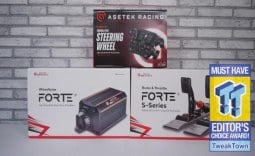 Asetek Forte S-Series Racing Simulator Bundle Review
 Razer Pro Type Ergo Wireless Split Ergonomic Keyboard Review - Built for Comfort and Support
 ASUS ROG Strix Morph 96 Wireless Gaming Keyboard Review - Great Performance, More Affordable
 SAPPHIRE Radeon RX 9070 GRE PULSE OC Review - A New 1440p Challenger Has Arrived
 NZXT H6 RGB+ Compact Dual-Chamber Chassis Review
 ASRock Radeon RX 9070 GRE Steel Legend Review - The RDNA 4 Mid-Range Reshuffle
 ASRock Z890 Taichi Aqua Motherboard Review - Flagship features without the flagship price
 GIGABYTE Z890I AORUS Ultra Motherboard Review - Mini-ITX with surprisingly good thermals
 Seagate FireCuda X1070 4TB SSD Review - A New Mainstream Contender
 The PowerToys utilities I keep enabled on every Windows 11 PC, and the ones I turned off within a week
 TweakTown's Best of Computex 2026 Awards - The Best Hardware, Gaming Gear, and AI
 Phison E37T SSD Controller Exclusive Preview - The Fastest DRAMless SSD Platform Yet
 USB Ports Not Working in Windows 11? Try These Fixes
 ASUS WiFi Routers and Networking Solutions Deliver Long-term Security and Reliability with No Additional Cost
 Second Monitor Not Detected in Windows 11? Try These Fixes
 Turn Your Old Smartphone Into a Dedicated Webcam for Your Windows PC
 The Send To menu is the right-click feature on Windows 11 that nobody bothers to customize
 Windows 11 will not let you pin a folder to the taskbar, but a 30-second workaround does
 ASUS ProArt Displays Unlock Creativity with Professional Monitors for Everyone