

Introduction
Back in October we took at look at three Intel P965 motherboards that we managed to get into our labs.
The Intel P965 chipset has really impressed us in the fact that it may be classed as the "mainstream chipset" compared to the older and more expensive 975X chipset but its features and performance surpass the enthusiast 975X chipset with DDR2-800 memory support, high FSB overclocking potential and now with Crossfire support, its hard to consider a 975X chipset.
We had already planned to do this second part roundup but waiting for all of the motherboards to come into our labs was a bit of a push back affair. After nearly two months of waiting we now have four more boards to put on our chopping blocks - two from Gigabyte, one from ABIT and one from Biostar.
Let's have a look as what we have here as we try and discover what is the ultimate Intel P965 motherboard.
Gigabyte P965-DS3

We have two boards from Gigabyte on our chopping blocks today, the high-end monster the DQ6 which we did look at earlier and the lower model the DS3 which we just had to get our hands on.
The DS3 uses a blue mid sized PCB for its mid ranged motherboard. The placement of the power connectors are extremely good considering the price range this board is meant to fit into. The 24-pin power connector is located behind the DDR-2 memory sockets with the FDD port. The DDR-2 memory slots are colour coded yellow for Channel 1 and red for Channel 2. The 4-pin power connector is located a the top left of the board behind the CPU socket.
The cooling for the motherboard components are taken care of by passive heatsinks on both the Northbridge and the Southbridge. While the ICH8R does supports 6 Serial ATA ports, only 4 of the Southbridge SATA ports are used and colour coded yellow. 2 purple and 1 green IDE port are provided by an add-on controller chip.

The layout around the CPU socket is extremely clean allowing for you to install large after markets CPU heat sinks and CPU power is supplied by a 3 phase power system. While this is enough for the Core 2 range of CPU, you won't want to be overclocking a Pentium 4 series CPU here as this will only just provide power to these older processors.

To the rear I/O ports now, and Gigabyte has a pretty good setup. On the lower end of their motherboard lists, Gigabyte puts the Parallel and Serial ports just in case you need them. A single RCA SPDIF output and a single Toslink SPDIF port make up the digital audio for this board along with your standard array of ports.

To the expansion slot there are more than enough for the modern day system. There is a single PCI Express x16 slot that runs at full speed for even the most demanding graphics cards. 3 PCI Express x1 slots are included for additional PCI-E based controllers such as add-on SATA controllers, Gigabit LAN and TV Tuners that are now starting to hit the market. For legacy support that are 3 PCI slots to support TV tuners and sound cards, if that's your thing.

Lastly we have a JMicron PCI Express based Serial ATA RAID controller with a single Parallel ATA channel. Since Intel prematurely cut IDE support with the ICH8 series Southbridge, the only way to get an IDE DVD drive onto your ICH8 based boards is to use a separate chip. Gigabyte had laser named the JMicron chip as the Gigabyte SATA 2 RAID chip and it controls the 2 purple SATA ports and the green IDE slot.
ABIT AB9 Pro

With ABIT back in the game, we managed to get a hold of their top P965 based board. The AB9 Pro uses a full size ATX board to pack its materials on to. ABIT has done a reasonable job on the layout, however, there are a couple of connectors in spots we would rather not see them in. The good side of things is the 24-pin power connector being placed behind the DDR-2 memory slots with the 4-pin power being located just to the left of the DDR-2 memory slots at the top of the board.
The bad however are the FDD port being located right at the bottom middle of the board below the PCI slots and the placement of the additional SATA and IDE ports between the last PCI-E x1 slot and the PCI slots, no doubt these will get in the way.

ABIT continues to use their Silent OTES system to cool the voltage regulators and Mosfets. A large heat block sits atop the main VRM's with a heatpipe attached that cools the Northbridge. A small row of RAM sinks sit on the upper VRM modules. The CPU is supplied with 4 phases of power for greater stability when overclocking compared to 3 phase. As for large heatsinks, there should be no problem as the CPU area is quite clean and free of high rise components.

Rear I/O ports are quite sparse as the Silent OTES takes up quite a bit of the real estate at the back to exhaust its hot air. You get PS/2 towers, a single e.SATA port, 2 Toslink ports, USB towers with Dual Gigabit LAN ports and your standard 7.1 audio ports. Its nice to see ABIT putting the e.SATA port onto its board for future external expansion capabilities.

While P965 chipset has been given the Crossfire seal of approval, ABIT hasn't availed itself of this, only 1 PCI Express x16 slot for graphics is used with 2 PCI Express x1 slots and 2 PCI slots.

While there is one slot missing, this is taken up by the JMicron SATA/PATA chip and the 2 extra SATA and 1 PATA port but it's not the most intelligent place to put these. To the right of the last PCI slot is a Texas Instruments PCI Firewire chip to add 2 Firewire ports to the board.
Biostar T Force P965 Deluxe

This is the first board we have ever had from Biostar in our labs, and we hope it isn't the last. From our initial inspection the for a mid ATX sided board there is certainly a bit put on there, and some of the layout has suffered to get all of the goods on in such a small space. The 24-pin and 4-pin power connectors are located between the Chipset Northbridge and the rear I/O ports, one of our pet hates for these bulky cables, as you need to run them past the CPU, obstructing the air flow. The FDD port is also located on one of the worst spots, right at the bottom of the board below the PCI slots. If your FDD is up higher in your case, you will need to stretch the FDD cable to reach, causing cable clutter as you have to route the cable rather untidily.

Biostar uses a 3 phase voltage regulations system for the CPU the same as Gigabyte's DS3 series board, while enough for Core 2, don't expect to see Pentium 4's overclocking succeed very well on these type of boards. The CPU area is clear of large components so large heat sinks are no problem here on this board either.

The rear I/O ports are pretty plain. There are no digital ports to speak of and only a legacy serial port for old school connectivity. The rest is as plain as you can get.

Biostar has also not availed itself of the Crossfire ability of the P965 chipset. Only a single PCI Express x16 slot is available for graphics cards. Unlike the rest of the boards however, Biostar includes a single PCI Express x4 slot for use with large scale RAID controllers like the ones we have seen from Highpoint, allowing mass storage without throughput bottleneck that PCI can cause. Rounding off the expansion slots are a single PCI Express x1 and 3 PCI slots. A very well thought out combination.

Since Parallel ATA support no longer exists on ICH8 Southbridges and is not set to return in ICH9, you need an external chip to get ATAPI IDE drives onto these boards. Most companies go with JMicron chips as they have 2 SATA and 1 IDE port. Biostar has gone plain and simple here using a VIA VT6410 Parallel ATA controller chip that is connected to the IDE bus. Also like Gigabyte, Biostar only uses 4 of the available 6 SATA ports the ICH8 supports - where have the extra two ports gone? We don't see any e.SATA ports?
Gigabyte P965-DQ6
Gigabyte P965-QD6

While we did look at this board before in our P965 chipset review, we didn't really get a chance to look at it as closely as we would have liked. The board is a full ATX layout with extremely good placement of connectors.
The 24-pin power along with the FDD connector sit behind the DDR-2 memory slots. The 4/8 pin power connector sits between the Mosfet heat sinks and the rear I/O well out of the CPU's way.

First off you may find getting large heatsinks into this board a bit of a fight since its rigged more for the water cooling users where you don't need as much space around the CPU. For power, Gigabyte has a 12 phase voltage system - that's right, 12 phases to keep that CPU fed with stable voltage. The Mosfets are cooled passively by heat sinks and heatpipes cooling the Southbridge and Northbridge.

The rear I/O of the board looks almost identical to that of the DS3. While Gigabyte doesn't put any e.SATA ports on the rear I/O section, it does include expansion cables that take up slots on the rear of the case that convert the internal SATA ports to e.SATA ports.

In all the boards we have here, the Gigabyte DQ6 was the only one to avail itself of supporting Crossfire. There are 2 PCI Express x16 slots on the board. The top blue one runs at full-speed while the orange only runs at x4 speed through the Southbridge. 3 PCI Express x1 slots and 2 PCI slots make up the expansion configuration.

The DQ6, like the DS3, uses the same JMicron chip renamed with 2 SATA ports and 1 PATA ports to give the IDE support the board needs for connecting DVD drives. The DQ6, unlike the DS3, has support for Firewire thanks to the Texas Instruments PCI Firewire chip.
BIOS and Overclocking - Gigabyte P965-DQ3

First off it's a look at the Gigabyte DS3 motherboard. The main menu looks just like any of the new motherboards that Gigabyte supplies today with the M.I.T menu holding all of the overclocking features.

Once inside the M.I.T menu its pretty simple to see how you overclock this board.
We are going to give a brief run down of the settings and their ranges to get though the boards as quickly as possible:
FSB Frequency: 200MHz to 600MHz in 1MHz increments
PCI Express Frequency: 90MHz to 150MHz
CPU Voltage: 0.8500c to 2.000c in 0.025v increments
DRAM Voltage: +0.1 to +0.6v in +0.1v
MCH Voltage: +0.1 to +0.3v in 0.1v increments
FSB Voltage: +0.1v to +0.3v in 0.1v increments
PCI Express Voltage: +0.1v
With these settings we managed to hit a FSB of 451MHz with CPU voltage at default, DRAM at +0.4v, MCH at +0.3v and FSB voltage at +0.3v. This result for Gigabyte's cheap P965 solution is amazing as it just beat out the high-end ASUS board, our top contender last time.
BIOS and Overclocking - ABIT AB9 Pro

ABIT's BIOS was quite colourful, while you can't see it in this light due to the monitor, the screen what bright pink background with white writing. The uGURU menu contains all the overclocking features.

To access the Overclocking functions you need to set CPU speed to User Defined.
FSB Frequency: 133MHz to 600MHz in 1MHz increments
PCI Express 100MHz to 200MHz in 1MHz Increments
CPU Voltage: 1.0v to 1.75v in 0,025v
DRAM Voltage: 1.8v to 2.5v in 0.05v increments
MCH: 1.25v to 1.45v in 0.05v increments
ICH: 1.5v to 1.7v in 0.05v increments
With these we managed just under the ASUS P5B Deluxe board with 438Mhz FSB but we had to max out the memory, ICH and MCH voltages to do so.
BIOS and Overclocking - Biostar T Force

Now its to the Biostar board. Using the same Award setup as the rest of the boards, the main menu looks almost identical, all overclocking features lie under the Overclock Navigator engine.

Biostar's Overclocking isn't much at all when compared to the other boards we have on the chopping block, but with a cheap price tag, you get what you pay for.
FSB: 200MHz to 600MHz in 1MHz increments
PCI Express: 100MHz to 200MHz
CPU Voltage: 1.10v to 1.8v in 0.025v increments
DRAM: 1.8v to 2.0v in 0.1v increments
MCH: 1.25 to 1.55 in 0.1v Increments
We managed a FSB of 421MHz with this board with all the voltages maxed out bar the CPU which was at 1.4v.
BIOS and Overclocking - Gigabyte 965P-DQ6
BIOS and Overclocking - Gigabyte 965P DQ6

While we have looked at this boards overclocking before we decided to do a quick recap. The BIOS main menu looks identical to the DS3 board with all the overclocking features under the M.I.T Motherboard Intelligent Tweaker Menu.

The layout and features again are almost a mirror of the DS3 with some extra voltages for the MCH, FSB and PCI Express.
FSB: 200MHz to 600MHz in 1MHz increments
PCI Express: 90MHz to 150MHz in 1MHz increments
CPU Voltage : 0.8500 to 2.000 in 0.025 increments
DRAM Voltage: +0.1 to +0.6v in +0.025v increments
MCH Voltage: +0.1 to +0.35v in 0.05v increments
FSB Voltage: +0.1v to +0.35v in 0.05v increments
PCI Voltage: +0.1v to +0.35 in 0.05v increments
Since we had the most time with this board as its now our test bed board for motherboard comparisons we managed a huge FSB of 483MHz with the DRAM at +0.225v, FSB, MHC and PCI Express voltages at all +0.3v. In all a very good overclock from this board.
Benchmarks - Test System Setup and Sandra
Test System Setup
Processor: Intel Core 2 Extreme X6800 (Supplied by Intel)
Memory: 2x 1GB DDR2-1066 Corsair (Supplied by Corsair)
Hard Disk: 500GB Seagate 7200.9 SATA (Supplied by Seagate Australia)
Graphics Card: nVidia GeForce 7800GT
Cooling: Gigabyte 3D Galaxy II (Supplied by Gigabyte)
Operating System: Microsoft Windows XP SP2
Drivers: Intel INF 8.1.1.1001, nVidia ForceWare 91.31 and DX9c
We included the results from our Part 1 review for your reference. We kept the CPU's as close to our stock speed to test out how well the memory and FSB overclocks affect system performance overall.
The Gigabyte DS3 ran a multiplier of 7x when overclocked as did the ABIT, Biostar boards. The DQ6 ran a multiplier of 6x when overclocked since the obtainable FSB was much higher than all of the other boards in Part 1 and Part 2.
Important Editor Note: Our maximum overclocking result is the best result we managed in our limited time testing the motherboard. Due to time constraints we don't have enough time to tweak the motherboard to the maximum and find the highest possible FSB as this could take days to properly find. We do however spend at least a few hours overclocking every motherboard to try and find the highest possible overclock in that time frame. You may or may not be able to overclock higher if you spend more time tweaking or as new BIOS updates are released or "burn in" time might come into play if you believe in that.
SiSoft Sandra
Version and / or Patch Used: 2007
Developer Homepage: http://www.sisoftware.co.uk
Product Homepage: http://sisoftware.jaggedonline.com/index.php?location=home&a=TTA&lang=en
Buy It Here
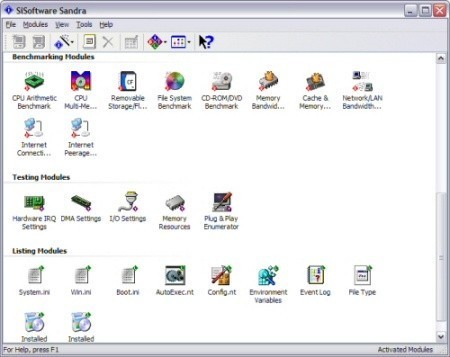
SiSoft Sandra (System ANalyser, Diagnostic and Reporting Assistant) is a synthetic Windows benchmark that features different tests used to evaluate different PC subsystems.

At stock speeds all of the boards are pretty close, with Gigabyte DQ6 just a tiny bit in front. When overclocking starts, the Gigabyte DQ6 manages to take a convincing lead with an extremely high FSB.
Benchmarks - PCMark
PCMark
Version and / or Patch Used: 1.1.0
Developer Homepage: http://www.futuremark.com
Product Homepage: http://www.futuremark.com/products/pcmark04/
Buy It Here
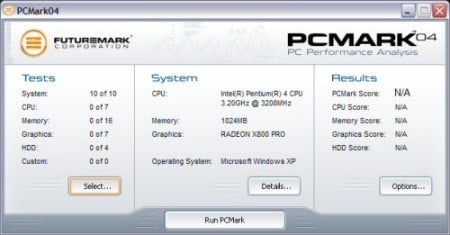
PCMark is a multipurpose benchmark, suited for benchmarking all kinds of PCs, from laptops to workstations, as well as across multiple Windows operating systems. This easy-to-use benchmark makes professional strength benchmarking software available even to novice users. PCMark consists of a series of tests that represent common tasks in home and office programs. PCMark also covers many additional areas outside the scope of other MadOnion.com benchmarks.


Again the Gigabyte DQ6 manages to win out here especially when the clock speeds are thrown up.
Benchmarks - 3DMark05
3DMark05
Version and / or Patch Used: Build 120
Developer Homepage: http://www.futuremark.com
Product Homepage: http://www.futuremark.com/products/3dmark05/
Buy It Here

3DMark05 is now the second latest version in the popular 3DMark "Gamers Benchmark" series. It includes a complete set of DX9 benchmarks which tests Shader Model 2.0 and above.
For more information on the 3DMark05 benchmark, we recommend you read our preview here.

3DMark05 doesn't seem to care as much for the increased bandwidth but the Gigabyte board does just win out here.
Benchmarks - 3DMark06
3DMark06
Version and / or Patch Used: Build 102
Developer Homepage: http://www.futuremark.com
Product Homepage: http://www.futuremark.com/products/3dmark06/
Buy It Here

3DMark06 is the very latest version of the "Gamers Benchmark" from FutureMark. The newest version of 3DMark expands on the tests in 3DMark05 by adding graphical effects using Shader Model 3.0 and HDR (High Dynamic Range lighting) which will push even the best DX9 graphics cards to the extremes.
3DMark06 also focuses on not just the GPU but the CPU using the AGEIA PhysX software physics library to effectively test single and Dual Core processors.
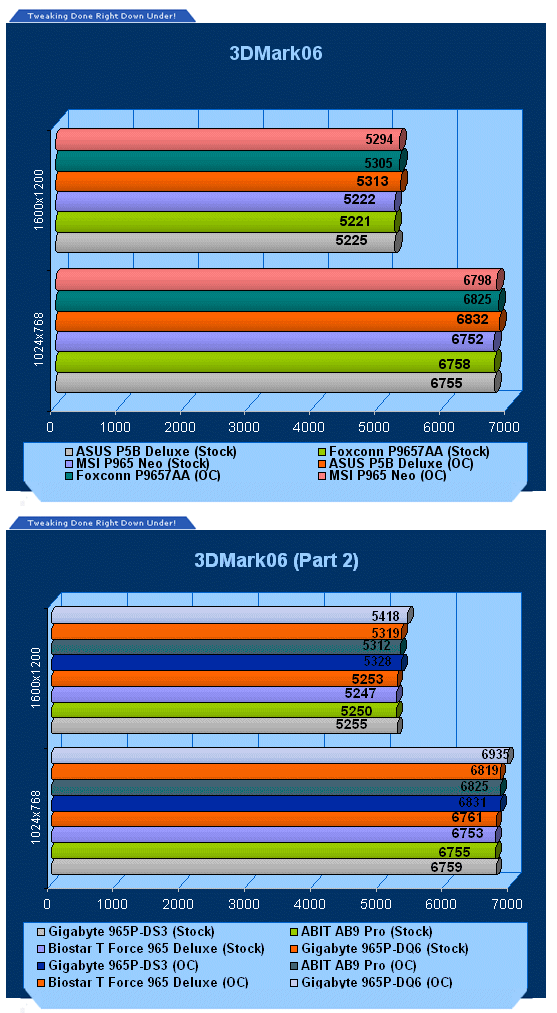
This time with more stress being placed on the system, the Gigabyte DQ6 does manage to show its true colours.
Benchmarks - Doom 3
Doom 3
Version and / or Patch Used: 1.1
Timedemo or Level Used: Custom Timedemo
Developer Homepage: http://www.idsoftware.com
Product Homepage: http://www.doom3.com
Buy It Here
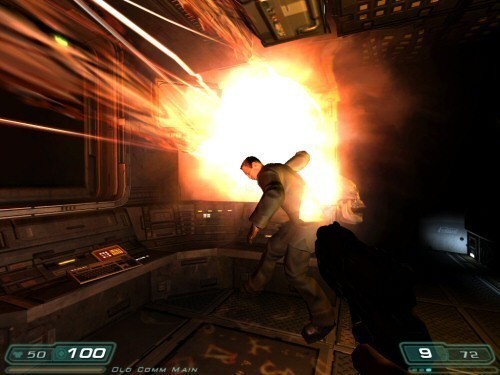
Doom 3 is still one of the most popular games at the moment and is quite intensive in the 3D department, even though it is starting to age. With our own custom time demo we are able to give a realistic rating on what kind of FPS you will be achieving.
For more information on benchmarking Doom 3 we recommend you check out our extensive article regarding it here.

Doom 3 really does like the extra bandwidth putting the DQ6 in the best possible light.
Benchmarks - Quake 4
Quake 4
Version and / or Patch Used: Unpatched
Timedemo or Level Used: Custom Timedemo
Developer Homepage: http://www.idsoftware.com
Product Homepage: http://www.quake4game.com
Buy It Here

Quake 4 is one of the latest new games to be added to our benchmark suite. It is based off the popular Doom 3 engine and as a result uses many of the features seen in Doom. However, Quake 4 graphics are more intensive than Doom 3 and should put more strain on different parts of the system.

Quake 4 also likes the DQ6's extra CPU and memory bandwidth supplied when overclocking.
Benchmarks - F.E.A.R.
F.E.A.R.
Version and / or Patch Used: Unpatched
Timedemo or Level Used: Built-in Test
Developer Homepage: http://www.vugames.com
Product Homepage: http://www.whatisfear.com/us/
Buy It Here
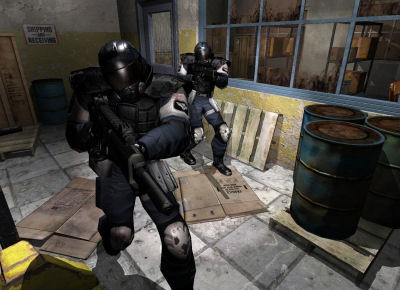
F.E.A.R. (First Encounter Assault Recon) is an intense combat experience with rich atmosphere and a deeply intense paranormal storyline presented entirely in first person. Be the hero in your own spine-tingling epic of action, tension, and terror...and discover the true meaning of F.E.A.R.

F.E.A.R. uses more graphics power than CPU, but we do see a slight lead to the DQ6. Here is where you will want dual graphics cards to really put your board over the top and the ones which support this are the Gigabyte DQ6 and the ASUS P5B Deluxe.
Benchmarks - Far Cry
Far Cry
Version and / or Patch Used: 1.3
Timedemo or Level Used: Benchemall Default
Developer Homepage: http://www.crytek.com
Product Homepage: http://www.farcrygame.com
Buy It Here

While Far Cry is now one of our older benchmarking games, it is still able to put pressure on most computers systems. Utilizing PS2.0 technology with the latest versions supporting Shader Model 3.0 with DX9c and offering an exceptional visual experience, there is no denying that even some of the faster graphics cards get a bit of a workout.

Our last benchmark shows the scaling of going to higher memory speeds, this is where the DQ6 really shines.
Final Thoughts
This now concludes our roundup of the Intel P965 motherboards currently on the market. We plan to bring you more boards as they come available, however, this is our last big roundup and the rest will be usual individual reviews.
Today we saw that the Gigabyte really knows how to kick come serious butt when it comes to making high-end boards - no longer a name to be avoided, Gigabyte really has put itself on the market, even against ASUS, one of the biggest names in the business. The DQ6 has more features, a higher overclocking rate and costs around the same as the P5B Deluxe, for your dollar the DQ6 is worth its weight in gold.
The DS3 on the other hand is extremely powerful mid-range board with a more attractive price tag. Its overclocking is extremely good for a board in its price bracket. Its features are above average, however, the removal of two of the ICH8 supporting SATA ports is a mystery - why not use what's included in the chipset?
ABIT's board while good does have a few drawbacks. Its placement of connectors is pretty weak for the IDE and two additional SATA ports. Its overclocking for a board of its price range isn't fantastic considering ABIT prides itself on overclocking.
Since the Biostar motherboard is our first board from them, we can't really criticize too hard as we haven't been able to test many of their boards, but hope to in the future. While the overclocking wasn't as good as we had hoped, it wasn't the worst board on the market. Its expansion ports are good and for its price you could do a lot worse.
We hope you enjoyed our Part 2 roundup of the P965 chipset and trust that it will assist you in choosing the right motherboard.
 United
States: Find other tech and computer products like this
over at
United
States: Find other tech and computer products like this
over at  United
Kingdom: Find other tech and computer products like this
over at
United
Kingdom: Find other tech and computer products like this
over at  Australia:
Find other tech and computer products like this over at
Australia:
Find other tech and computer products like this over at  Canada:
Find other tech and computer products like this over at
Canada:
Find other tech and computer products like this over at  Deutschland:
Finde andere Technik- und Computerprodukte wie dieses auf
Deutschland:
Finde andere Technik- und Computerprodukte wie dieses auf  Blizzard praises Microsoft's 'let it be' hands-off approach to management
 Target confirms plans to reduce physical media, but games are unaffected
 Fallout 4 conquers PlayStation Plus charts amid TV show success
 Meet Microsoft's VASA-1: AI can now take a photo and turn it into a 'talking head' video clip
 Microsoft has brought its OneNote app to the Apple Vision Pro, get it now
 FlexiSpot C7B-Mesh Ergonomic Office Chair Review
 Samsung G8 34-inch QD-OLED Gaming Monitor Review - 175Hz for $900
 ASRock NUCBOX-155H Mini PC Review
 NuPhy Air96 V2 Wireless Mechanical Keyboard Review
 TEAM T-FORCE Siren DUO360 RGB Liquid CPU Cooler Review
 AVerMedia Live Streamer ULTRA HD Review
 AVerMedia Live Gamer 4K 2.1 Review
 XPG Invader X Mid-Tower Chassis Review
 Intel Core i9-14900KS CPU Review
 Arbiter Polar 65 Magnetic Gaming Keyboard Review
 Everything you need to know about the latest ASUS NUC Mini PCs - NUC 14 Pro and ROG NUC
 How to Overclock Your GPU and Boost Your PC Gaming with ASUS GPU Tweak III
 ASUS's AMD Radeon RX 7000 Series GPU lineup has something for every gamer
 ASUS OLED Premium Care defends the ROG Swift OLED PG32UCDM gaming monitor from burn-in
 Patriot Viper Xtreme 5 Engineering Prototype 48GB Dual-Channel Memory Kit Preview