









Introduction
Over the last ten years battery power has come a long way. I remember seeing the commercials as a kid for copper tops, alkaline and eventually what every kid with an RC car had to have, rechargeable. Recently I was amazed at just how far battery technology had advanced after visiting TweakTown's own news reporter, Zac O'Vodka's war room, only to find an AA battery that recharged via USB power. Yes, batteries have come a long way, but what is in store for us beyond battery power?
Last week I sat down with Scott Cleland from Adaptec and was amazed with what Adaptec's latest product offering that will allow RAID controllers to move beyond batteries for backing up the cache data. Before we get too far ahead of ourselves, I am sure there are several people asking just what the problem is with batteries.
If you remember, back in your Tyco radio control car days going through 30 or 40 AA batteries a day was a pretty easy task. Back then no one really worried about what was going on with the batteries, so it was common to just toss them in the trash and open a new pack. Even then batteries were expensive; that 75 Dollar RC car was eating 30 Dollars worth of batteries a day. Who knows how much damage my buddies and I caused the Earth in just one summer. Fast forward to today and we now realize that batteries are not meant to be buried in the ground with our plastic water bottles and used motor oil. Battery disposal is a big concern and it costs big money when you are talking about server rooms filled with storage controllers every 1.75 inches of server rack height.
Of course the lithium ion batteries themselves cost considerably more than the AA wonders we all enjoyed as children, but just like the copper tops of yesteryear controller batteries lose their ability to perform as they should. Many controller companies recommend replacing a controller's battery every year. Under ideal conditions the batteries only power the cache responsible for holding your data for 72 hours. That is not a very long time to get a technician out to the server's location to pull the server from the rack, open the box and fix the issue.
Adaptec now has a better way.
The Adaptec 5Z Series
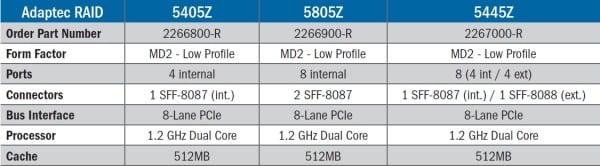
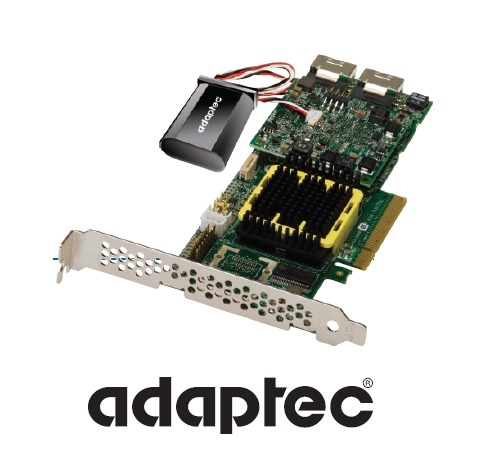
Yesterday Adaptec launched three new controller products. The controllers are similar to products already found in the class leading 5-Series SATA/SAS RAID controller family, but they have now been teamed with Adaptec's new Zero-Maintenance Cache Protection.
NAND flash has played an important role in storage technology, but has really evolved over the last few years. From the mini thumb drive that is sitting on your desk or key chain to the solid state drives that I talk about weekly, flash memory is what makes these products possible. Up until now I never considered flash memory to be a true archive product, but the fact is that flash can safely hold data for ten years without ever being powered.
Modern flash memory is very fast, something those of us with solid state hard drives praise on a daily basis. We have also learned that flash memory doesn't require large amounts of power to operate. Traditional DRAM memory used in cache systems on RAID controllers are still faster than flash memory, but when data is being sent from DRAM to flash the transfer is very fast. The entire 512MB DRAM cache module's data can be quickly transferred to flash memory in seconds, even with ECC and CRC protection.
If a 512MB data transfer can be made in under a minute then why would you want to have only 72 hours worth of data protection when the data can be held safely in flash storage for up to ten years? - Better yet, why would you want to spend 200+ Dollars on a battery that needs to be replaced every year compounding the cost of the controller card, often times doubling the initial investment in just four years or less? - That is what Adaptec asked themselves before planning the new 5Z Series of controller products.
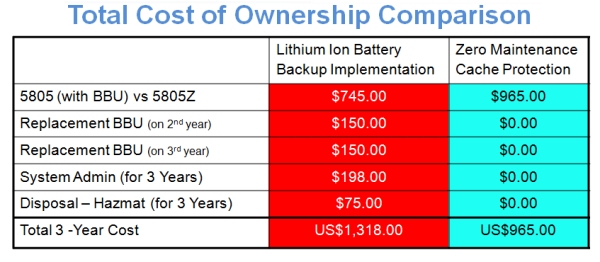
In the above chart provided by Adaptec we see the Dollar figures that Adaptec came up with. Their numbers are a little different than mine, but it all works out the same; batteries cost your company time and money.
The Technology
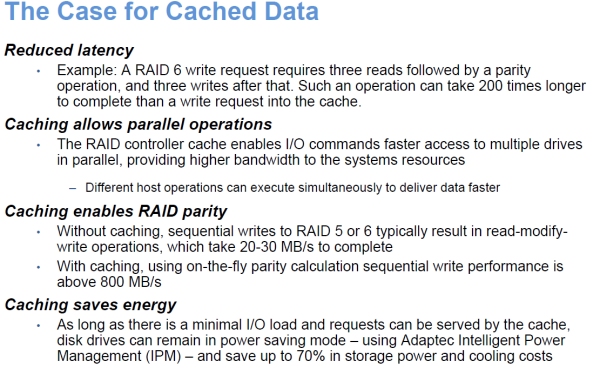
Cache data obviously plays an important part in a controller's ability to effectively handle data quickly and safely.
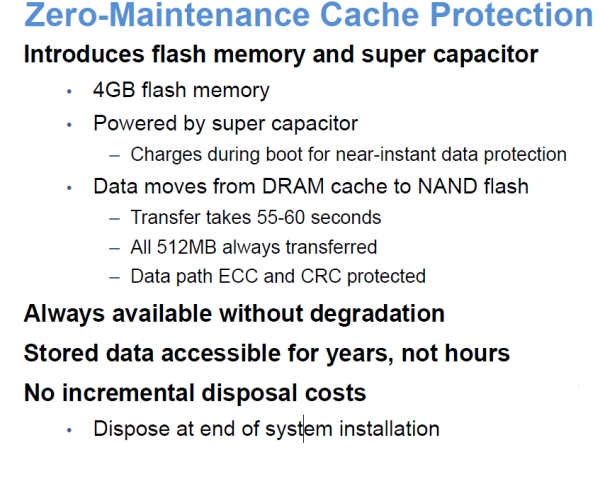
By adding flash memory and a capacitor pack Adaptec was able to eliminate the lithium ion battery completely.
As noted previously, lithium ion batteries add considerable cost to a product before it is deemed end of life.
Conclusion
In these trying times many companies are looking for ways to reduce spending and letting a battery that sits in a closet may seem like a well calculated risk, until disaster strikes.
At this time we are not prepared to comment on the overall performance of the new 5Z Family of products, since we have not completed testing. The 5-Series products from Adaptec that the 5Z controllers are based on are class leading products and I don't see Adaptec compromising their products speed.
Based on the information received from Adaptec, pre-sales of controllers are already underway and retail products should be available in July. Look for a full review to hit the pages of TweakTown in early August; at that point we will be able to examine the new product and run our tests and report the findings back to you.
Our Latest Editorials Article Coverage
- Building the Ultimate Home Entertainment Server with an ASUSTOR NAS and Viper Gaming NVMe SSDs
- PS5, Xbox Scarlett SSD may use Optane-like ReRAM to supercharge speeds
- Investigation: m.2 Heatsinks, are they worth it?
- Thunderbolt 3 Cable Roundup: Do they differ?
- Alienware 15 R3 Laptop Storage Performance Investigation

 Phison E37T SSD Controller Exclusive Preview - The Fastest DRAMless SSD Platform Yet
 Seagate FireCuda X1070 4TB SSD Review - A New Mainstream Contender
 ASUSTOR Lockerstor 2 Gen2+ AS6702T v2 NAS Review - Fast Performance
 TERRAMASTER D1 SSD Pro Thunderbolt/USB Portable Enclosure Review - Incredible Potential
 Orico K20 Mini 2TB Magnetic Portable SSD Review - Ultra-Thin MagSafe Drive
 Apple is adding a Liquid Glass slider in iOS 27 after a year of user complaints about readability
 Leaked Intel Nova Lake-S image confirms new LGA-1954 socket and a notch placement that kills backward compatibility
 The Wolf Among Us 2 is coming in 2027 and Telltale is also bringing a remaster of the original this holiday season
 Game Pass bled millions of subscribers after price hike, Microsoft says Xbox not in 'healthy place'
 Xbox promises 'reliable pipeline' of console exclusives in radical shift
 Xeron debuts at Computex 2026, showcasing an extensive stylish line-up of PC hardware
 Nintendo Direct announced for June 9, new Zelda, Mario and more expected
 INNO3D showcases new GeForce RTX GPU designs, with one including Founders Edition-style cooling
 Hands-on with MSI's new Claw 8 EX AI+ handheld, Intel Arc G3 Extreme continues to impress
 DLSS 4.5 Ray Reconstruction looks fantastic, and it's the missing piece of DLSS 4.5
 IQUNIX Magi96 Pro Aluminum Low Profile Mechanical Keyboard Review - Premium Build, Satisfying Sound
 Asetek Forte S-Series Racing Simulator Bundle Review
 Razer Pro Type Ergo Wireless Split Ergonomic Keyboard Review - Built for Comfort and Support
 ASUS ROG Strix Morph 96 Wireless Gaming Keyboard Review - Great Performance, More Affordable
 SAPPHIRE Radeon RX 9070 GRE PULSE OC Review - A New 1440p Challenger Has Arrived
 NZXT H6 RGB+ Compact Dual-Chamber Chassis Review
 ASRock Radeon RX 9070 GRE Steel Legend Review - The RDNA 4 Mid-Range Reshuffle
 ASRock Z890 Taichi Aqua Motherboard Review - Flagship features without the flagship price
 GIGABYTE Z890I AORUS Ultra Motherboard Review - Mini-ITX with surprisingly good thermals
 The PowerToys utilities I keep enabled on every Windows 11 PC, and the ones I turned off within a week
 TweakTown's Best of Computex 2026 Awards - The Best Hardware, Gaming Gear, and AI
 USB Ports Not Working in Windows 11? Try These Fixes
 ASUS WiFi Routers and Networking Solutions Deliver Long-term Security and Reliability with No Additional Cost
 Second Monitor Not Detected in Windows 11? Try These Fixes
 Turn Your Old Smartphone Into a Dedicated Webcam for Your Windows PC
 The Send To menu is the right-click feature on Windows 11 that nobody bothers to customize
 Windows 11 will not let you pin a folder to the taskbar, but a 30-second workaround does
 ASUS ProArt Displays Unlock Creativity with Professional Monitors for Everyone